

Custom Air Suspension Parts Manufacturer for Luxury Vehicle Applications
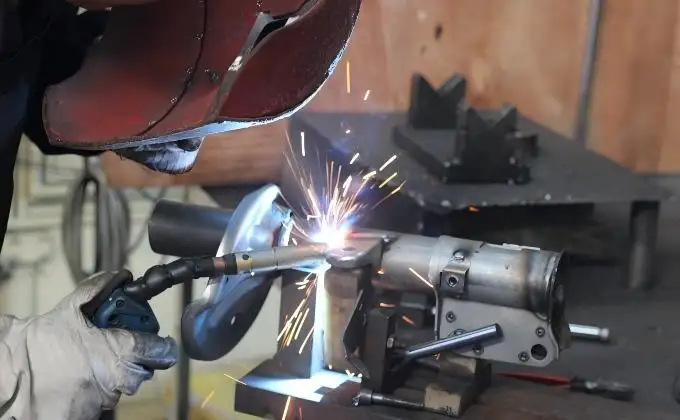
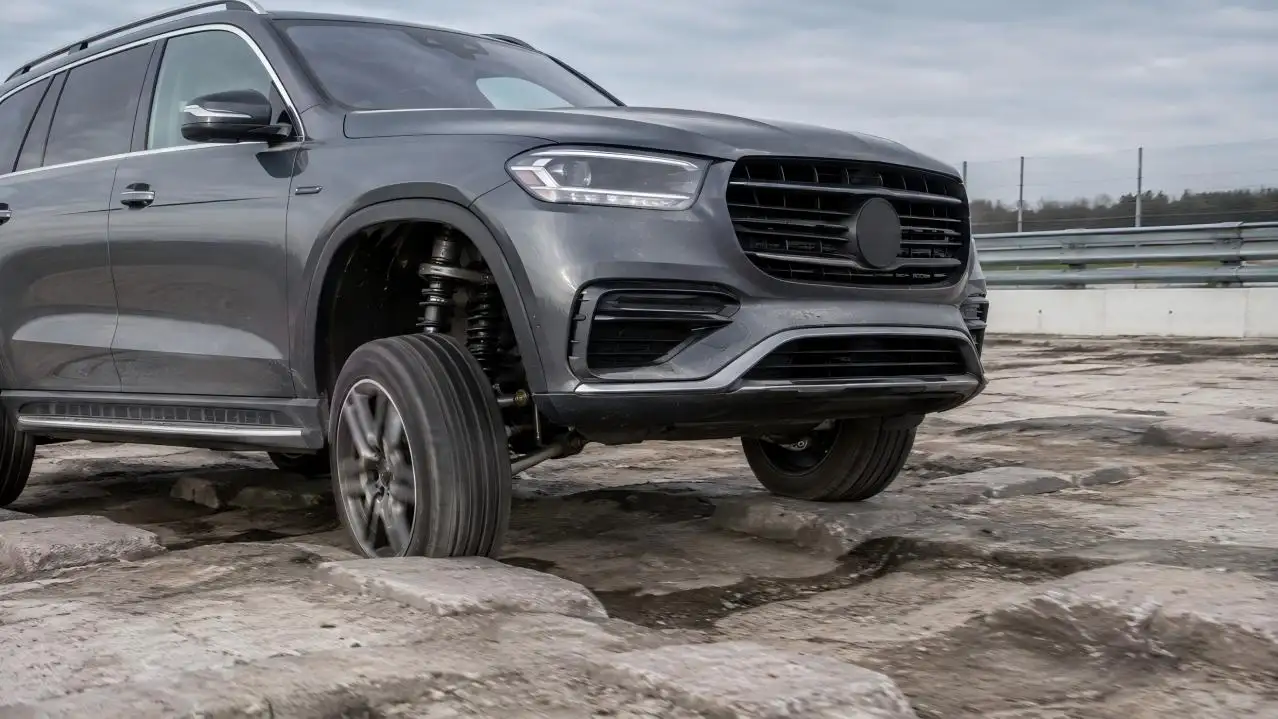
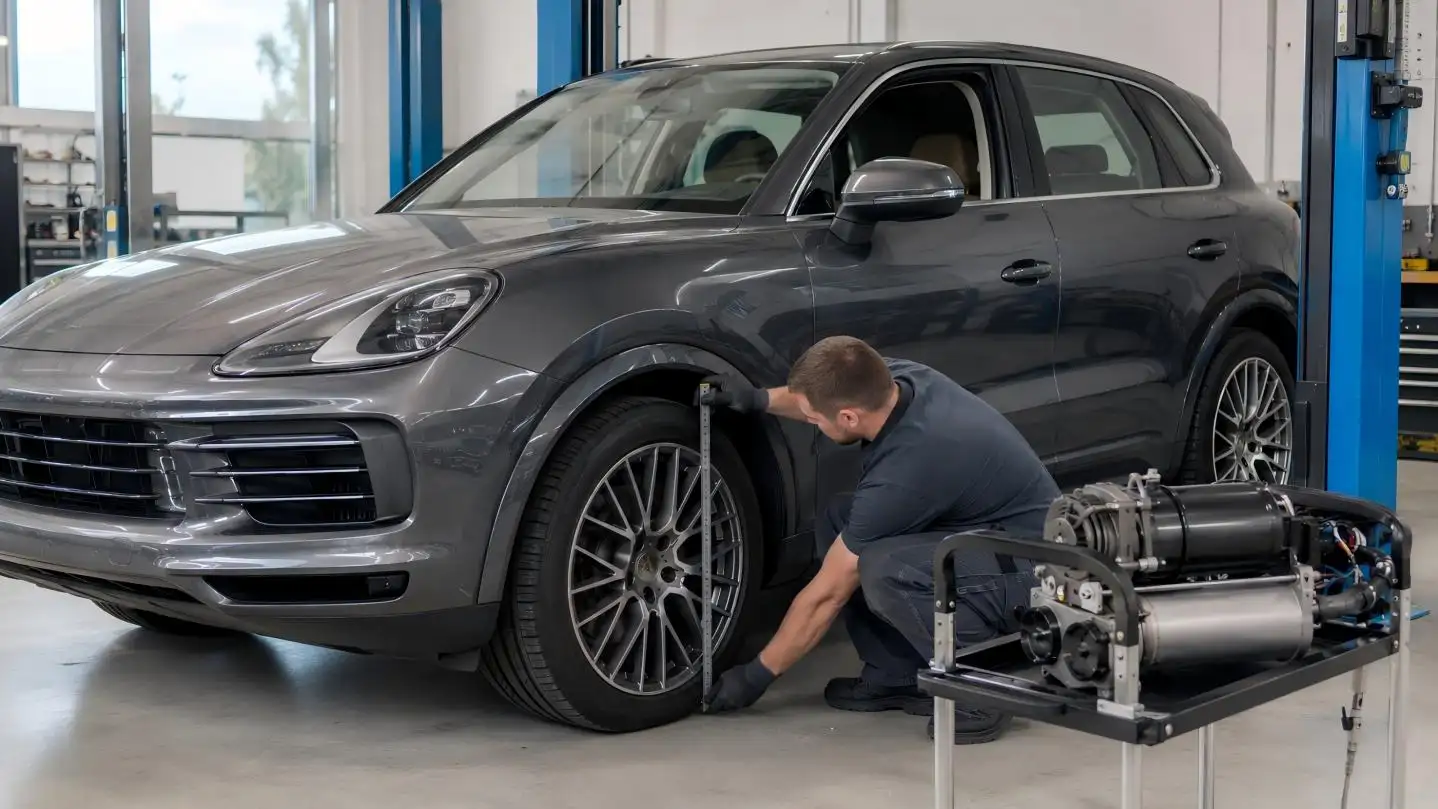
Luxury vehicles rely on air suspension to combine low-frequency ride isolation, controlled body motion, automatic leveling, and selectable chassis height. Reproducing that behavior requires more than matching the original mounting points. A qualified Custom Air Suspension Parts Manufacturer must control four interfaces simultaneously: load support, damping, pneumatic flow, and electronic compatibility.
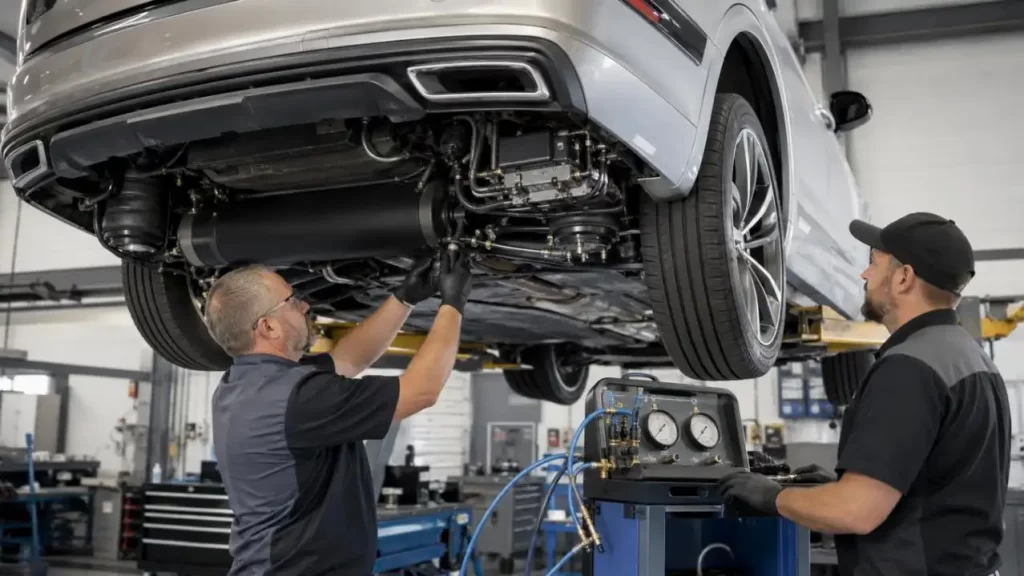
Diagnose the System Before Selecting the Part
Air suspension faults often overlap:
•Overnight corner sag can originate from the air sleeve, pipe fitting, valve block, or seal.
•Slow lifting may indicate low compressor output, restricted airflow, moisture-saturated desiccant, or system leakage.
•Repeated compressor operation increases motor temperature and may damage a technically sound replacement pump.
•Correct ride height with poor ride quality often points to an incorrect air-spring curve or damping mismatch.
•A mechanically compatible strut may still trigger a warning if its connector, sensor, or electronic damping valve differs.
For a Custom Air Suspension Parts Manufacturer, the first engineering task is therefore to identify the failure path—not simply reproduce the visible component.
Pressure Alone Does Not Define Air-Spring Performance
Air-spring supporting force can be approximated by:
Supporting force ≈ gauge pressure × effective area
However, effective area changes as the suspension moves. Spring rate is also affected by air volume, installed height, rubber geometry, temperature, and the rate at which the air is compressed. Two air springs operating at the same pressure can therefore produce different ride behavior.
Luxury-vehicle tuning also depends on the relationship between the air spring and shock absorber:
•Compression damping controls how the suspension absorbs a road input.
•Rebound damping controls body recovery after the input.
•The valve block determines how quickly air reaches or leaves each circuit.
•Compressor flow under backpressure—not free-flow output—determines practical lifting time.
•Height sensors provide the reference needed for automatic leveling.
A technically capable Custom Air Suspension Parts Manufacturer must evaluate these parameters as one operating system. Higher pressure, a larger compressor, or firmer damping is not automatically better.
Comparing Replacement Strategies
The correct solution depends on the condition of the complete suspension, not the lowest component price.
| Decision | Lower-scope option | Higher-scope option | Selection logic |
| Air spring vs. complete strut | Reuse the original damper | Replace air spring and damper together | Choose the assembly when damping is weak, noisy, leaking, or electronically faulty |
| OE-spec vs. performance-tuned | Restore original height and response | Change load, height, or damping behavior | Custom tuning requires vehicle-level validation |
| Electronic vs. passive damper | Retain adaptive control | Remove electronic adjustment | A passive conversion requires fault-management compatibility |
| New vs. remanufactured | New materials and components | Reused structural core | Compare traceability, test coverage, and warranty—not appearance |
| One side vs. axle pair | Replace the failed corner | Balance both sides of the axle | Consider mileage, damping variation, and rubber aging |
| Compressor only vs. system repair | Replace the pump | Repair leaks, valve restrictions, and dryer faults | Unresolved leakage can rapidly damage a new compressor |
This comparison prevents a Custom Air Suspension Parts Manufacturer from turning technically different solutions into generic product claims.
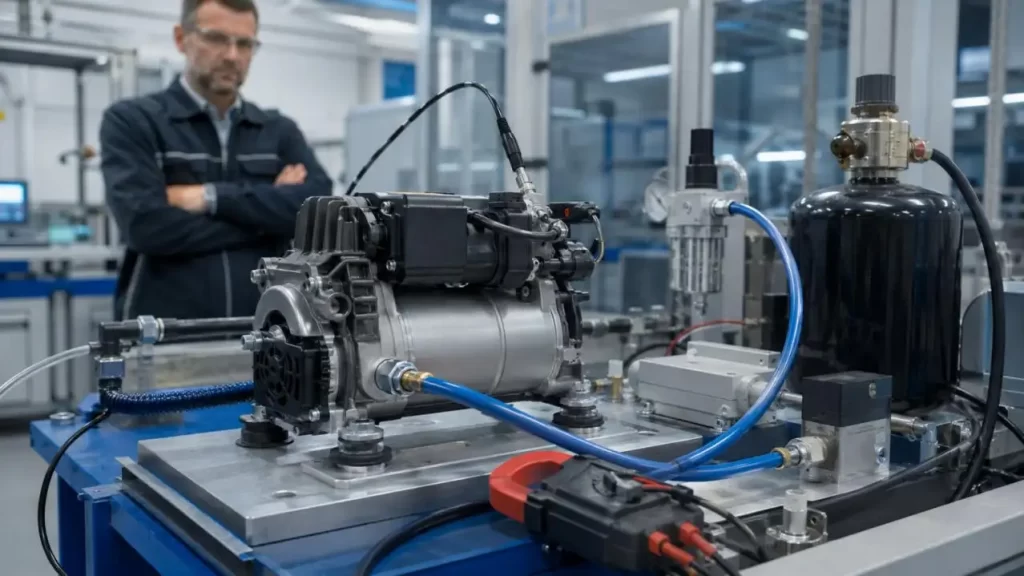
Vehicle-Specific Matching Requires More Than an OE Number
A useful RFQ should include the OE reference, chassis code, production year, axle position, left or right side, drivetrain, wheelbase, electronic damping type, connector photographs, and air-line interface.
Huijie's air suspension product range shows why these details matter. Its catalog covers complete struts, air springs, compressors, valve blocks, and control arms for Audi, BMW, Mercedes-Benz, Porsche, Maserati, Bentley, Jaguar, Land Rover, Volvo, and Tesla applications.
Huijie specifications illustrate the differences between platforms:
| Huijie component | Application data | Engineering significance |
| Audi A8 D5 front air strut | OE 4N4616039K/4N4616039G; 2016–2021; front position | Complete air-spring and damper integration must match the 4N chassis |
| BMW compressor | OE 37206789450/37206864215/37206794465; F07/F10/F11 and F01/F02/F04; 2008–2015 | Huijie states that working current and voltage are tested before shipment |
| Audi Q7 valve block | OE 4M0616013A; 2018–2022; 5 × Φ4 and 3 × Φ6 interfaces | Port count and tube diameter affect routing and installation compatibility |
| Tesla valve block | OE 1027919-00-A through -E; 5 × Φ4 and 2 × Φ6 interfaces | Similar external appearance does not imply identical pneumatic connections |
| BMW valve block | OE 4722525610; E53/E39/E65/E66; 3 × Φ4 interfaces | Chassis generation and circuit architecture must be confirmed together |
These are fitment specifications, not evidence that every derivative within a model family is interchangeable.
Huijie Production Data in Practical Context
For its Audi A8 D5 air suspension, Huijie specifies a high-strength aluminum-alloy structure, rubber air bladder, corrosion-resistant coating, and heat-resistant materials. The published product target is a 50,000+ km service life, supported by a one-year warranty, stability checks, and real-vehicle performance testing.
Across its category pages, Huijie states that:
•Regular catalog items can be dispatched in 1–3 days.
•100% of products are tested before shipment.
•Compressor working current and voltage are checked.
•Complete component coverage supports cross-checking between the strut, compressor, spring, and valve block.
For professional procurement, "100% tested" should still be converted into a product-specific control plan. The buyer should confirm the test pressure, allowable pressure decay, electrical limits, test duration, sample traceability, and rejection criteria.
Installation Must Remove the Original Failure Cause
Before installing a new part, technicians should inspect air lines, fittings, valve-block leakage, compressor relay condition, dryer restriction, reservoir pressure, connectors, and height sensors. The air sleeve must not be twisted or fully loaded while unpressurized.
After replacement, the vehicle may require:
•Controlled initial inflation
•Leak and pressure-decay inspection
•Diagnostic fault clearing
•Ride-height calibration
•Wheel-alignment verification
•Compressor run-time monitoring
Replacing a compressor without correcting the leak that increased its duty cycle is a repair delay, not a complete repair.
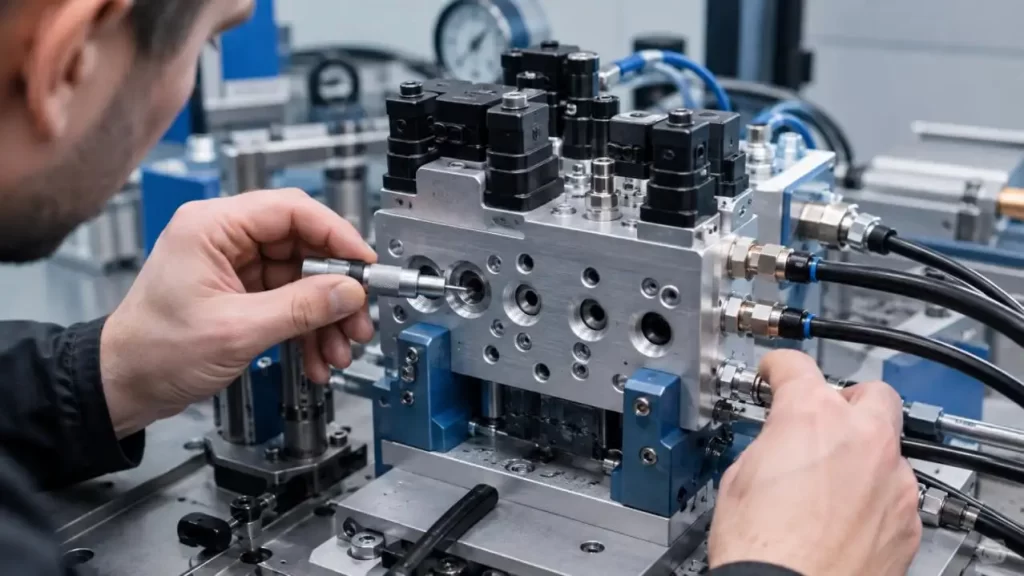
Validate the Manufacturer, Not Only the Sample
A Custom Air Suspension Parts Manufacturer should support component-specific verification through leakage, proof-pressure, burst, fatigue, damping-dynamometer, compressor flow-pressure, temperature, vibration, and corrosion testing.
ISO 16750 may guide environmental testing for electrical components, while ISO 20653 addresses enclosure protection and ISO 9227 defines salt-spray procedures. These standards do not automatically set the product's acceptance limits; the drawing or customer specification must define them.
Huijie offers automotive quality certifications and manufacturing experience on its website. Buyers should verify certificate scope and validity alongside PPAP capability, batch traceability, engineering-change control, warranty procedures, and actual test reports.
For a new program, send Huijie the OE number, chassis information, electronic configuration, annual volume, target market, and required validation documents. This allows Huijie to develop a technically matched proposal—and gives the buyer a clearer basis for evaluating a Custom Air Suspension Parts Manufacturer beyond unit price.
FAQs
Q1. What custom air suspension parts does Huijie offer?
Huijie sells complete sets of air suspension struts, air springs, and all necessary accessories, along with pumps, valve blocks and control arms. Because of this, users can purchase individual components as needed or as complete assembly.
Q2. Which luxury vehicle platforms does Huijie cover?
Huijie offers applications for Audi, BMW, Mercedes-Benz, Porsche, Maserati, Bentley, Jaguar, Land Rover, Volvo, Tesla, and Volkswagen. The specific fitment for each platform should be compared to the chassis, year, OE number, axle position, and electronic configuration.
Q3. How does Huijie confirm the correct air suspension fitment?
The OE reference, model year, chassis code, left or right side, front or rear position, and drivetrain should be provided. Photos of the connectors and electronic sensors should be provided to prevent electrical and air suspension mismatches.
Q4. What information does Huijie need for a custom air suspension project?
The most informative RFQ should include a sample or a drawing, a description of the vehicle and its axles, a target ride height, an estimate for the weight to be carried, an electronic interface, an estimated quantity to be purchased, and a description of any additional testing to be performed. Based on this information, Huijie will determine if a given platform can be modified or if a new design is necessary.
Q5. Does Huijie test every air suspension part before shipment?
Every air suspension part is tested prior to shipping. The test plan should be requested for each air suspension part that was built to include test pressure, pressure decay limits, electrical range, test duration, sampling method, and rejection criteria.


Contact Us
In This Article
- 1 Diagnose the System Before Selecting the Part
- 2 Pressure Alone Does Not Define Air-Spring Performance
- 3 Comparing Replacement Strategies
- 4 Vehicle-Specific Matching Requires More Than an OE Number
- 5 Huijie Production Data in Practical Context
- 6 Installation Must Remove the Original Failure Cause
- 7 Validate the Manufacturer, Not Only the Sample
