


Oil-Free Air Ride Compressor for Cars: Efficiency and Service Life
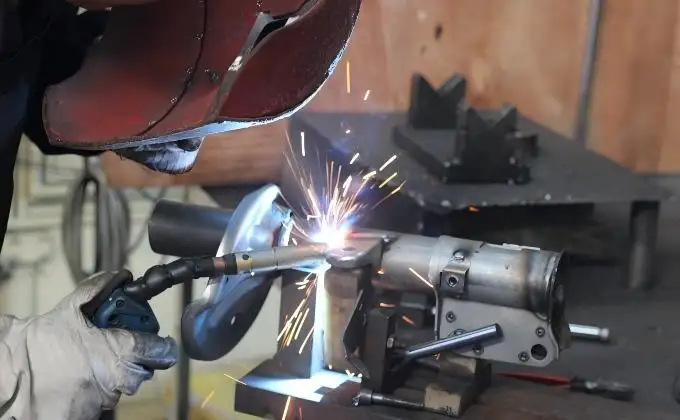

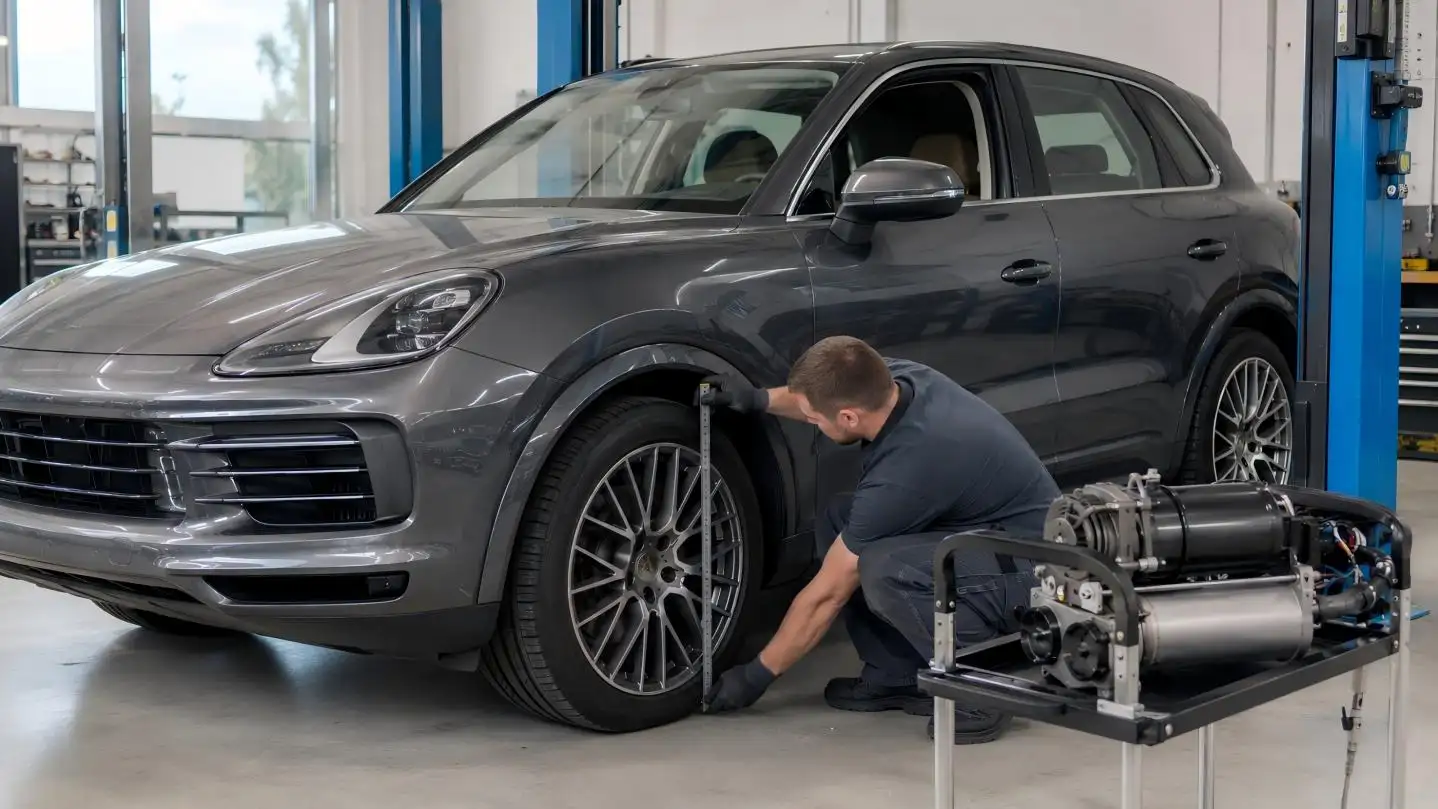
An Air Ride Compressor for Cars is oil-free and therefore, avoids addition of lubricating oil to the compression chamber resulting in less contamination of oil in the dryer, valve block and air lines. The absence of ‘oil-free' does not necessarily imply increased efficiency or less maintenance or longer life.
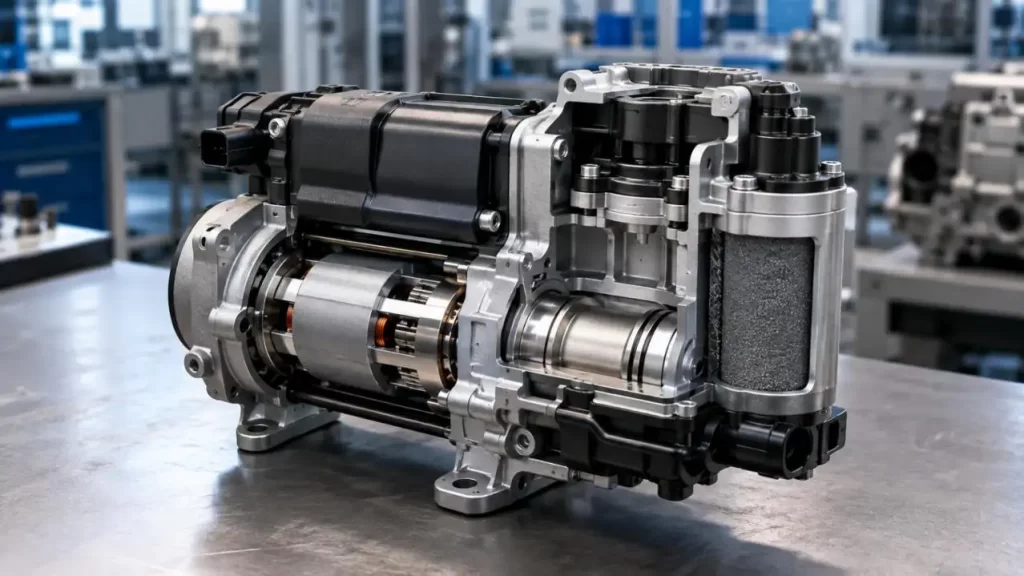
Actual performance depends on the compressor's dry friction surfaces, airflow under pressure, electrical load, thermal management and compatibility with the complete suspension system.
Slow Leveling Is Not Always a Compressor Failure
Common symptoms include slow vehicle lifting, repeated compressor cycling, excessive noise, thermal shutdown and suspension warning lights. These symptoms may indicate compressor wear, but they may also result from:
•Leaking air springs or fittings
•Restricted intake filters or saturated dryers
•Sticking valve blocks
•Faulty pressure or ride-height sensors
•Damaged relays, fuses or wiring
A replacement Air Ride Compressor for Cars can fail quickly if an existing leak forces it to run beyond its intended duty cycle. Diagnosis should therefore begin with a pressure-retention test and electrical inspection rather than immediate pump replacement.
What "Oil-Free" Really Means Inside the Compressor
In an oil-free piston compressor, a low-friction piston ring moves against a precisely finished cylinder surface without an oil film in the compression chamber. Bearings or other isolated components may still contain sealed grease, so oil-free does not mean lubricant-free throughout the assembly.
Efficiency losses occur through internal air leakage, piston friction, motor resistance, voltage drop and compression heat. As system pressure rises:
•Effective airflow normally falls
•Motor current and temperature may increase
•Pressure recovery becomes slower
•Available continuous operating time decreases
From Huijie's manufacturing perspective, the material pairing, cylinder finish, sealing clearance and thermal protection are therefore as important as maximum pressure.
Compare Technical Designs Before Selecting a Compressor
Different compressor configurations solve different operating problems.
| Technical solution | Main advantage | Main limitation | Suitable decision |
| Oil-free dry piston | Clean air and low routine maintenance | Dry friction requires controlled temperature and surface quality | Preferred where clean pneumatic circuits are critical |
| Oil-lubricated compression | Strong lubrication under extended operation | Oil migration and maintenance may affect the air circuit | More relevant to certain industrial systems |
| High-flow, short-duty design | Faster initial leveling | Higher current, noise and thermal load are possible | Suitable when the vehicle requires short recovery events |
| Moderate-flow, thermally balanced design | Lower heat accumulation | Vehicle lifting may be slower | Suitable for systems prioritizing repeatable cycling |
| Integrated dryer | Better moisture and corrosion control | Desiccant can become saturated or restricted | Valuable in humid and cold environments |
| Universal compressor | Flexible installation | Requires adaptation of brackets, ports and electrical controls | Best for engineered custom systems, not blind OE replacement |
The correct Air Ride Compressor for Cars should be selected from the system requirement—not from one headline specification.
Efficiency Must Be Measured Under Pressure
Free-air flow measured with little or no backpressure does not represent actual suspension performance. Buyers should request airflow at a defined pressure, voltage and temperature.
Huijie's technical guidance notes that modern automotive systems commonly operate around 10–17 bar, depending on vehicle design. This range should not be treated as the specification of every Huijie model. The vehicle's OE requirement remains the controlling value.
Important parameters include:
•Airflow in L/min at the required pressure
•Time to fill a stated reservoir volume between two pressures
•Starting, running and peak current
•Thermal cut-off and reset behavior
•Pressure leakage after shutdown
•Noise measured at a stated distance and load
•Endurance cycles under defined pressure and temperature
Power can be estimated from voltage and current, but energy per leveling event also depends on runtime. A higher-flow compressor is not more efficient if its current demand, heat generation or repeated cycling increases disproportionately.
Match the Compressor to the Complete Vehicle System
Most passenger-car compressors use a 12V electrical system, but voltage alone does not confirm compatibility. An Air Ride Compressor for Cars must also match:
•Reservoir and air-spring volume
•Target operating pressure
•Relay, fuse and wiring capacity
•Electrical connector and control logic
•Mounting bracket and vibration isolators
•Air ports, dryer arrangement and intake routing
•OE number, chassis, production year and suspension version
Huijie supplies replacement compressors for platforms including Mercedes-Benz, BMW, Audi, Land Rover, Jaguar, Porsche, Tesla and Volvo. Its broad OE-number-based range helps buyers narrow the initial selection, but final fitment should still be confirmed using the complete vehicle information.
Installation Conditions Directly Affect Service Life
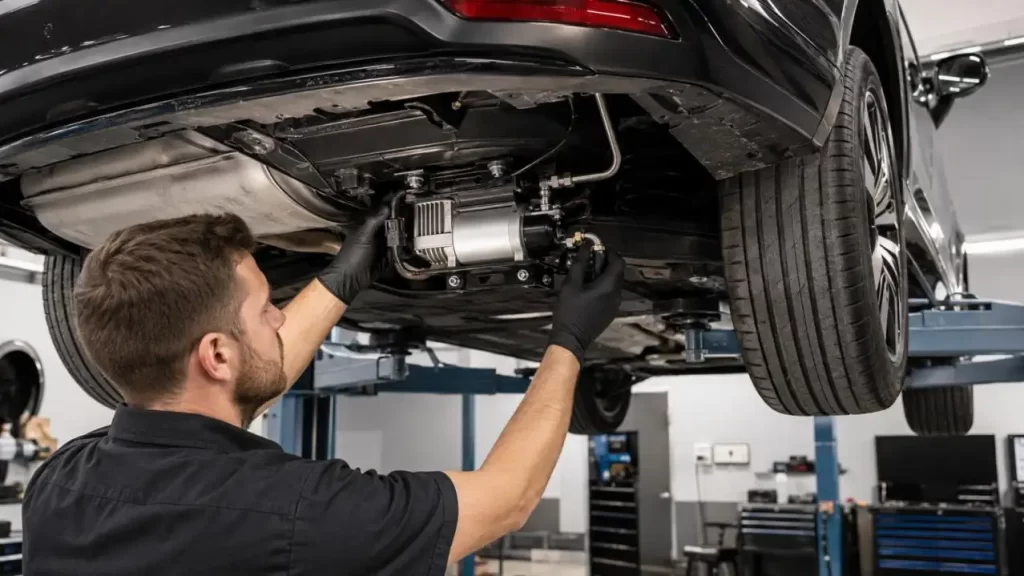
Before installation, technicians should test the air springs, lines and valve block for leakage. The relay, fuse, intake filter and dryer condition should also be inspected.
After installation, record:
•Pressure recovery time
•Running current
•Noise and vibration
•Housing temperature
•Pressure decay after shutdown
These measurements provide a baseline for future diagnosis. They also reveal restrictions, wiring losses or leaks before they shorten compressor life.
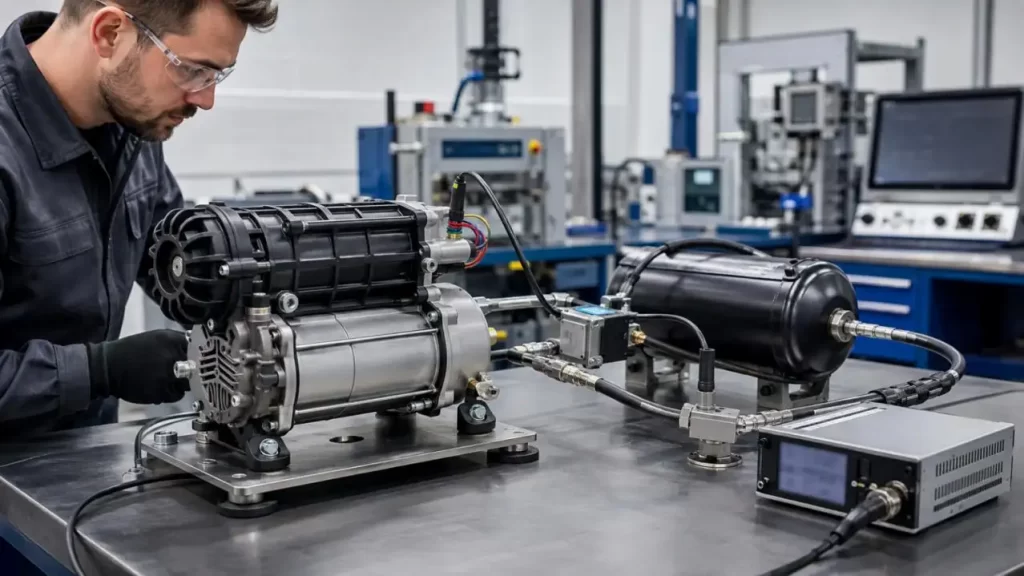
Validate Service-Life Claims With Test Conditions
A statement such as "50,000 cycles" has little meaning without pressure, ambient temperature, operating time, cooling interval and failure criteria.
Automotive validation may need to consider ISO 16750 for electrical, mechanical, climatic and chemical loads; ISO 20653 for vehicle IP protection; and ISO 7637-2 for electrical transients. IATF 16949 and ISO 9001 evaluate quality-management systems—they do not replace product-level performance reports.
Huijie's regular air suspension products are tested before shipment. For a serious purchasing decision, buyers should still request model-specific pressure, airflow, current, leakage and endurance criteria, together with certificate scope and batch traceability.
Purchase Verified Performance, Not Maximum Pressure
A reliable Air Ride Compressor for Cars should provide the required airflow at system pressure without exceeding the vehicle's electrical or thermal limits. Oil-free construction is valuable, but system matching, moisture control and leak-free installation determine whether that advantage produces a longer service life.
Buyers can send Huijie the OE number, vehicle model, chassis, year and required quantity to confirm an appropriate compressor configuration and obtain the relevant technical documentation before ordering.
FAQs
Q1. Does Huijie offer an oil-free Air Ride Compressor for Cars?
Huijie sells car air suspension compressors built using oil-free compression. Buyers should verify internal configurations and technical specifications of the model as these may differ by vehicle platform.
Q2. Are there any vehicle brands covered by Huijie's air ride compressors?
Huijie has air ride compressors that cover platforms used by Mercedes-Benz, BMW, Audi, Land Rover, Jaguar, Porsche, Tesla, Volvo and many other brands. You must verify compatibility using OE number, chassis, model and the suspension variant.
Q3. Does Huijie meet OE air ride compressor requests for Cars?
Yes, Huijie makes air ride compressors according to OE references and VIN information of the vehicle and vehicle models and chassis. Providing the VIN and giving the part number reduces fitment errors.
Q4. What pressures do Huijie compressors operate at?
Huijie's products operate at a range of approximately 10-17 bar, depending on the design of the vehicle. The specific compressor must be checked for pressure, airflow, and duty cycle rather than applying the range to all models.
Q5. Does Huijie test its air ride compressors for Cars?
Huijie tests its products before shipping and recommends that customers requiring a bulk supply of air suspension compressors set model specific acceptance limits for pressure, airflow, current, leakage, and sound and pressure recovery.


Contact Us
In This Article
- 1 Slow Leveling Is Not Always a Compressor Failure
- 2 What "Oil-Free" Really Means Inside the Compressor
- 3 Compare Technical Designs Before Selecting a Compressor
- 4 Efficiency Must Be Measured Under Pressure
- 5 Match the Compressor to the Complete Vehicle System
- 6 Installation Conditions Directly Affect Service Life
- 7 Validate Service-Life Claims With Test Conditions
