


Automotive Air Suspension Strut for Electric Vehicles: New Design Requirements
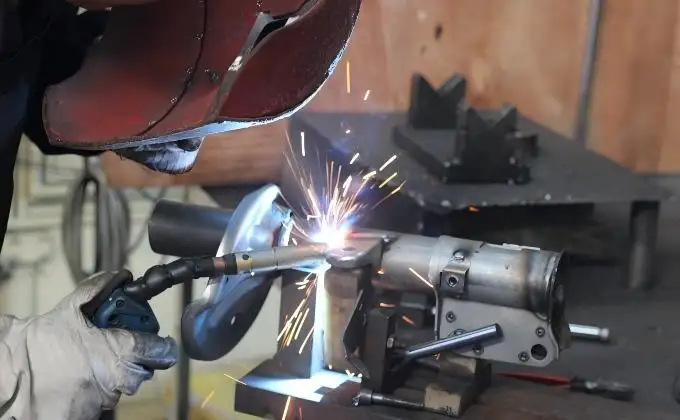
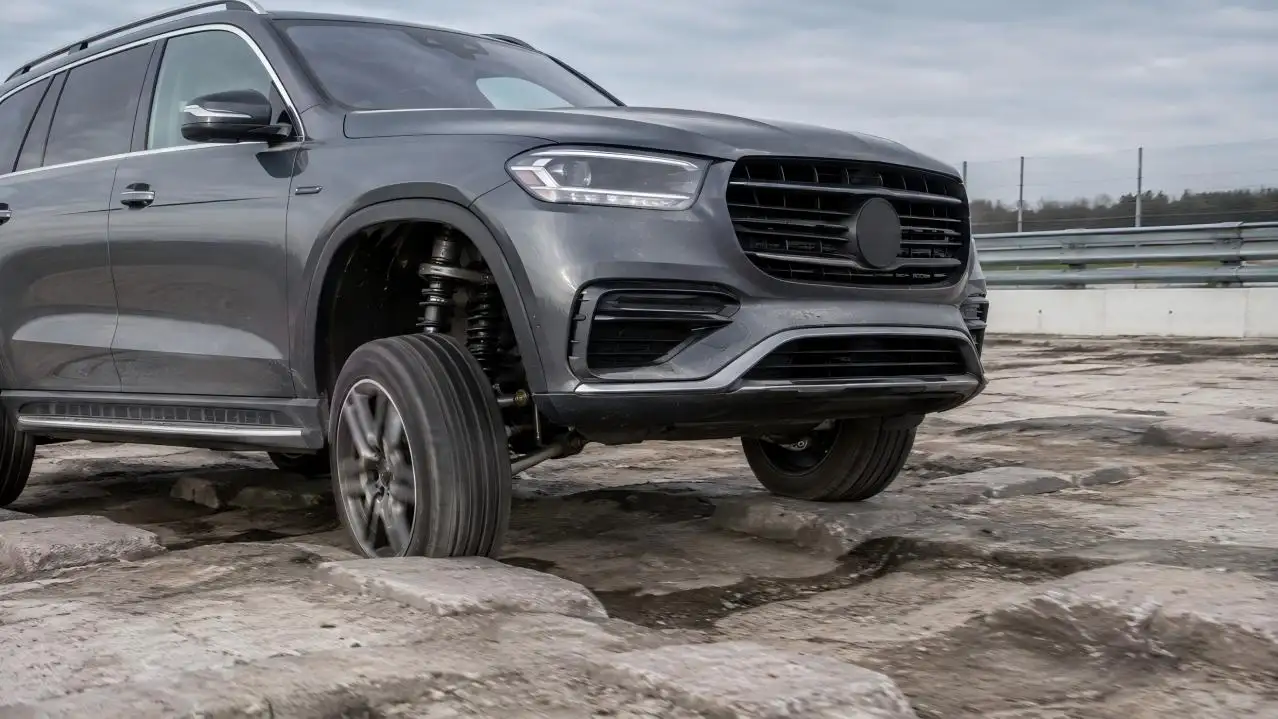
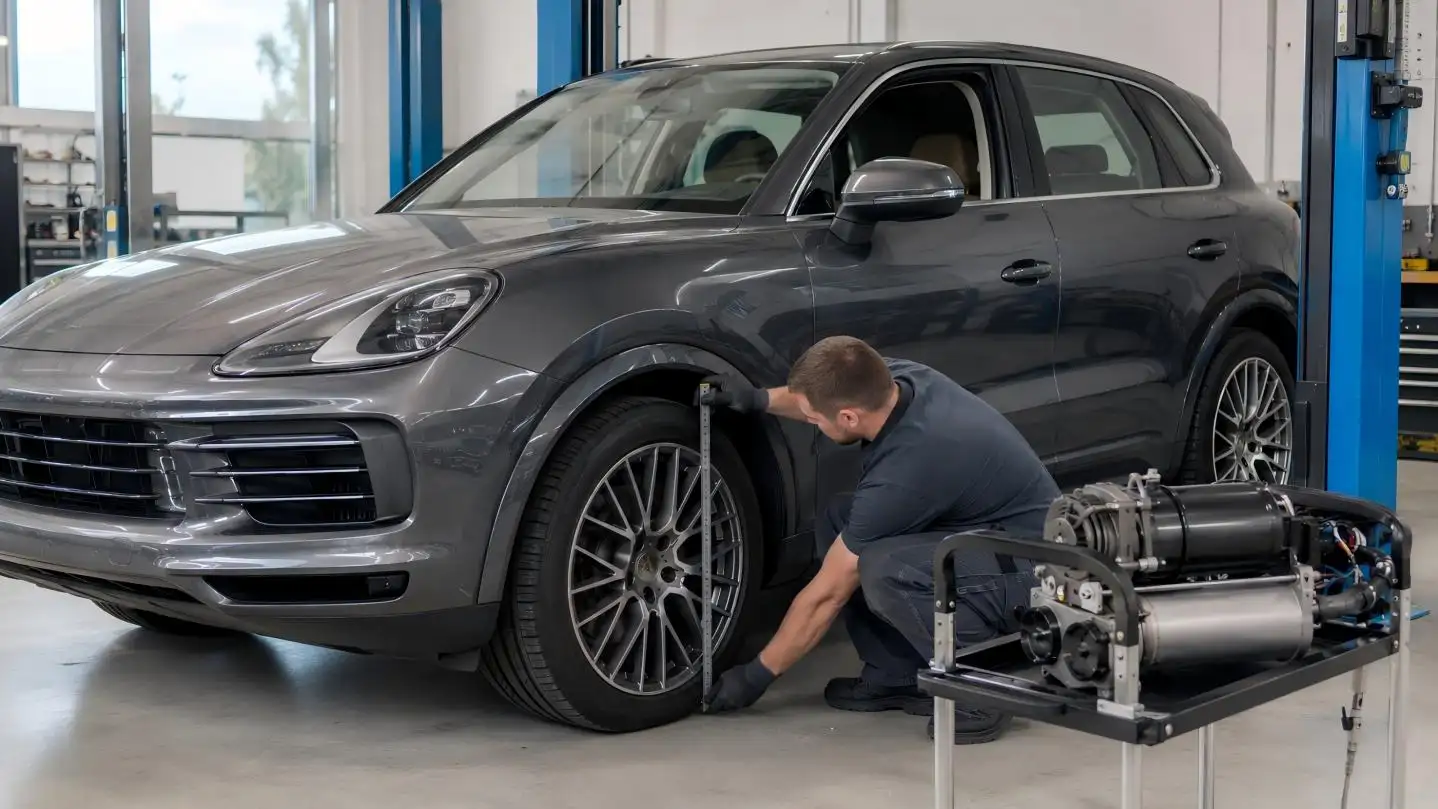
An EV needs a correctly matched Automotive Air Suspension Strut because corner load, battery packaging, wheel travel, cabin NVH and chassis-control strategy differ by platform. At Huijie, we therefore begin with the vehicle load case and OE interface—not a generic pressure rating. Higher pressure cannot correct insufficient travel, the wrong effective area or unsuitable damping.
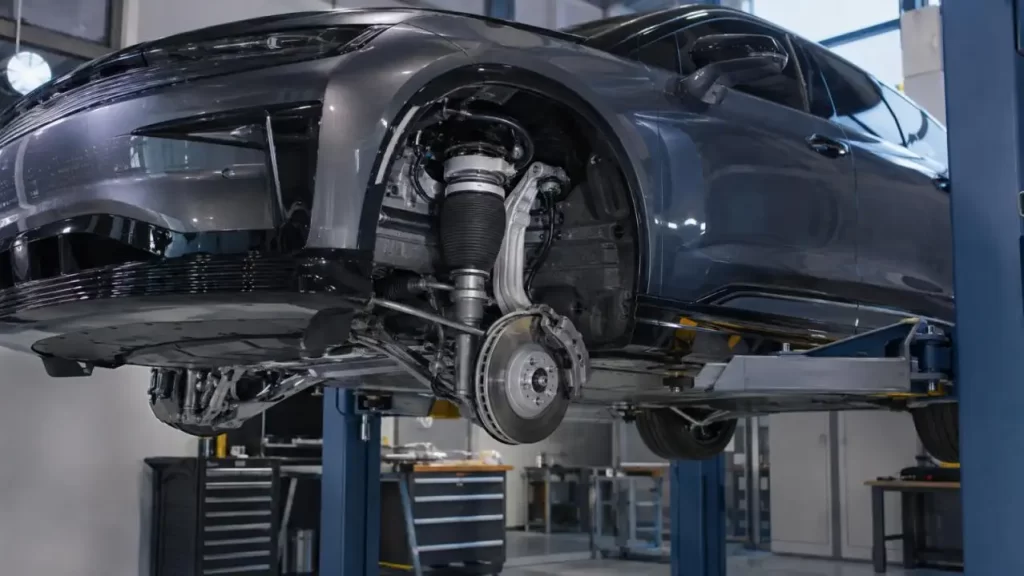
EV Mass Changes the Complete Load Case
The engineering input is the load at each wheel, not curb weight alone. The strut must be checked at empty, rated and uneven loading, including acceleration, braking, cornering and road-impact loads.
EV development also introduces four practical constraints:
• A low battery floor can restrict the strut, air line and wheel-travel envelope.
• A quiet powertrain exposes seal stick-slip, valve switching and compressor noise.
• Leakage increases leveling frequency, compressor temperature and electrical consumption.
• Electronic damping requires compatible sensors, connectors and fault logic.
Translate Vehicle Data into Air-Strut Targets
The approximate vertical support force is:
[F \approx P_g \times A_{eff}]
Here, (P_g) is gauge pressure and (A_{eff}) is the effective bellows area at the installed height. Because effective area changes through the stroke, two struts operating at the same pressure can produce different force and spring-rate curves.
| Engineering relationship | Effect on the Automotive Air Suspension Strut |
| Higher corner load | Requires greater effective area, pressure or both |
| Smaller installed air volume | Usually raises progressive spring stiffness |
| Higher sprung mass without retuning | Lowers body natural frequency and changes damping demand |
| Higher leakage rate | Increases compressor duty, heat, noise and energy use |
| Shorter jounce travel | Raises bump-stop engagement and peak-load risk |
Evaluating damping as part of automotive design requires assessment of force vs velocity curves in both directions, compression and rebound. An Automotive Air Suspension Strut increased in pressure with original damping may carry an EV. Despite this, pitch, float and harsh impact response may still be significant.
Compare Architectures Before Selecting a Supplier
| Design choice | Technical benefit | Trade-off | Best fit |
| Integrated Air Strut | Spring and damper combination is a space efficient package | Replacement is more difficult | Restricted packaging on the wheelhouse |
| Separate Springs and Dampers | Independent placement and adjustment of springs and dampers | Increased space in the chassis | Flexible platform design |
| Single Chamber | Simple construction | Narrow adjustability range | A stable target load |
| Multi Chambers | Adjustment range extended by switching air volume | Complex and more expensive | Multiple modes of EV drive |
| Fixed Damping | Less expensive and simple to control | Adjustility limited | Standard Suspension Strut |
| Semi Active Damping | Resposes to speed, load, and motion of body | Control is more complex and has a fail safe | Premium or Performance EVs |
While aluminum or hybrid housings reduce weight, challenges of corrosion, NVH, joints and fatigue still need to be validated. This proves low mass in a Spring and Damper Package does not prove it is EV ready.
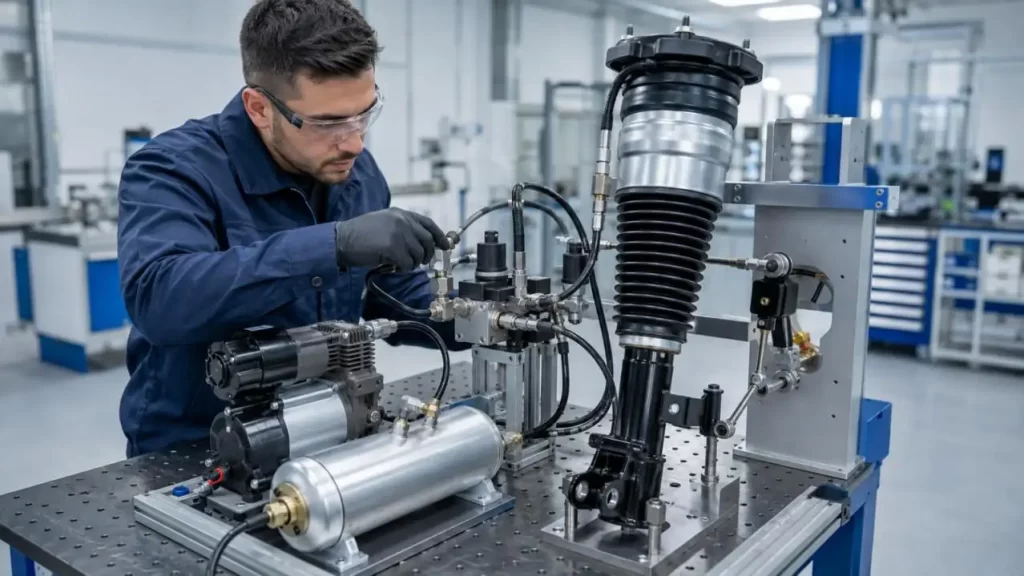
Match the Strut with the Pneumatic and Electronic System
Leveling time depends on compressor flow, reservoir pressure, valve passages, line diameter and target volume. The strut cannot be approved independently.
Huijie's portfolio provides useful system-level reference points:
• The catalog covers air struts, air springs, compressors and valve blocks.
• Its Tesla Model X compressor uses OE reference 670039247, with working current and voltage tested during production.
• A Tesla-compatible valve block is listed under OE references 1027919-00-A/B/C/D with a 5 × Φ4 + 2 × Φ6 pneumatic interface.
Huijie has 15+ years of manufacturing experience. Its air suspension category specifies 100% pre-shipment testing and 1–3-day dispatch for stocked regular items.
These figures support manufacturing and supply qualification but do not replace part-specific force, pressure or leakage data. Huijie does not publish one universal operating pressure, burst ratio or fatigue-cycle value for every Automotive Air Suspension Strut because these limits follow the OE application. Buyers should request the relevant test specification by part number.
Protect the Battery Envelope During Installation
Check fitment at full rebound, compression, commanded ride heights and steering lock:
• Bellows clearance from control arms, bodywork and the tire
• Air-line distance from sharp edges, heat and high-voltage cables
• Top-mount orientation and fastener torque
• Left/right position, damping version and connector keying
• Ride-height calibration, diagnostic reset and wheel alignment
Huijie identifies products by vehicle, axle position, chassis and OE number. Model year, damping system and connector configuration must still be confirmed.
Validate Failure Modes, Not Only Dimensions
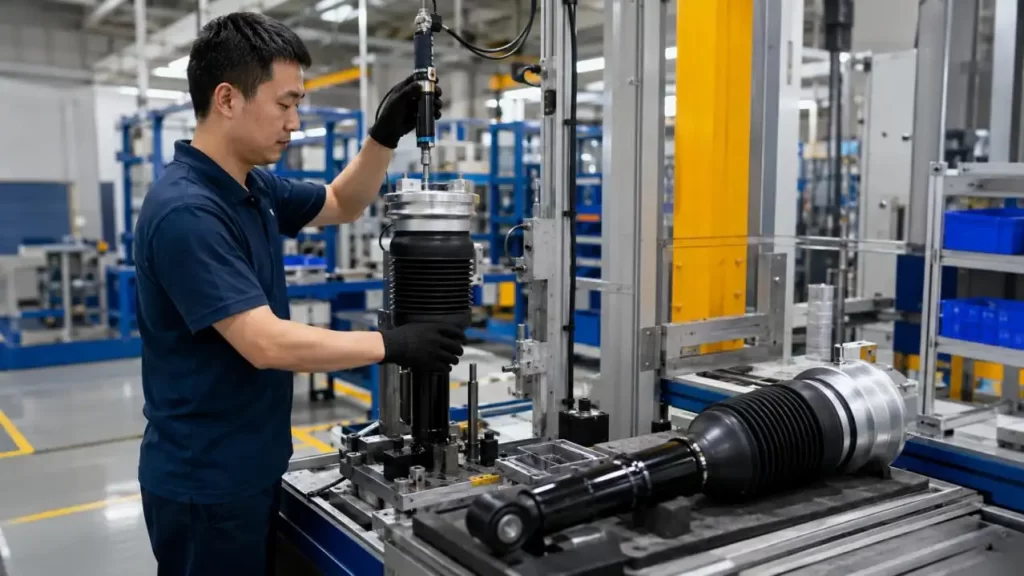
Validation for an Automotive Air Suspension Strut should combine leak and pressure tests with side-load durability, compression/rebound cycling, damping consistency, temperature cycling and corrosion exposure. Reports should identify the sample, pressure, temperature, cycle count and acceptance limit.
For an electronically controlled strut:
• ISO 16750 may define environmental loads on E/E hardware.
• ISO 20653 addresses ingress protection of E/E hardware.
• UN Regulation No. 10 outlines the kind of EMC approval which is concerned.
• ISO 26262 is concerned with safety-related E/E hardware.
• UN Regulation No. 100 includes safety of vehicle level systems and powertrains of EVs.
These should not be interpreted as general product certificates for passive struts for all instances.
Build the RFQ Around Verifiable Data
A useful RFQ includes the OE reference, chassis, axle position, corner-load range, ride heights, travel, damping configuration, electrical interface, environment and required PPAP level.
For an EV replacement or development project, send these inputs to Huijie with the required annual volume. Huijie can review the available Automotive Air Suspension Strut configuration, identify matching system components and confirm which engineering values require sample testing before purchase.
FAQs
Q1. What are the air suspension products offered by Huijie?
Huijie provides Automotive Air Suspension Strut assemblies, air springs, compressors, valve blocks, and other types of suspension parts. This range of products allows them to meet individual and system-level replacement needs.
Q2. Does Huijie provide air suspension parts for electric vehicles (EVs)?
Yes. They have the Tesla Model X compressor, with OE number 670039247, and Tesla compatible valve blocks with OE numbers 1027919-00-A/B/C/D, listed on their website. For Automotive Air Suspension Struts, the EV chassis and OE number must be provided.
Q3. How does Huijie verify Automotive Air Suspension Struts?
For verification, Huijie looks at the OE number, the vehicle model, the chassis, the placement of the strut, and the model year. The buyer must also provide the control of the damping (fixed or electronic).
Q4. Can Huijie manufacture a custom Automotive Air Suspension Strut?
Huijie will evaluate custom air-strut requirements with drawings, sample OE units, or specific vehicle data. The project must define corner loads, ride height, travel, damping, and control, mounting configuration, and electrical interface.
Q5. What certifications does Huijie hold?
Huijie's website presents ISO 9001, CE and IATF-related certification information. Buyers should obtain current certificate copies and verify the issuing body, validity period, manufacturing location and certified product scope.


