


How Temperature and Road Conditions Affect Air Shock Absorber Performance

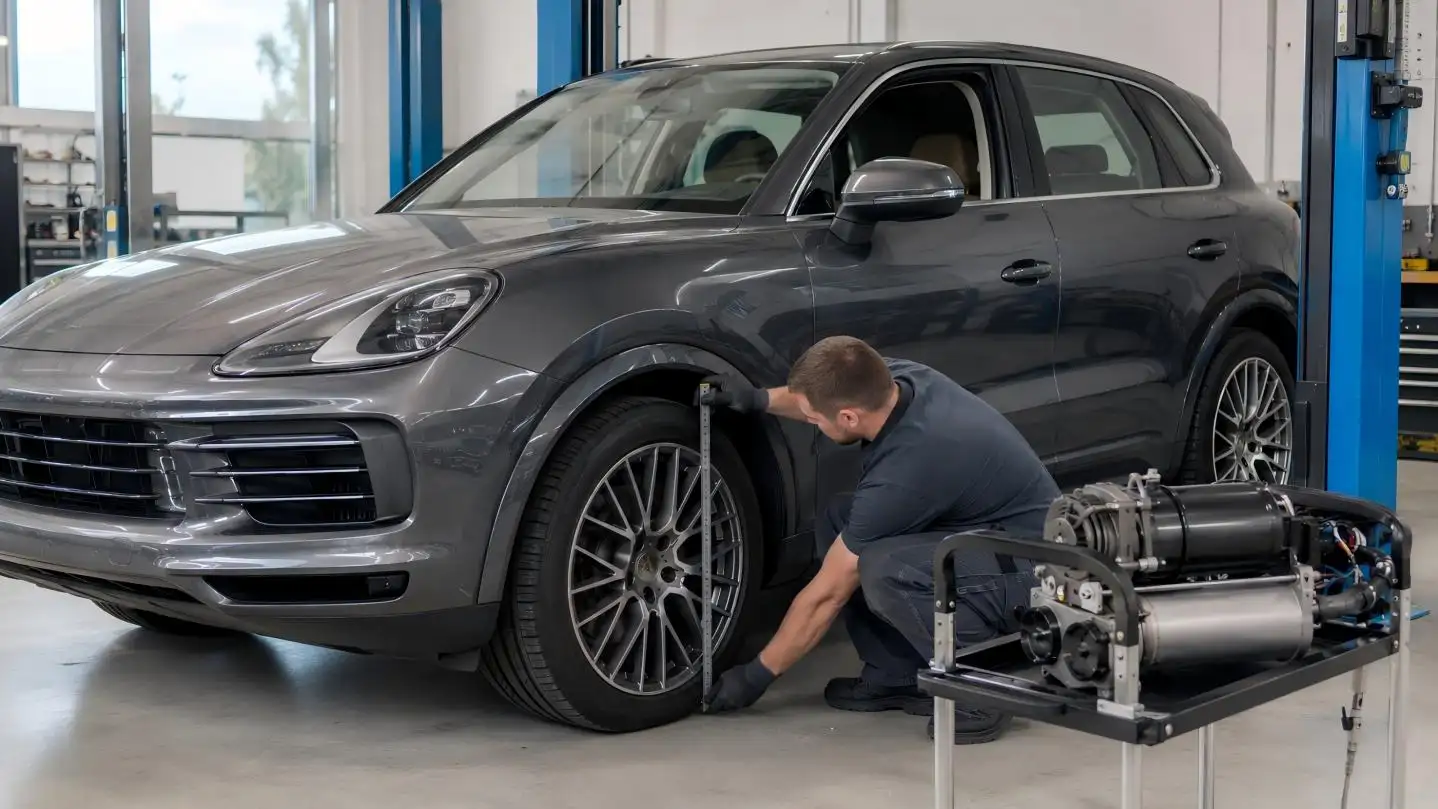
An Air Shock Absorber carries vehicle load through compressed air while its hydraulic damper controls wheel and body movement. Temperature, potholes, salt, dust and continuous vibration affect these two functions differently. Reliable diagnosis therefore requires more than checking whether the vehicle still rises after starting.

Read the Vehicle Symptoms Before Replacing Parts
Environmental stress usually appears as:
• One corner dropping after a cold night
• Slow height recovery and longer compressor runtime
• Excessively firm damping during the first kilometres
• Bouncing after extended driving on broken roads
• Corrosion around crimp rings, fittings or mounting points
• Suspension warnings after installing a replacement unit
Cold-related pressure loss is not automatically an air leak. If one corner continues to sink after temperatures stabilize, inspect the Air Shock Absorber, air-line connection and valve block separately.
Temperature Changes Pressure, Rubber and Damping Oil
Air Pressure and Load Support
For a nearly fixed air mass and volume:
P1/T1 = P2/T2
The calculation requires absolute temperature and absolute pressure. Cooling from 20°C to −20°C reduces absolute pressure by approximately 13.7% before the leveling system adds air.
Approximate supporting force is:
F=Pgauge×Aeffective
However, the effective area changes with bellows geometry and working height. A higher maximum pressure does not necessarily mean that an Air Shock Absorber can safely carry more load at the vehicle's design height.
Rubber and Seal Behavior
Low temperature increases rubber stiffness and can reduce the ability of seals to follow surface movement. High temperature accelerates oxidation, increases gas permeation and changes seal compression. Temperature cycling is often more demanding than steady exposure because the rubber, aluminum housing, crimp rings and sealing elements expand at different rates.
Damping Changes With Oil Temperature
Cold hydraulic oil has higher viscosity, so low-speed compression and rebound may initially feel too firm. Repeated pothole or washboard inputs move the piston at high velocity and convert suspension energy into heat. As oil viscosity falls, damping force can decrease, producing body float or repeated wheel movement.
| Environment | Main mechanism | Typical result |
| Cold parking | Pressure reduction and seal contraction | Low corner or slow height recovery |
| Hot, rough road | Oil heating and rapid piston motion | Damping fade and increased bounce |
| Salt and moisture | Coating damage and metal corrosion | Fitting, crimp or bracket deterioration |
| Dust and gravel | Abrasion and stone impact | Bellows or piston-rod surface damage |
Compare Air Shock Absorber Designs by Duty Cycle
There is no universally superior design. Selection depends on the operating environment.
• Low-temperature compound vs. all-season rubber: Cold-optimized rubber improves flexibility, but heat aging, ozone resistance and permeability must also be verified.
• Monotube vs. twin-tube damping: Monotube construction generally transfers heat effectively, while twin-tube designs may offer packaging and ride-tuning advantages.
• Passive vs. electronically controlled damping: Passive units reduce electrical complexity; adaptive units require correct solenoid, connector and ECU compatibility.
• Standard vs. enhanced corrosion protection: Coastal and salted-road applications need protection at connectors, crimps, welds and exposed brackets—not only on visible surfaces.
Match the Unit to the Complete Air Suspension System
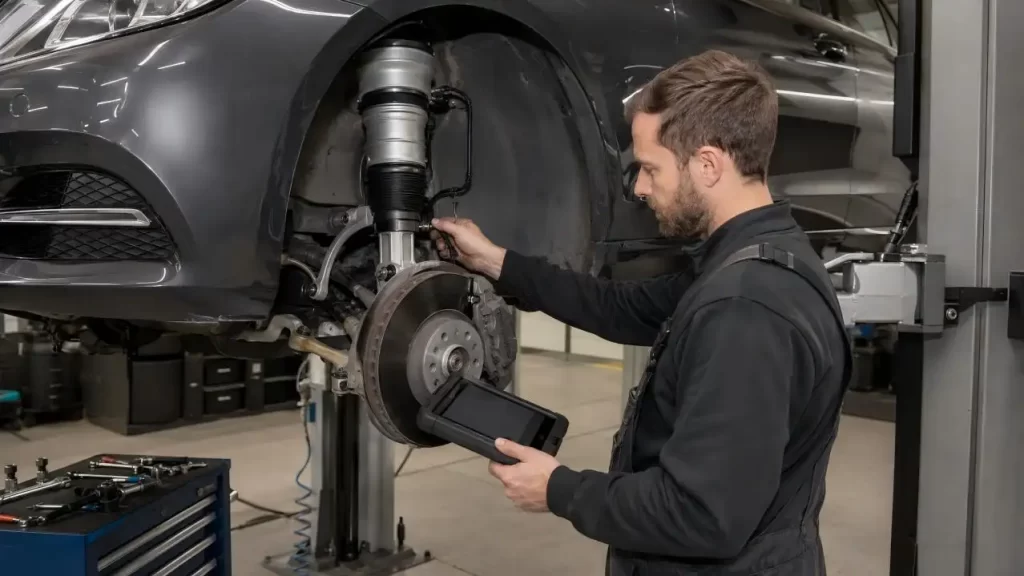
An OE number is a reference, not a complete engineering specification. Before approving an Air Shock Absorber, confirm:
• Axle position, mounting geometry and vehicle chassis
• Design height, axle load and usable stroke
• Compression and rebound damping curves
• Air-line diameter and connector geometry
• Solenoid resistance and electronic damping function
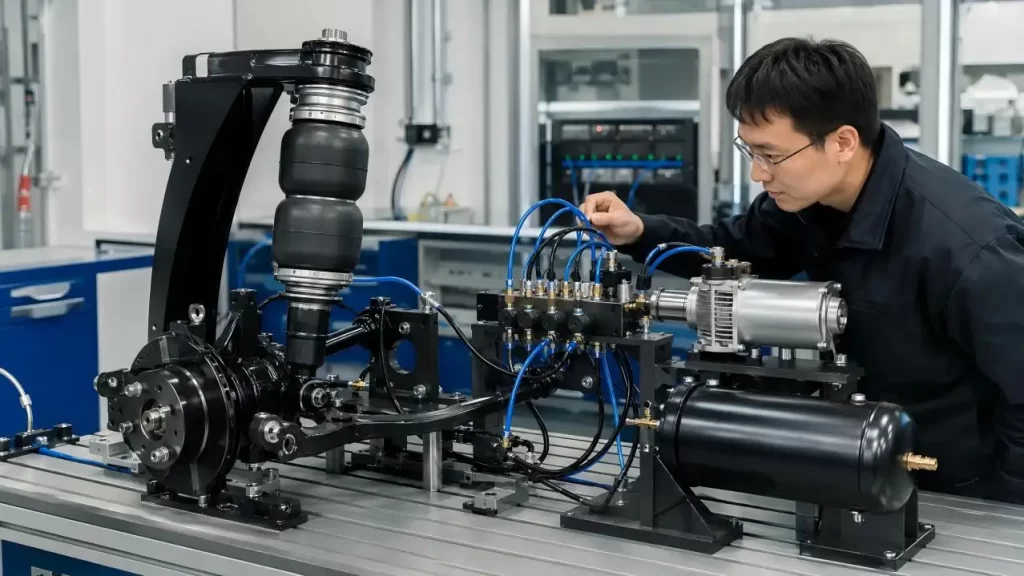
• Compressor, dryer, reservoir and valve-block condition
• Height-sensor calibration requirements
Huijie's range covers air shocks, air springs, compressors and valve blocks for platforms including Audi, BMW, Mercedes-Benz, Land Rover, Porsche and Volkswagen. The company reports more than 2,000 products, coverage for over 95% of air-suspension systems and a 10,000 m² R&D and production base. This wider system coverage helps us evaluate pneumatic compatibility instead of treating the Air Shock Absorber as an isolated part. Huijie company data
Put Huijie's Product in Context
For a concrete product example, Huijie offers front-right Air Shock Absorber for Audi A8 D3/4E, A8L and S8 under the 4E0616040 OE series. The complete unit is specified at 84 × 20.3 × 20 cm and 9.5 kg. Its construction includes:
• Strengthened rubber sleeve
• Heavy-duty crimping rings
• Reinforced aluminum-alloy housing
• High-strength plastic components
• Corrosion-resistant metal connectors
• Individually performed air-leak testing
These details establish a physical and manufacturing baseline, but dimensions and weight do not prove damping equivalence. The same product still requires correct right-front position, ride-height calibration and system-level diagnosis. 4E0616040 Air Shock Absorber specifications
Huijie's regular products are tested before shipment. Selected vehicle-specific Air Shock Absorber pages also publish a 50,000+ km service-life target and a one-year warranty. These figures should be evaluated against the exact vehicle, installation quality, temperature range and road duty rather than applied automatically to every model. Huijie product validation example
Installation Errors Can Resemble Environmental Failure
Before fitting a new Air Shock Absorber:
• Inspect the opposite axle position for damping imbalance.
• Check the compressor, dryer, air lines and valve block.
• Keep the bellows untwisted and protect the inlet from contamination.
• Follow the specified support, inflation and tightening sequence.
• Stabilize temperature before conducting a pressure-decay test.
• Calibrate ride height and clear stored suspension faults.
Frequent compressor cycling after replacement usually indicates leakage, calibration error or pneumatic mismatch—not necessarily a defective compressor.
Compare Standards to Compared Part
ISO 1431-1:2024 applies to the evaluation of rubber ozone-cracking. Although ISO 9227:2022 defines the procedure of salt-spray tests, it does not define how to transform test hours into the life of a vehicle. ISO 16750 is related to climatic tests for automotive electrical and electronic components. The relevance of this Standard is determined by whether the Air Shock Absorber contains controlled valves, sensors or other types of electronic damping. ISO 1431-1, ISO 9227 and ISO 16750.
Define Environment Prior to Quote
For a professional enquiry for an Air Shock Absorber, information on the chassis, OE reference, the position of installation, temperature range, axle load, road type, and the electronic configuration is needed. Huijie would be able to choose the best Air Shock Absorber for the customer and provide the customer with information for sampling a unit. With this information, the customer is provided evidence of approval for fitment and running a unit, rather than relying on the information provided in the catalogue.
FAQs
Q1. What types of Air Shock Absorber does Huijie supply?
Huijie supplies Air Shock Absorber assemblies for vehicles such as Audi, BMW, Mercedes-Benz, Land Rover, Porsche, and Volkswagen, as well as for other brands. Select your product by chassis, OE number, axle and position of installation.
Q2. How does Huijie confirm Air Shock Absorber compatibility?
Please give the model, year of production, chassis, OE number and whether it is left or right installation. For an electronically controlled suspension, check the connector and damping control configuration.
Q3. Does Huijie test every Air Shock Absorber before shipment?
Huijie said that regular shipments of air suspension products are tested for quality assurance. Depending on the products, the quality control checks include air leak, stability, fitment, and the performance of the vehicle.
Q4. What materials are used in Huijie Air Shock Absorber products?
The materials used are different based on the application. Select Huijie products that use rubber bellows, aluminum alloy housing, heavy-duty crimp rings, engineering plastics and metal connectors of corrosion-resistant.
Q5. Can Huijie provide an Air Shock Absorber for cold climates?
Huijie can provide appropriate products based on the vehicle and the operating environment. Instead of relying on the general temperature range, buyers are suggested to request model-specific cold-temperature leakage, rubber flexibility and damping data.


Contact Us
In This Article
- 1 Read the Vehicle Symptoms Before Replacing Parts
- 2 Temperature Changes Pressure, Rubber and Damping Oil
- 3 Compare Air Shock Absorber Designs by Duty Cycle
- 4 Match the Unit to the Complete Air Suspension System
- 5 Put Huijie's Product in Context
- 6 Installation Errors Can Resemble Environmental Failure
- 7 Compare Standards to Compared Part
