


Passenger Vehicle Air Suspension Compressor Failure Signs and Diagnostic Methods

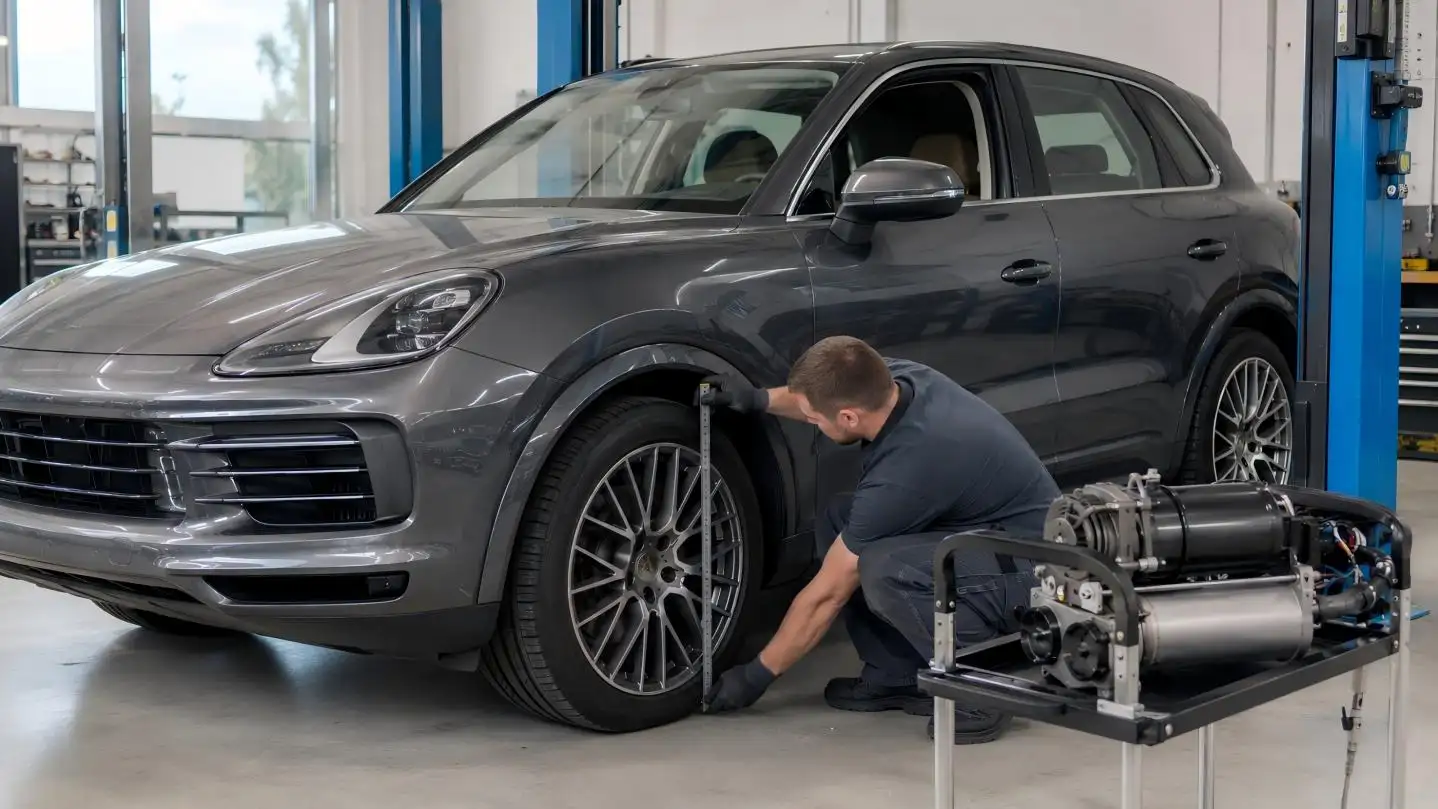
A Passenger Vehicle Air Suspension Compressor does more than inflate air springs. It must build pressure within the time expected by the suspension control module while operating within defined electrical and thermal limits. A vehicle that sits low, rises slowly or displays a suspension warning therefore does not automatically have a failed compressor.
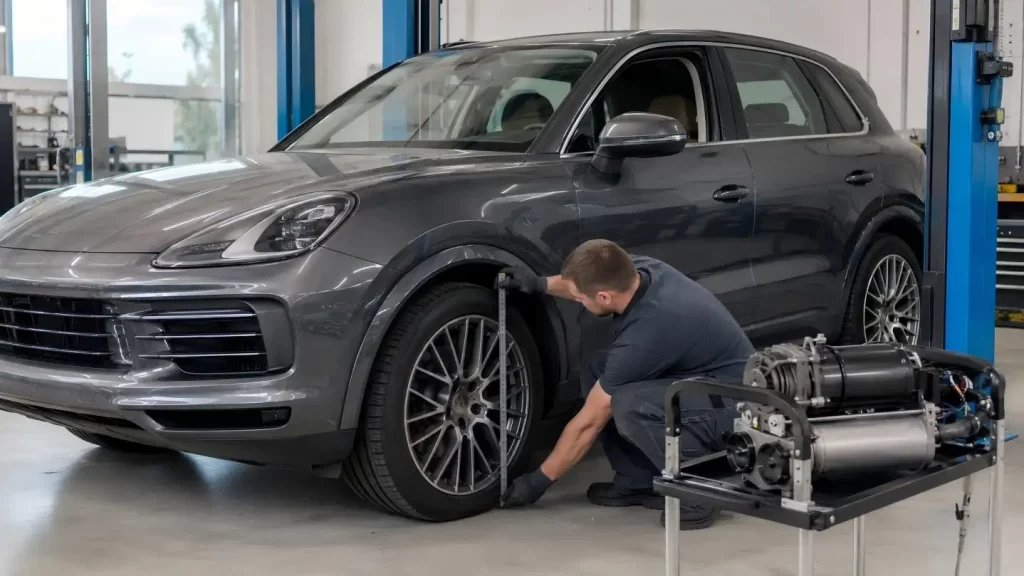
Accurate diagnosis must separate four possible fault groups: insufficient air output, pneumatic leakage, electrical supply problems and incorrect control signals.
Read the Vehicle's Behavior Before Replacing Parts
The location and timing of ride-height loss provide the first useful evidence.
| Vehicle behavior | More likely causes | First confirmation |
| One corner drops overnight | Air spring, fitting or corner valve leak | Measure four-corner height and isolate that circuit |
| One axle sits low | Shared line, valve block or two air springs | Perform an axle-level pressure-decay test |
| Vehicle rises slowly after startup | Weak pump, air leak, dryer restriction or voltage drop | Record filling time, voltage and current |
| Compressor does not start | Fuse, relay, wiring, thermal lockout or ECU command | Read DTCs and perform a bidirectional test |
| Compressor runs repeatedly | System leakage or implausible height signal | Monitor pressure decay and live sensor data |
| Noise or vibration increases | Pump wear, damaged bracket or compressed isolator | Compare bench noise with installed NVH |
If the vehicle loses height while parked but returns to normal after startup, the Passenger Vehicle Air Suspension Compressor may still be functioning correctly. The static pressure loss should be located before the pump is condemned.
Why Pressure Alone Cannot Confirm Compressor Health
Most passenger cars use a nominal 12V compressor. Passenger-car air suspension systems can operate at pressures up to approximately 17 bar, or 247 psi, although the correct pressure range is always vehicle-specific.
A healthy Passenger Vehicle Air Suspension Compressor must satisfy several parameters simultaneously:
• Target pressure;
• Airflow at that pressure;
• Reservoir filling time;
• Running current;
• Permitted duty cycle;
• Thermal protection behavior;
• Leakage and pressure retention;
• Installed noise and vibration.
Maximum pressure is not the same as useful output. A worn compressor may eventually reach the target pressure but deliver insufficient airflow at 10–15 bar. If reservoir pressure rises too slowly, the ECU can store a plausibility or filling-time fault even though the motor still runs.
For context, one OE-style 12V compressor specification lists 16 bar operating pressure, 32A rated current and a −40°C to +80°C temperature range. These figures illustrate the electrical and environmental demands involved; they must not be treated as universal limits for every model.
Use Pressure, Current and Voltage as One Diagnostic Set
Electrical input is directly related to compressor load:
Pelectrical=V×I
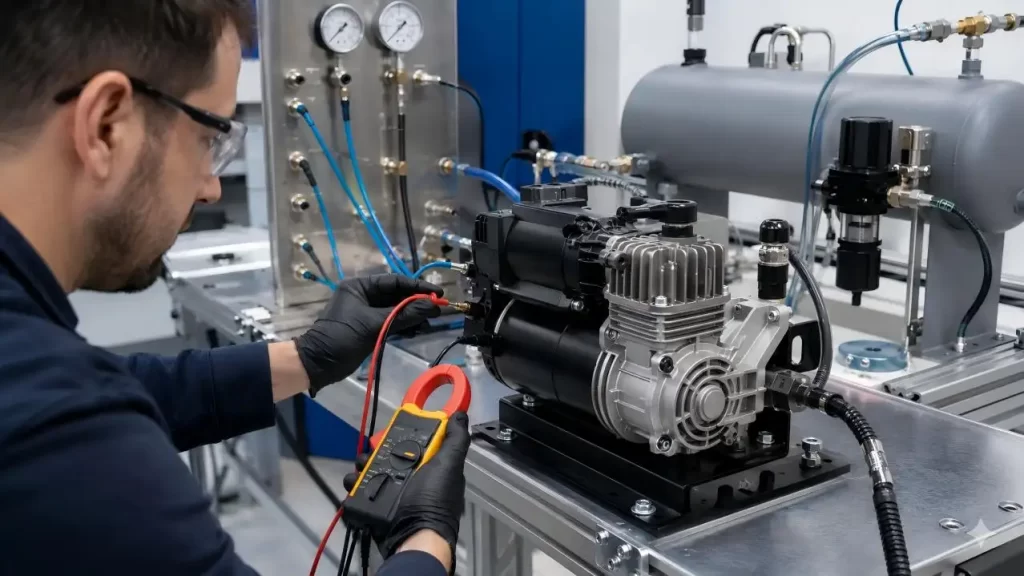
Testing should be performed at the compressor terminals, not only across the battery. A corroded connector or worn relay can show acceptable battery voltage but create significant voltage drop when the motor starts.
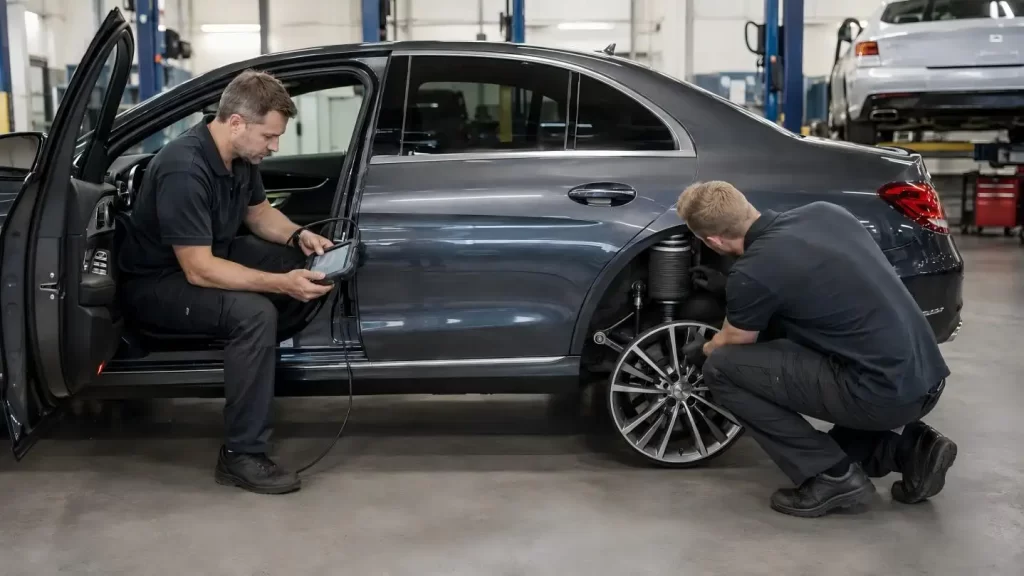
Interpreting the Measurements
• Low pressure rise + correct voltage + normal/high current: internal wear, piston-seal loss or mechanical restriction is likely.
• Low pressure rise + low terminal voltage: Inspect the relay, power cable, connector and ground.
• High current + abnormal noise: Mechanical resistance or internal pump damage may be present.
• Normal output + excessive run frequency: Search for an external leak or incorrect height signal.
• Power and ground present + no operation: Allow the unit to cool before ruling out thermal protection.
Pressure before the dryer is acceptable but outlet flow is weak: check for dryer saturation or restriction.
Because airflow decreases as back pressure rises, suppliers should provide a pressure–flow curve, not only a zero-pressure flow figure.
Separate Compressor Failure From System Leakage
A leak produces a predictable failure chain:
Pressure Loss → Frequent Leveling Commands → Longer Duty Cycle → Higher Temperature → Relay And Piston-Seal Wear
Check the following areas systematically:
• Air spring folds and crimping zones;
• Push-fit line connectors;
• Dryer inlet and outlet fittings;
• Reservoir and pressure-sensor joints;
• Valve-block ports and internal isolation;
• Compressor check valve.
A static pressure-decay test is more reliable than simply listening for escaping air. Record the starting pressure, isolated circuit volume, test duration and ambient temperature. Pressure changes caused by temperature must not be mistaken for leakage.
Replacing a Passenger Vehicle Air Suspension Compressor without correcting the leak commonly leads to repeat failure.
Confirm Mechanical, Pneumatic and Electronic Compatibility
A replacement cannot be selected by voltage or physical appearance alone. Verify:
• OEM cross-reference number;
• Vehicle model, chassis and production year;
• Factory suspension option;
• Connector shape and pin assignment;
• Air outlet orientation and fitting size;
• Bracket geometry and isolator position;
• Dryer and sensor configuration;
• Pressure–flow performance;
• ECU, relay or PWM control strategy.
Compressors for Mercedes-Benz W164/X164, Audi Q7 4L, Jaguar X350/X358 and Tesla Model X may share similar oil-free piston principles but use different brackets, interfaces and control requirements.
Install the New Compressor Without Preserving the Old Fault
Before removal, support the vehicle mechanically and depressurize the system according to the OEM procedure. Air suspension must never be used as the sole support during service.
The following repairs are included:
- Repair for air leaks.
- Inspect fuse, wiring and connectors, ground.
- Replace stuck or heat failed relays.
- Inspect intake hose and dryer for moisture and contamination.
- Install isolators and brackets with no preload and no distortion.
- Clear DTCs, perform required compressor activation and other necessary functions.
- Calibrate ride height.
- Check time to fill and pressure retention again.
Final test will be to see if the compressor reaches the required pressure within the limits of the current and runtime of the vehicle.
Verify Test Data Before Making a Purchase
Claims such as "high pressure," "low noise" and "OE quality" need measurable evidence. A qualified Passenger Vehicle Air Suspension Compressor supplier should be able to provide:
• Pressure–flow and filling-time results;
• Voltage and running-current limits;
• Thermal protection and duty-cycle data;
• Leakage and pressure-decay criteria;
• Noise test distance and mounting conditions;
• Temperature, vibration and water-ingress testing;
• Corrosion testing for housing and brackets;
• Batch inspection and product traceability.
Relevant validation references may include ISO 16750 for automotive environmental loads, ISO 7637-2 for electrical transients, ISO 20653 for ingress protection, ISO 9227 for salt-spray testing and UN/ECE R10 or CISPR 25 for applicable EMC requirements. A certificate name alone is insufficient—the test version, severity, sample size and acceptance criteria should also be checked.
A Better Passenger Vehicle Air Suspension Compressor Decision
The correct decision is based on diagnosed root cause, system compatibility and verified performance—not the highest advertised pressure.
Huijie provides a model-specific Passenger Vehicle Air Suspension Compressor range for sedans and SUV models with OEM references and specific model applications posted on the individual product pages. Distributors and repair specialists can request confirmation of fitment and ask for the relevant pressure, electrical and quality data sheets for sample usage or for placing bulk orders.
FAQs
Q1. Does Huijie offer Passenger Vehicle Air Suspension Compressors?
Huijie offers air suspension compressors for selected passenger vehicles, luxury sedans and SUVs, as well as some applications for the Mercedes-Benz, Audi, Jaguar and Tesla platforms.
Q2. How do buyers verify that a Huijie compressor will fit their vehicle?
Please provide the original equipment manufacturer (OEM) number, model, chassis code, manufacturing year, and configuration of the air suspension. A Vehicle Identification Number (VIN) may help resolve model year and/or suspension option differences.
Q3. Do Huijie air suspension compressors provide a direct-fit?
Huijie lists replacement compressors for many OEM models. Customers are advised to verify the connector, air outlet, bracket, control method, and applicable vehicle model year prior to purchase.
Q4. What checks should be done prior to installation of a Huijie compressor?
Diagnose for trouble codes, check for air springs and line leakage, inspect reservoir pressure, check relay, check voltage and compressor current. Installing a new compressor to a system with a leak may result in the new compressor failing prematurely.
Q5. Can Huijie support OEM or customized compressor projects?
Huijie presents customization options involving voltage, pressure capacity, airflow, mounting design, dryer integration and electronic interfaces. Project feasibility should be confirmed against technical drawings, target performance and forecast volume.


Contact Us
In This Article
- 1 Read the Vehicle's Behavior Before Replacing Parts
- 2 Why Pressure Alone Cannot Confirm Compressor Health
- 3 Use Pressure, Current and Voltage as One Diagnostic Set
- 4 Separate Compressor Failure From System Leakage
- 5 Confirm Mechanical, Pneumatic and Electronic Compatibility
- 6 Install the New Compressor Without Preserving the Old Fault
- 7 Verify Test Data Before Making a Purchase
