


Off-Road SUV Air Suspension Compressor: Ground Clearance, Sealing and Fast Recovery
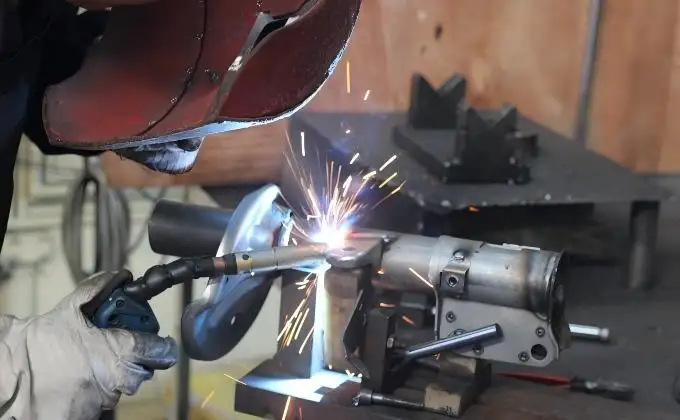
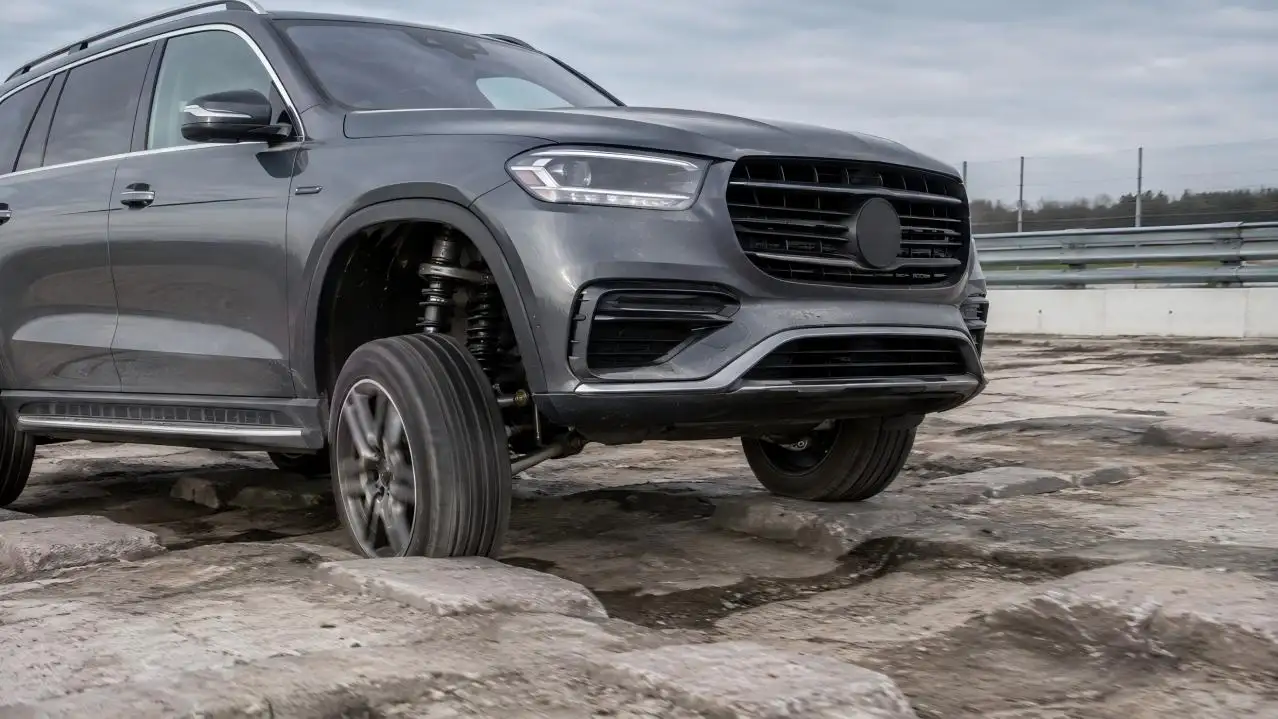
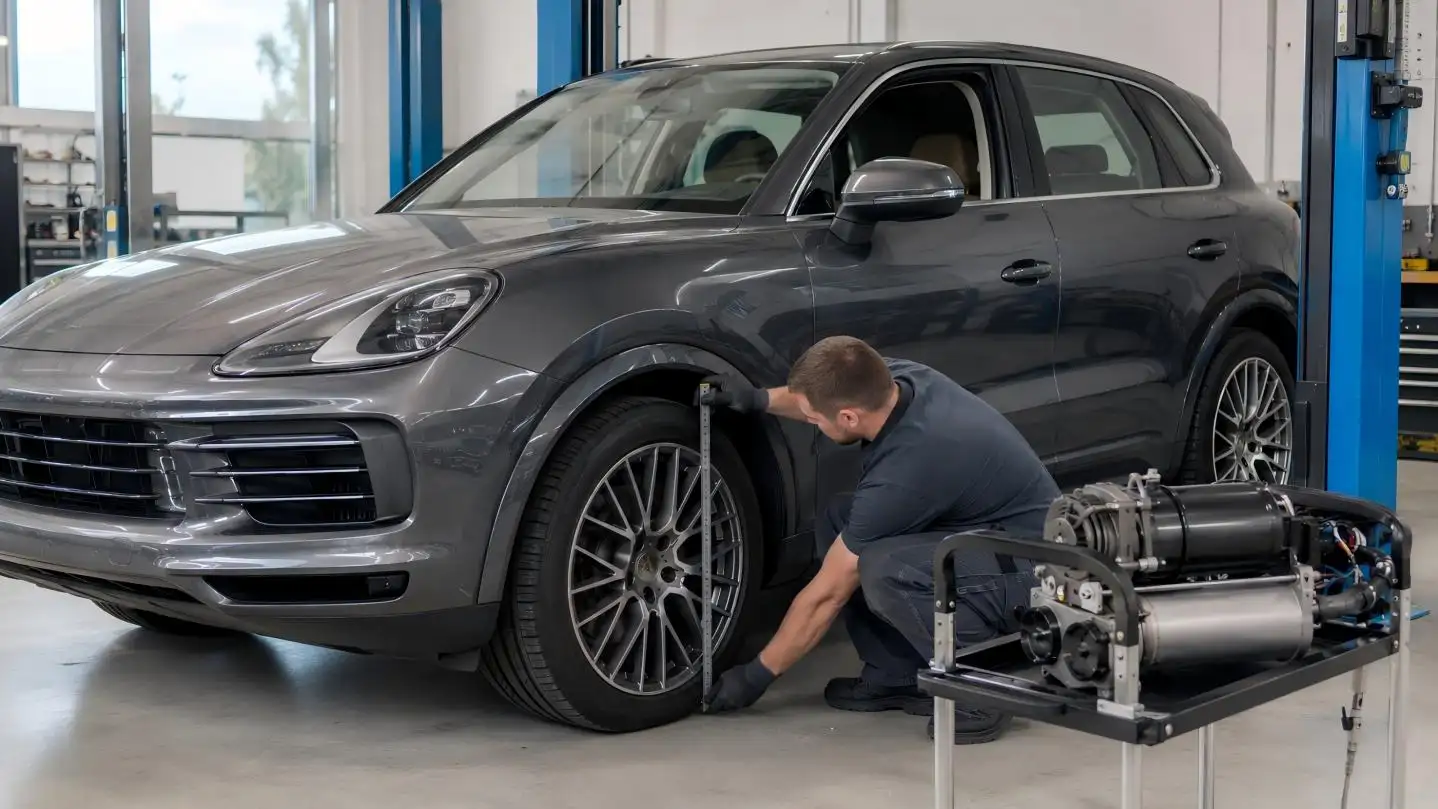
An off-road SUV Air Suspension Compressor must cope with conditions rarely reproduced in a basic workshop test: repeated ride-height changes, uneven axle loading, low battery voltage, high altitude, mud, water and extended running time.
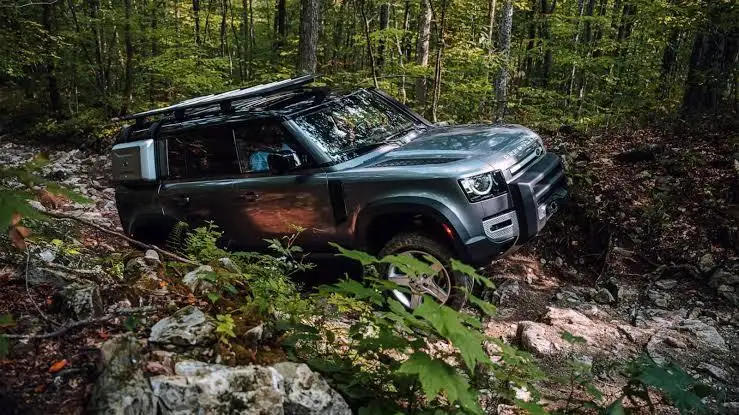
The correct unit is therefore not simply the compressor with the highest pressure rating. It must deliver sufficient airflow at system pressure while remaining compatible with the vehicle's air springs, reservoir, valve block, sensors, wiring and suspension ECU.
Why an SUV Lifts Slowly Off Road
When passengers, equipment or a trailer increase axle load, the air springs need more air mass to reach the calibrated off-road height. A slow response may result from the SUV Air Suspension Compressor, but several system faults produce the same symptom:
•Air leakage from a spring, fitting, line or valve block
•Restricted compressor intake
•Saturated dryer material
•Voltage loss through the relay, connector or wiring
•Reduced compressor efficiency
•Incorrect height-sensor data
•Excessive compressor temperature
A vehicle that sinks while parked should be leak-tested before the compressor is replaced. Otherwise, a new SUV Air Suspension Compressor may be forced into the same excessive duty cycle and fail prematurely.
Pressure Creates Lift, but Flow Determines Recovery
Air-suspension behavior can be described through:
PabsV=mRT
To increase ride height, the system must add air mass to the air springs. Recovery time is therefore governed by the required air volume divided by the compressor's average delivery at actual back pressure.
Peak pressure only shows whether the compressor can reach the required pressure. It does not indicate how quickly it will raise the SUV. For engineering comparison, buyers need:
•Flow measured at operating pressure—not zero-pressure free flow
•Starting and target system pressure
•Vehicle payload and suspension volume
•Supply voltage measured at the compressor
•Ambient temperature and altitude
•Time required to reach the calibrated height
Ground clearance is also limited by air-spring travel, suspension geometry and ECU calibration. A higher-output SUV Air Suspension Compressor may shorten recovery time, but it cannot safely increase suspension travel beyond the original design.
Huijie Production References for SUV Platforms
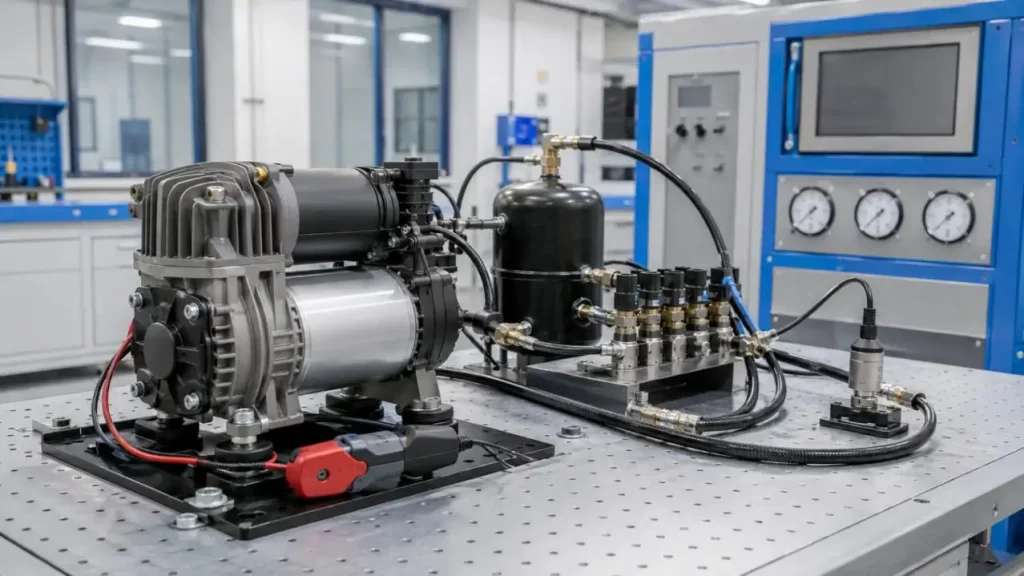
Huijie's broader compressor technical guide identifies 12V and 24V configurations, a typical 150–250 PSI pressure class, integrated thermal protection, low-noise operation and corrosion-resistant housings. These are platform-level engineering references; the exact pressure curve and electrical limits must be confirmed for each OE number.
Huijie's current SUV replacement range includes the following documented applications:
| SUV platform | Huijie OE reference | Production features |
| Range Rover, 2006–2012 | LR025111, LR011839, LR015089 | Reinforced metal housing, sealing structure, current and voltage testing |
| Audi Q7 4L | 4L0698007A/B, 7L0698853A, 7L8616006A | Direct-fit construction, reinforced casing, current and voltage testing |
| Mercedes-Benz ML/GL W164/X164, 2005–2012 | 1643201204, 1643200904, 1643200204 | Reinforced aluminum housing, heat- and corrosion-resistant materials |
| Tesla Model X | 670039247 | Reinforced aluminum housing, high-efficiency motor components, current and voltage testing |
Every unit is tested before shipment. Our SUV product pages offer working-current and voltage checks. For B2B approval, these end-of-line results should be matched to the selected part number and supplemented by pressure, leakage and recovery-time criteria where available.
The range covers more than a single pump. Huijie manufactures air suspension compressors, air springs, valve blocks, struts and related fittings, allowing compressor performance to be evaluated within the complete pneumatic circuit.
Comparing Fast-Recovery Architectures
The following alternatives represent genuine engineering trade-offs rather than interchangeable product features.
| Design decision | Faster-response option | Main engineering trade-off |
| Pressure versus airflow | Higher flow at working pressure | More current, heat and possibly noise |
| Direct fill versus reservoir | Reservoir-assisted leveling | Faster initial lift but later reservoir refill |
| Thermal design | Higher-duty compressor | Requires suitable wiring, relay and control strategy |
| Moisture control | Serviceable dryer or remote protected intake | Better maintenance access but more installation complexity |
| Replacement strategy | Universal high-output compressor | Greater output but higher integration and calibration risk |
A compact OE-style SUV Air Suspension Compressor is usually preferable for an unmodified vehicle because its mounting, current demand and control behavior remain close to the original system. A higher-duty solution may be justified for frequent height changes or additional pneumatic volume, but only after the electrical and thermal effects are assessed.
Sealing Requires More Than an IP Claim
"Waterproof" is not a complete engineering description. Four separate functions must be evaluated:
Enclosure and Connector Protection
The motor housing and electrical connector must resist dust, splash and the water exposure expected at their actual mounting position.
Pneumatic Leakage Control
Housing protection does not prove that fittings, hoses, the valve block or air springs will retain pressure.
Intake Filtration
A finer filter protects the cylinder and seals, but excessive filter pressure drop reduces airflow and lengthens compressor running time.
Compressed-Air Drying
The dryer must control moisture entering the reservoir and valve block. Saturated desiccant can contribute to corrosion, sticking valves and cold-weather problems.
For severe off-road use, a remote high-mounted intake may reduce water and mud exposure. Its hose length and filter restriction must still be checked so that intake protection does not reduce compressor capacity.
System Matching Comes Before Installation
An SUV Air Suspension Compressor should be approved against more than an OE number. The engineering check should cover:
•Chassis code, model year and OE supersession
•Connector pinout, bracket and pneumatic ports
•Starting current, running current, relay and fuse
•Reservoir volume and pressure-sensor range
•Valve-block configuration
•Air-spring volume and target ride-height window
•ECU fault logic and calibration requirements
Huijie uses OE cross-references for Range Rover, Audi Q7, Mercedes ML/GL and Tesla Model X applications. Even with a listed cross-reference, VIN-level confirmation is advisable where production-year changes affect the connector, bracket or control system.
Installation and Maintenance Affect Service Life
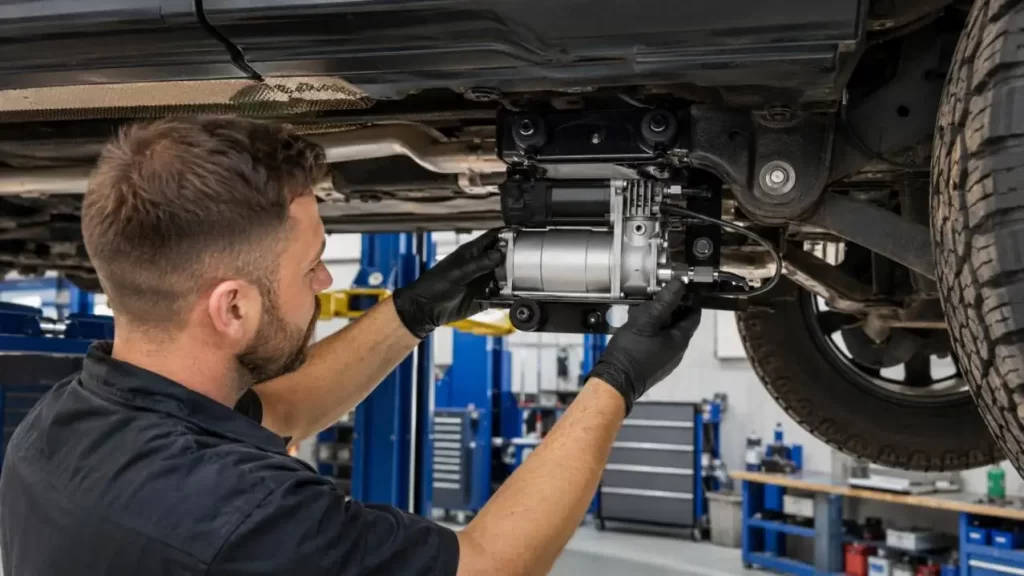
Mount the SUV Air Suspension Compressor in the specified orientation with its vibration isolators intact. Keep air lines away from exhaust heat, sharp edges and moving suspension components.
After installation, record a baseline for:
•Lift time from normal to off-road height
•Current at startup and stabilized pressure
•Pressure loss after shutdown
•Operating noise and vibration
•Thermal cutoff or stored fault codes
If recovery later becomes slower, check leaks, voltage, the intake filter and dryer before condemning the compressor.
Verify Off-Road Performance With Evidence
Depending on the target market and project, relevant verification may include ISO 20653 for enclosure protection, ISO 16750 for automotive environmental loads, ISO 7637-2 for electrical transients, CISPR 25 or UN R10 for EMC, and ISO 9227 for controlled corrosion testing.
Procurement teams should request the exact test level, operating condition, pass criteria and report traceability. An IP code, salt-spray duration or "100% tested" statement should never replace part-number-specific performance data.
For an off-road SUV Air Suspension Compressor project, send Huijie the OE number, VIN or chassis code, model year and intended duty cycle. Huijie can use this information to confirm the closest direct-fit option and clarify the available electrical, fitment and production-test data before sample approval.
FAQs
Q1. Does Huijie offer SUV Air Suspension Compressor units?
Huijie offers air suspension compressor units and other suspension components in its factory. Huijie has over 10 years of experience for multiple vehicle families.
Q2. Which SUV models are included with Huijie compressors?
Huijie has advertisements for compressors for Range Rover, Audi Q7 4L, Mercedes-Benz ML/GL, W164 and X164, and Tesla Model X. Compatibility should be verified by OE number, chassis code, model year and VIN.
Q3. How does Huijie verify compressor compatibility?
Huijie uses OE cross references, vehicle platforms and production year to identify applicable units. Buyers are required to provide the original part number, VIN and connector details to verify the unit.
Q4. Are Huijie SUV Air Suspension Compressor units tested prior to shipment?
Huijie claims each unit is tested prior to shipment. There are specific references for each SUV product page for working current and voltage tests.
Q5. Does Huijie offer direct-fit SUV compressor replacements?
Yes. The compressors for Range Rover, Audi Q7 and Mercedes-Benz ML/GL are designed to meet the original requirements for mounting, connections and systems. It is necessary to verify OE supersession prior to sample approval.


Contact Us
In This Article
- 1 Why an SUV Lifts Slowly Off Road
- 2 Pressure Creates Lift, but Flow Determines Recovery
- 3 Huijie Production References for SUV Platforms
- 4 Comparing Fast-Recovery Architectures
- 5 Sealing Requires More Than an IP Claim
- 6 System Matching Comes Before Installation
- 7 Installation and Maintenance Affect Service Life
