


Heavy Duty Air Suspension Components: Types, Functions and Applications

Heavy Duty Air Suspension Components maintain vehicle height, axle-load balance and ride control as payload changes. "Heavy duty," however, is not a universal pressure or capacity class. Selection must begin with axle load, suspension geometry, operating environment and required duty cycle.
Read Vehicle Symptoms as System Problems
A heavy vehicle that sags, leans or levels slowly does not automatically need a new air spring. Typical symptoms indicate different faults:
•One corner drops while parked: air-spring, fitting or valve-block leakage.
•Both sides sit low under load: insufficient effective spring area or incorrect ride-height calibration.
•Height recovery is slow: restricted tubing, low valve flow or weak compressor output at working pressure.
•The compressor runs frequently: leakage, insufficient reservoir capacity or unsuitable control deadband.
•Bellows wear at one edge: misalignment, rubbing or operation outside the specified height range.
Heavy Duty Air Suspension Components must therefore be diagnosed as one pneumatic and mechanical circuit. Huijie supports this approach through a product range covering air springs, compressors, valve blocks and complete suspension assemblies.
How Heavy Duty Air Suspension Components Support Load
Air-spring support can be approximated by:
F=Pg×Aeff
Where Pg is gauge pressure and Aeff is effective area. Suspension motion ratio must then be applied to determine wheel-end support.
This relationship explains why maximum pressure alone is a poor selection criterion. A larger effective area can support the same load at lower pressure, while air volume and the effective-area curve affect dynamic spring rate. Wheel-end stiffness, sprung mass and damping then determine the vehicle's natural frequency and response to road input.
Each component controls a different part of this process:
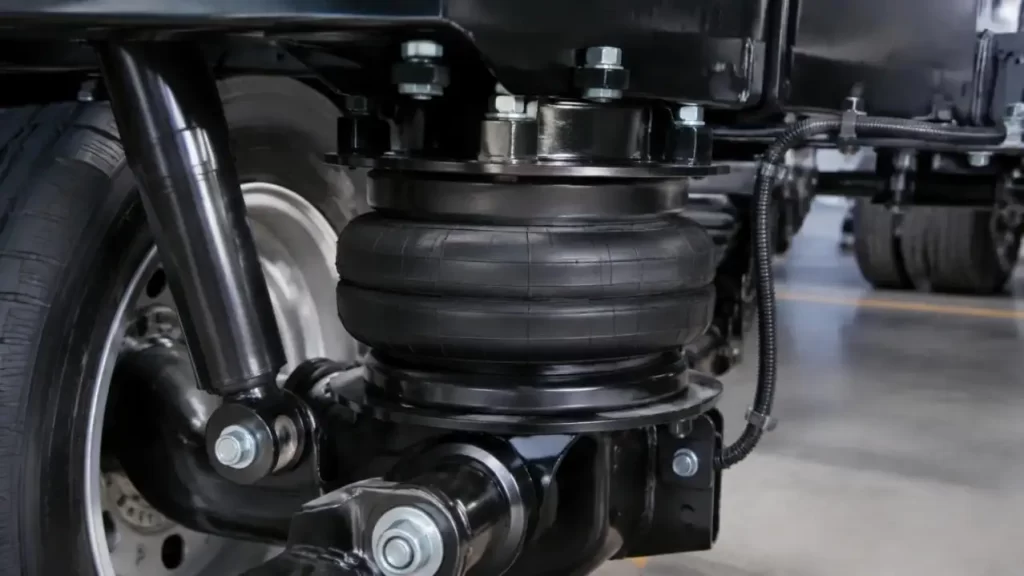
•The air spring supports static and dynamic load.
•The shock absorber controls suspension velocity; it does not carry normal static load.
•The compressor and reservoir determine available air mass and recovery capacity.
•The dryer protects internal valves and seals from moisture.
•The valve block or height-control valve meters air into and out of each circuit.
•The height sensor and ECU determine when adjustment is required.
•The pressure protection valve preserves brake-system air where supplies are shared.
Huijie's compressor places modern electric suspension systems are in a typical 10–17 bar operating context. This is an engineering reference, not a universal rating for Heavy Duty Air Suspension Components; project pressure must come from the vehicle load calculation and component-specific data.
Compare Air-Spring and Control Architectures
| Technical Solution | Engineering Advantage | Limitation | Suitable Duty |
| Rolling-lobe spring | Long usable stroke and relatively low spring rate | Requires controlled piston geometry and radial clearance | Truck drive axles, trailers and buses |
| Convoluted bellows | High force in a compact installed height | Shorter stroke and typically higher stiffness | Lift axles and compact heavy-load positions |
| Sleeve spring | Compact and lightweight | Usually unsuitable for primary heavy axle support | Cab and seat suspension |
| Mechanical HCV | Simple, robust and serviceable | Limited control functions and diagnostics | Conventional trucks and trailers |
| ECAS | Precise leveling, kneeling and lift-axle logic | Requires sensors, ECU calibration and EMC validation | Buses and electronically controlled fleets |
These options cannot be reduced to "better comfort." Rolling-lobe and convoluted designs produce different load–height curves, while mechanical and electronic control systems create different failure modes and maintenance requirements.
Match the Entire Pneumatic Circuit
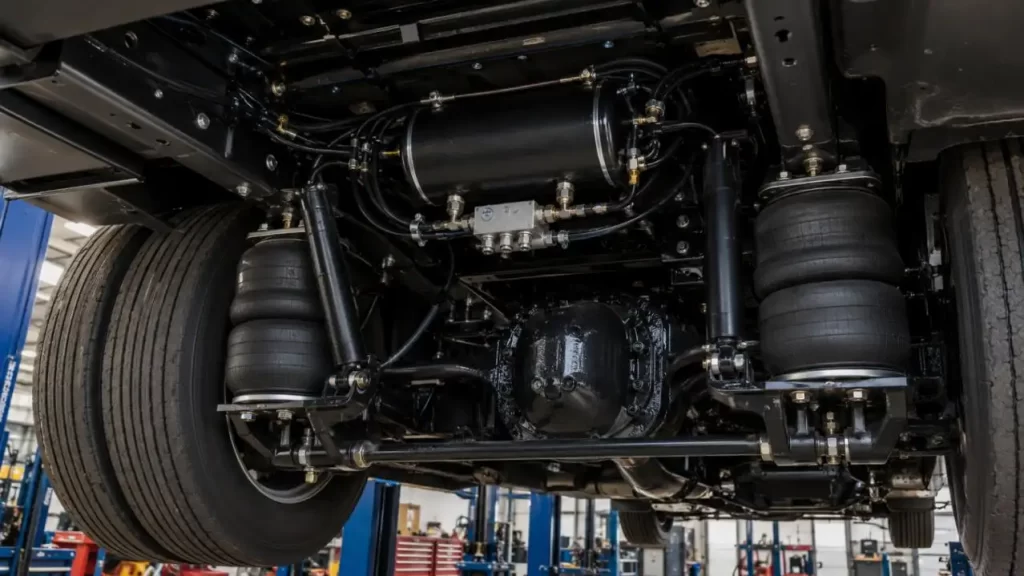
Heavy Duty Air Suspension Components should be specified together rather than by isolated catalog ratings.
| Subsystem | Critical Matching Data | Consequence of Mismatch |
| Air spring | Load per spring, design height, travel, effective-area curve | Excess pressure, rubbing, overextension or unstable ride |
| Compressor and reservoir | Flow at discharge pressure, duty cycle, tank volume | Slow leveling, overheating and repeated thermal shutdown |
| Valve block and tubing | Flow coefficient, port diameter, pressure loss, leakage | Delayed response or uneven left/right height |
| Damper | Force–velocity curve, stroke and thermal capacity | Oscillation, harsh rebound or premature mount wear |
| Electronic control | Sensor range, voltage, fault logic and communication | Incorrect height, warning codes or uncontrolled adjustment |
Huijie's valve-block range illustrates why interfaces must be checked precisely. The catalog includes configurations such as 2-Φ4 + 1-Φ6, 2-Φ4 + 2-Φ6, 5-Φ4 + 2-Φ6 and 6-Φ6. Port count and diameter determine circuit compatibility, but heavy-duty buyers should additionally request flow, internal-leakage and pressure-resistance results.
Application also dictates the priorities:
•Drive Axles: Traction, Torque Reaction and Roll Control
•Steer Axles: Ride-Height and Steering Geometry
•Trailers: Axle-Load Equalization and Lift and Dump
•Buses: Kneeling Speed, Passenger Comfort and Body-Roll
•Off Highways: Articulation, Contamination and Shock Loading
Huijie's Production Capacity in Procurement Perspective
Some aspects of Huijie's manufacturing capacity are of interest to buyers evaluating Heavy Duty Air Suspension Components
| Huijie Capacity | Procurement Relevance |
| 10,000 m² R&D and production base | Integrated development, manufacturing and inspection |
| 80+ R&D personnel | Fitment development and product adaptation |
| 100+ new products developed annually | Expanding platforms and OE references |
| 2,000+ air suspension products/SKUs | Simplification of multi-platform sourcing |
| 15+ years of air suspension manufacturing | Application and aftermarket experience |
| 100% pre-shipment product testing | Adds inspection at batch level |
Installation and Maintenance Control Service Life
Correct installation is part of the engineering specification. Workshops should:
- Set ride height before tightening suspension linkages.
- Check bellows clearance at full jounce and rebound.
- Verify shock stroke and mechanical stops.
- Route tubing away from heat, abrasion and sharp bends.
- Calibrate height sensors after installation.
- Leak-test springs, fittings, reservoirs and valves before judging compressor condition.
- Use filtration and pressure protection where suspension and braking share compressed air.
Validate Data, Standards and Supplier Claims
Reliable Heavy Duty Air Suspension Components require more than a maximum-pressure figure. Qualification should include load–height–pressure curves, proof and burst testing, temperature-conditioned fatigue testing, defined leakage limits, compressor flow curves and damper force–velocity data.
ISO 23365 supports heavy-vehicle suspension characteristic definitions. ISO 16750, ISO 7637-2, SAE J1455 and UN R10 may apply to electronic controls. UN R13 and FMVSS 121 become relevant when suspension air supply interacts with braking, but they are not general air-spring certifications. Likewise, ISO 9001 and IATF 16949 evaluate quality systems rather than proving individual component durability.
For a quote-ready evaluation, provide Huijie with axle load, design height, suspension travel, mounting envelope, pneumatic schematic and environmental conditions. Huijie can then review fitment and return the relevant Heavy Duty Air Suspension Components, technical documentation and project-specific validation requirements through its air suspension product center.
FAQs
Q1. What Heavy Duty Air Suspension Components does Huijie supply?
Huijie supplies air springs, suspension compressors, valve blocks, air struts and complete suspension assemblies. Customers should identify the corresponding truck, bus or trailer application prior to making a purchase.
Q2. Can Huijie select components according to axle load?
Yes. Huijie requires the axle rating, load per air spring, design ride height, suspension travel, dimensions, and operating pressure to make a selection.
Q3. Does Huijie manufacture custom Heavy Duty Air Suspension Components?
Product development and adaptation to new vehicles is supported by Huijie, however, this will require a sample, drawing, pneumatic schematics or complete vehicle data.
Q4. What manufacturing capacity does Huijie have?
Huijie has a 10,000 m² R&D and production base, over 80 R&D personnel and over 2,000 air suspension products. The company develops over 100 new products a year.
Q5. How does Huijie test its air suspension products?
Every product is inspected by the quality control team before shipping. For heavy-duty applications, buyers should ask for the actual leakage, pressure and fatigue tests, endurance tests and dimensional tests.


