


Commercial Vehicle Air Spring: Choosing the Right Suspension for Real Operating Conditions

A commercial vehicles air spring shows its worth when they're doing everyday tasks — such as backing onto a loading dock, lowering the bus for passengers, or unloading a trailer, carrying a different load this time than an earlier morning.
The right product needs to comply with the axle, suspension geometry, operating height, vehicle duty, the ambient temperature and control system.
That said, The Same Component (TPC) Now Serves Different Vehicles (DV) Differently
Air springs are utilized on lift axles, cabs, lift trucks, trailers, buses and in some off-the-road vehicles. Their fundamental place is the same, but the priorities on operating are different.
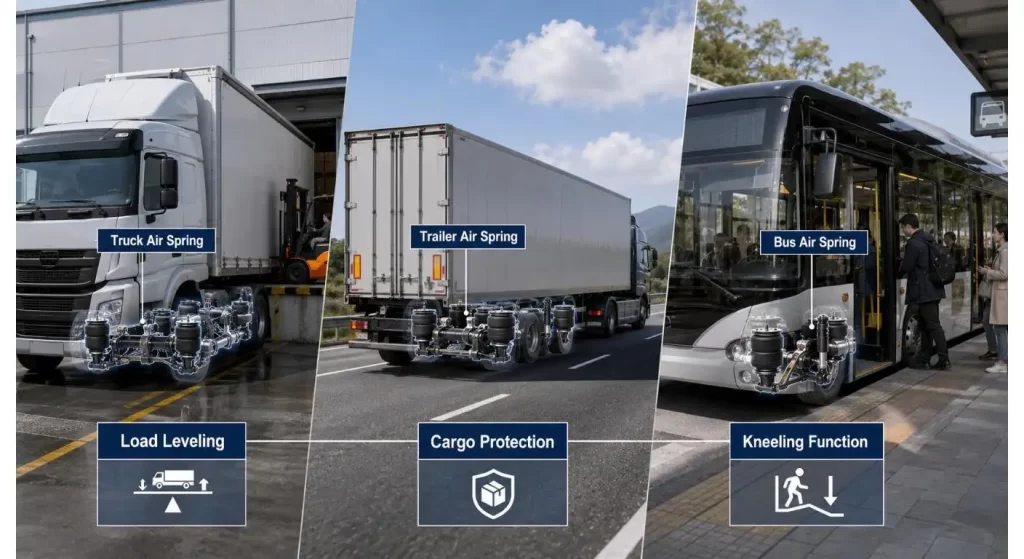
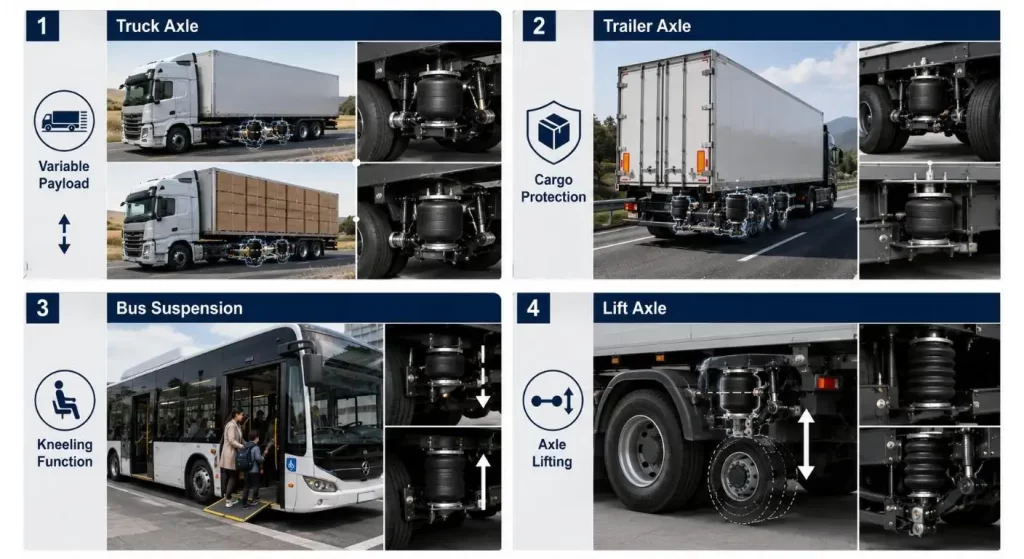
A truck air spring has to experience quite large changes in the operating range between “empty” and “loaded” conditions. The main objectives of a trailer suspension are to safeguard the load, and to control and monitor the axle loads. As seats fill or empty a bus must be stable on its wheels equipment-wise and it can be fitted with a kneeling system that makes it easier for the passengers to get on and off.
However, Continental notes, truck air suspension with level control can hold the chassis and road deck at constant level or dimensions as loads of differing ammounts will vary. It can be used in its bus systems to enable low natural-frequency suspension behaviour; in the vehicle, its trailers can feature air springs which allow for protection to the payload and trailer structure.
The correct commercial vehicle air spring then starts not when it comes to size, but rather the task the vehicle is assigned with.
Variations in elevation are very real
Where a loaded truck does not tilt, there is the added good thing that it looks right.
Keeping the desired ride height will help to keep the suspension closer to its Designed Geometries. It can provide for predictable road clearance and driveline angles, shock-absorber travel, axle alignment and loading-dock heights.
ZF's traditional air-suspension system for trailers senses the gap between the chassis and axle and controls air into or out of the system to keep the proper vehicle height. It can also lower or raise the chassis to cater for varying loads.
When the ride height is not right, the air spring could be compressed or extended. This reduces the available travel time in the suspension, increases the strain on other parts of the suspension, and/or decreases its ability to absorb impacts from the roadway.
No single sensor or actuator is doing it all when it comes to controlling the chassis motion
The weight is supported by an air spring and the springing medium is the air spring – it does not supplant the full suspension.
Repeated movements in the vertical direction are governed by shock absorbers. Axle is guided by links and torque rods. Controlled damping, or anti-roll devices to control body roll. Air pressure and chassis position are controlled by height-control valves or electronically-controlled air-suspension systems.
With electronics-controlled air suspension, ZF can fine-tune the body height of its vehicles and can also make use of auxillary suspension components to achieve improved handling. It has controlled damping system to limit over-pitching and over-polling behaviour, as well as contribute to vehicle stability and comfort.
If the commercial vehicle feels a bit off-center while performing this task, then replacing the air spring without checking the dampers, bushings, axle links, sensors and control valves might not solve the issue.
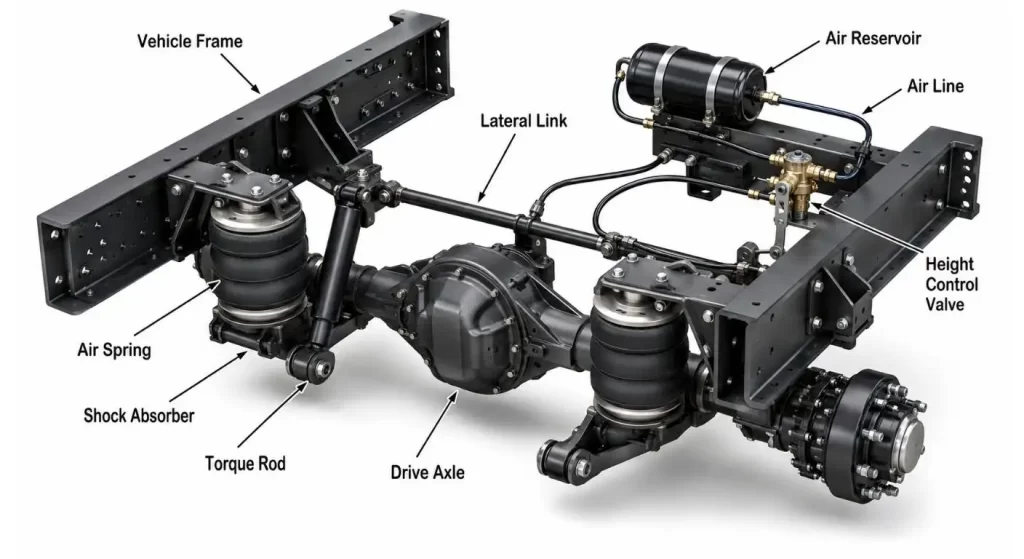
Using the opening, apply the Air Spring to the Axle Application
Reversible sleeves, convoluted bellows, use of different pistons, internal bumpers, bead plates, or inbuilt damper systems are some different approaches to commercial air springs.
These designs cannot just be switched out as it were because even if two parts have the same diameter, they do not fit together.
For specific applications Continental offers different configurations including sleeve-type axle springs, convoluted lift-axle springs, integrated heat-protected air-spring damper modules and designs with integrated heat-protection for twin-roof installations.
| Selection Factor | Why It Matters | What to Confirm |
| Vehicle type | Trucks, buses and trailers have different duties | Exact application |
| Axle position | Steering, drive, trailer and lift axles differ | Installation location |
| Suspension model | Determines geometry and movement | Suspension identification |
| Design height | Keeps the air spring within working range | Approved ride height |
| Stroke | Prevents overextension or bottoming | Compressed and extended height |
| Piston design | Affects fit and spring behaviour | Original configuration |
| Mounting system | Ensures correct installation | Studs, plates and air inlet |
| Duty cycle | Reflects road, loading and operating conditions | Vehicle usage profile |
| Heat and clearance | Prevents local rubber damage | Nearby components |
| Control system | Regulates height and pressure | Mechanical or electronic control |
The load support being used must not exceed the limits of the vehicle being loaded
Air suspension will even out the load if it is loaded and unloaded, but does not allow it to exceed approved loads.
Axle, tires, brakes, wheel bearings, chassis and suspension links are still key components in their ability to traverse the road and legally and safely transport the desired load.
The vehicle can still be overloaded and the driver will not be able to see it if the vehicle is level. Information on axle weights should be used, not only for load condition but also on the vehicles' ratings provided by the manufacturer.
The load distribution is also required in multi-axle vehicles, and requires the suspension and control system to do so. Even if the vehicle is well balanced, incorrect settings, used mixed air springs, faulty leveling valves or clogged air lines can cause air loading problems.
If you are driving to an area, remember the following:
Air springs are subjected to various environments in a long-haul tractor, refuse truck, intercity coach, city bus, refrigerated trailer and construction vehicle.
Many hours of stable, long distance road speed are spent by long distance vehicles. The braking, cornering, kneeling and boarding and alighting behaviours of urban buses are frequent. It is very common that the construction vehicles experience mud, stones, articulation and heavy suspension movement.
A commercial trailer air suspension can help minimize load variations on wheels and guard the mounted equipment, cargo and body from the effects of rough terrain road travel.
The following points should be specified in the sourcing specification: real duty cycle, which means the quality of the road to be used, the annual mileage, the temperature range, average load, loading frequency and exposure to potential contaminants.
The design can also be affected by heat or by installation space
The space in commercial vehicle chasm is cramped. They can be located near an exhaust system, brake components, battery pack, frame bracket, tire, cable harness or pneumatic line.
Continental manufactures bus air springs for use in a compact environment and in applications that are subjected to hot conditions and exhaust-treatment systems and share space with engines.
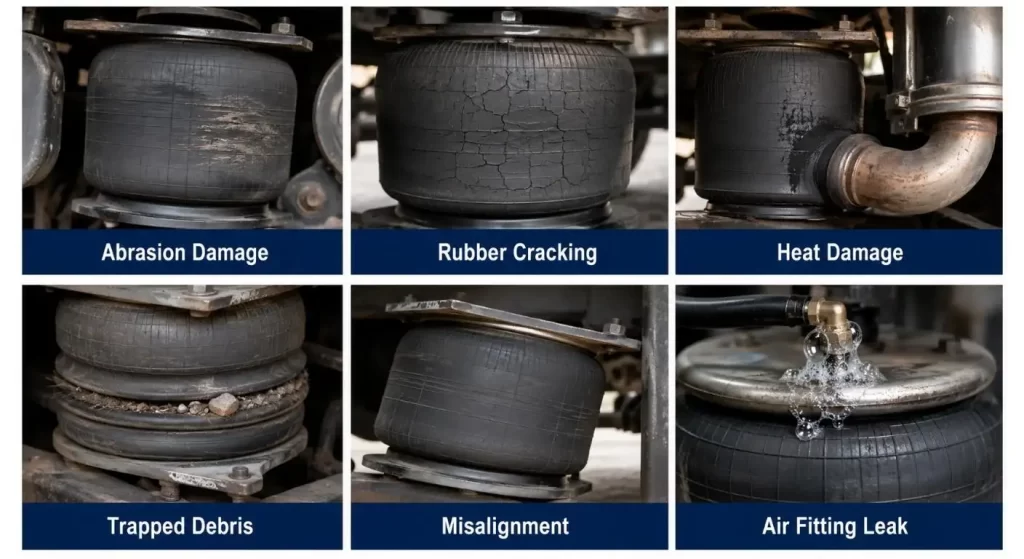
The chosen air spring should have ample clearance during all movement of the axle. Bellows should not come in contact with brackets, hoses, wiring or debris. If necessary, appropriate heat shields need to be properly placed.
This is especially critical where the original product is replaced with a product with a different shape of piston and/or bellows. The slightest mismatch of dimensions can develop into big problem when going through a suspension's articulation or compression.
The rise of EV packaging is causing strain for businesses
Battery electric trucks and buses tend to mount large battery packs either in the chassis or on the roof of the trucks or buses. This alters vehicle dynamics, installation space and weight distribution.
ZF says its air-suspension solutions are available for both internal combustion- and battery-electric-powered truck platforms, from which drive and travel geometry variations can be picked to suit various applications. In addition its sterter will provide stability issues that arise when the batteries are mounted on the roof of a vehicle.
When selecting air-springs for these type of vehicles, it is necessary to take into account their load, battery location, damping control, roll response and packaging with the chassis, instead of making air-spring decisions in isolation.
Keep your fingers off your tires until you've read up on Fleet Wear Patterns
The condition of the suspension of a commercial vehicle can be determined by a commercial vehicle air spring.
One side of the component might have a smutty patch, which would suggest contact with the other side. Damage at the fold could be caused by use, mis-line, over-lay or aging. When it gets hot, local hardening is a sign of heat exposure. If there is uneven wear between the two axles it could be due to different ride heights or operating loads.
If multiple vehicles indicate the same issue, fleet should take into account the installation environment versus each being a separate component failure.
It is much easier to spot patterns in failed components if these failures are consistently recorded.
Restore parts should be replaced as a form of suspension set and not isolated
Before installation a new air spring should be compared to the air spring that has been removed. Ensure the height/piston, mounting points, air inlet, clearance and internal bumper are in check.
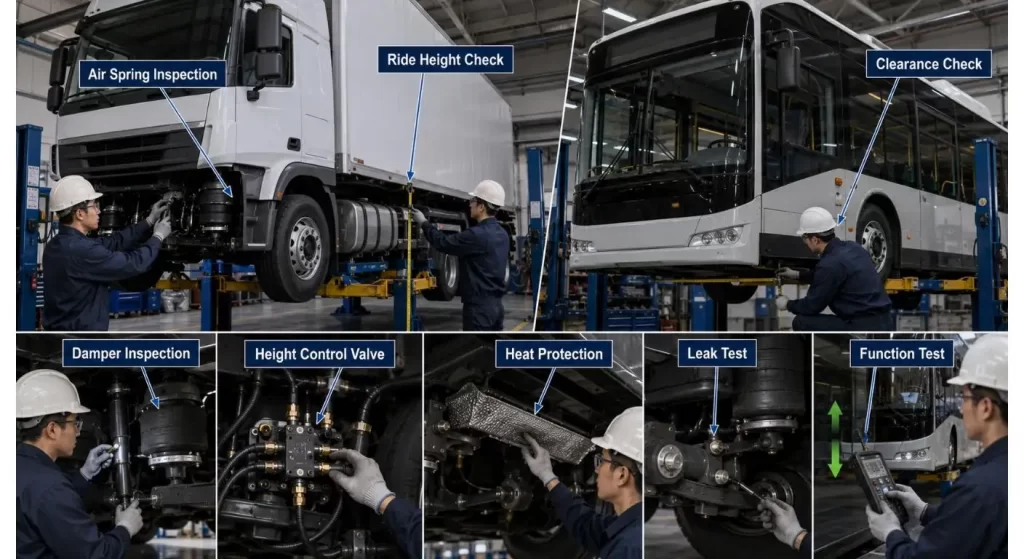
The opposite side of the air spring, shock absorber, height control system, brackets, airlines and fasteners as well as axle links should also be checked by the technician.
When multiple distinct air-spring designs are used on a single axle, this can result in noticeable differences in stiffness, load sharing, air spring travel and height. When ageing and mileage is comparable, axle pairs can be replaced, however it is recommended to consult the suspension manufacturer when making the service decision.
Validate the Vehicle after installation
When the new air spring hold up the air pressure in the workshop, it doesn't mean the repair was completed.
The car needs to be brought back to the normal ride height and tested in normal operating conditions. Check that the chassis levels properly, that the bag stays aligned, the suspension clearance is proper and no airlines are extended or trapped.
Test and verify the operation of all air suspension systems, kneeling, raising, lowering and automatic air suspension return to ride height of buses and vehicles equipped with ECS (Electronic Control Systems) air suspension. ZF believes that air spring control, automatic ride-height return and controlled chassis adjustment are fundamental air-suspension applications in the commercial vehicle industry.
Sometimes problems such as noise, movement, pull, or instability of the body cannot be seen during a visual inspection, and can only be detected in a short road test.
Conclusion
Air spring for a commercial vehicle is not just rubber! It is a carriage which supports the load and is used in an integrated chassis system.
The "best", one of the most important considerations, is the best choice in line with the vehicle application, the axle configuration, the design height, available travel, temperature environment, the control system, and also the real transport duty.
Durability is increased for fleets by issuing air springs as part of the entire suspension; by documenting failure patterns; and by replacing air springs based on engineering area fit and not appearance.
FAQs
Q1. Commercial Vehicle Air Spring - What?
It is an reinforced pneumatic spring to support chassis of trucks, trailers, buses, job sites cabs and others commercial vehicles.
Q2. What are the Primary advantages of Air Springs?
They can keep the ride level when loading or unloading, enhance ride comfort, provide protection of the cargo and assist in the raising and lowering or kneeling of the vehicle.
Q3. Could "One Air Spring" be used for a variety of commercial vehicles?
When it is as appropriate as regards dimensions, mounting, load characteristics, stroke, piston, and operating requirements for the particular suspension application.
Q4. Why correct seat height is important?
Proper height will maintain the air spring's working range and help to distribute the load correctly.
Q5. When Should Commercial Vehicle Air Springs Be Replaced?
Change them if they leak, crack, rub, deform, become heat damaged or don't keep the required height of the vehicle.


Contact Us
In This Article
- 1 That said, The Same Component (TPC) Now Serves Different Vehicles (DV) Differently
- 2 Variations in elevation are very real
- 3 No single sensor or actuator is doing it all when it comes to controlling the chassis motion
- 4 Using the opening, apply the Air Spring to the Axle Application
- 5 The load support being used must not exceed the limits of the vehicle being loaded
- 6 If you are driving to an area, remember the following:
- 7 The design can also be affected by heat or by installation space
- 8 The rise of EV packaging is causing strain for businesses
- 9 Keep your fingers off your tires until you've read up on Fleet Wear Patterns
- 10 Restore parts should be replaced as a form of suspension set and not isolated
- 11 Validate the Vehicle after installation
- 12 Conclusion
- 13 FAQs
