


Vehicle Air Suspension Spring: How to Restore the Ride, Not Just the Height

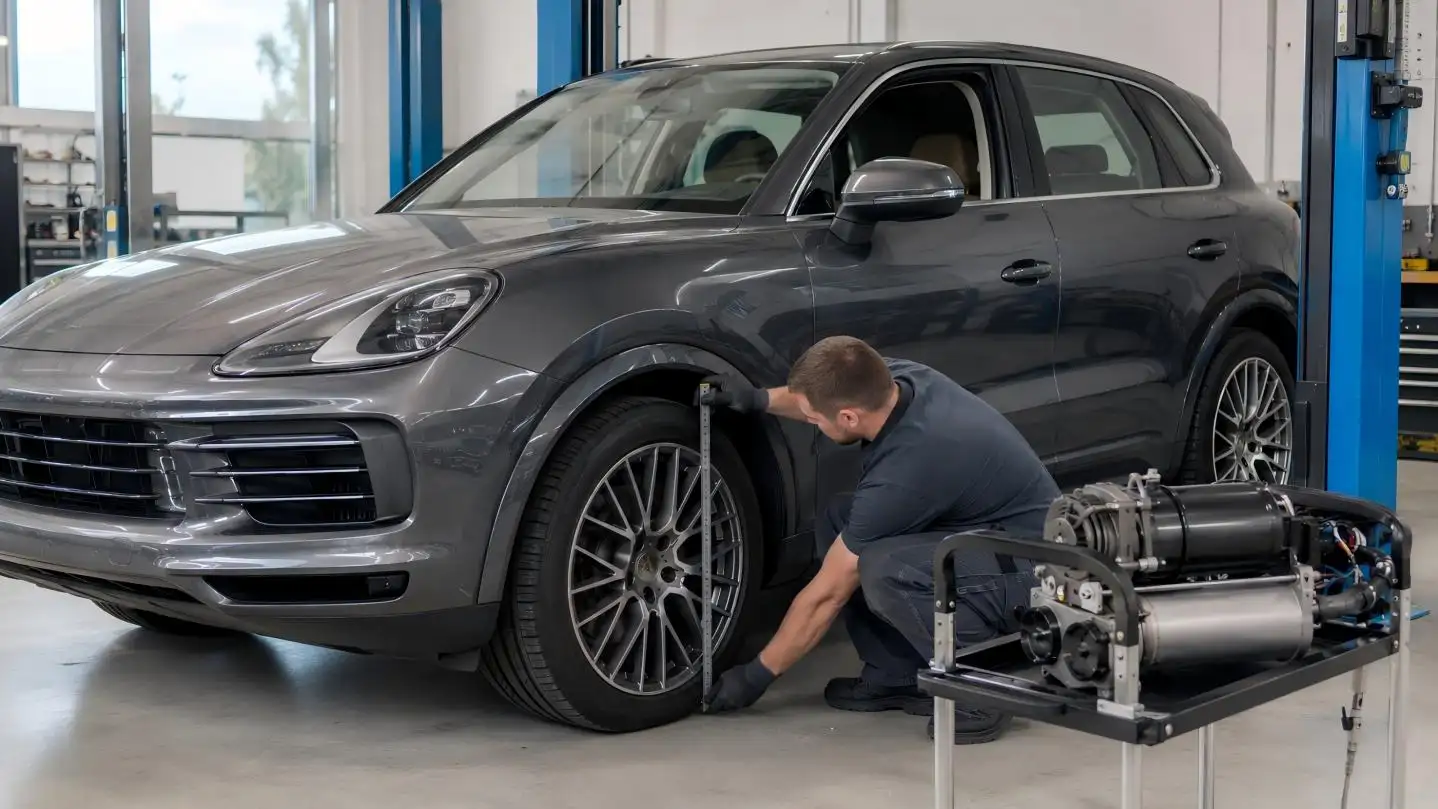
In an air suspension spring system, typically one corner of the vehicle will be lower after the car is left in the garage. Sometimes, that's the right diagnosis. The problem is not necessarily a broken hoses, but sometimes it is leaking airline, leaky compressor, leaky valve block, or leaky height sensor.
This is why it is best to replace the obviously worn out air spring without test fitting the rest of the system to avoid a costly second repair.

If you are replacing a car, and SUV, the reason for replacing it is not just to raise the body back up! A properly designed vehicle air suspension spring should also aid in restoring the original ride height, suspension motion, comfort and handling balance.
When creating a complaint, begin with the problem the driver actually sees
Air suspension problems don't necessarily happen as a total collapse. Often grow slowly.
| Vehicle Symptom | Possible Cause | Recommended Check |
| One corner sinks overnight | Air spring or local connection leak | Measure height and perform leak test |
| Entire axle sits low | Valve block or shared air-supply fault | Check pressure distribution |
| Vehicle rises slowly | Compressor, dryer or major leakage | Test pressure-building time |
| Compressor runs frequently | Small continuous system leak | Inspect springs, lines and fittings |
| Ride feels too firm | Incorrect height or damper problem | Check ride height and damping |
| Vehicle leans in corners | Uneven spring or damper performance | Compare both sides of the axle |
| Suspension warning appears | Sensor, electrical or pressure fault | Perform system diagnostics |
| Height remains incorrect after repair | Calibration or installation issue | Measure and recalibrate |
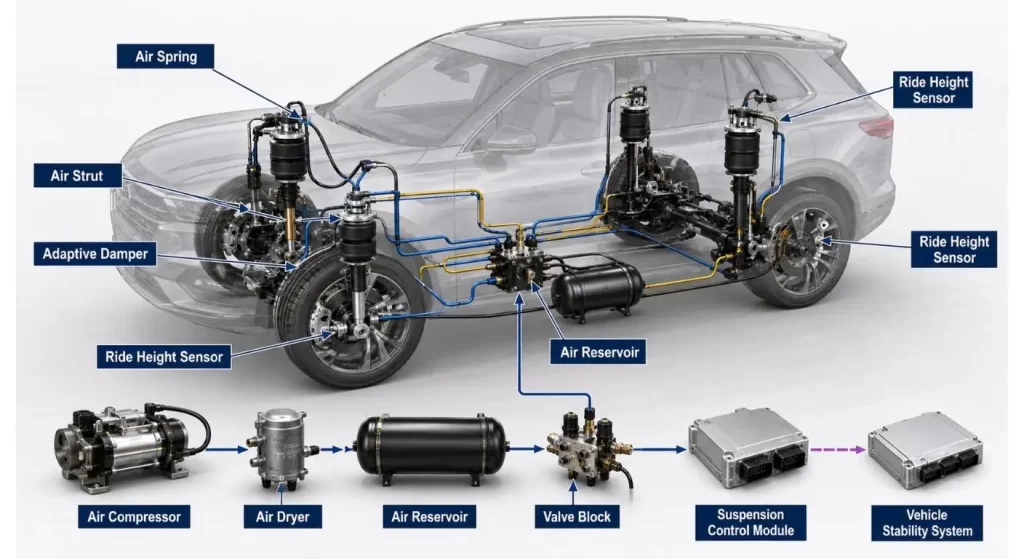
Modern air suspension is a system of combined mechanical, pneumatic, electrical and software. Passenger-car systems can feature air springs or air struts, a compressor and dryer, air lines, ride-height sensors, and communication with other car systems via valves and a suspension control module, says ZF.
So the warning light is really a starting point in diagnosis rather than an indicator of failure of one component.
Be able to determine if the vehicle is equipped with an Air Spring or Air Strut
The words may be interchangeable and the components can vary.
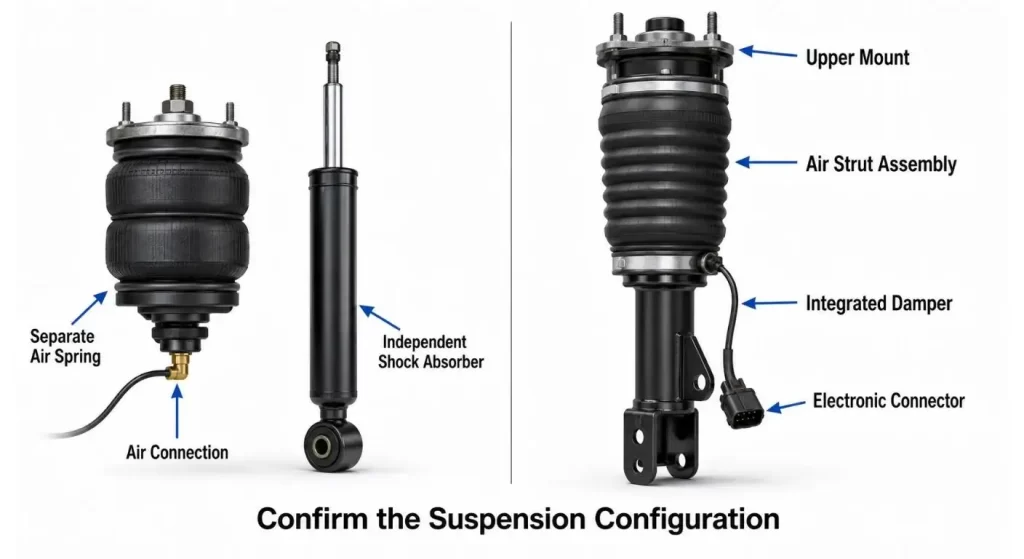
The vehicle is suspended from a separate spring (air suspension) with a shock absorber near by regulating movement. An air strut is a combination of the pneumatic spring and damper.
This is important if ordering parts. One application can only be the flexible air spring, another application may be the complete strut with damper, air connection, mounting hardware and electronic components.
According to ZF, an air strut is a combination of an air spring and a shock absorber in one part. Electronically controlled versions can vary damping as a function of vehicle motion, road and load.
Before ordering a replacement, check the axle number, side number, suspension code, production date, type of connector and if the spring and damper are combined or separate.
The ride height forms a part of the vehicle's dynamic setup
Ride height does not just impact how it looks, it impacts the ride as well.
Air suspension systems can provide a more even body height with additional loads, like passengers or luggage. Other vehicles may also raise their body for rough roads or adjust to lower their body for high speed travel. ZF recognizes the following as typical air-suspension operations used in the passenger-car industry: constant load-independent height, increased off-road clearance and high-speed lowering.
If one corner is too low, the car may not start in the desired suspension parameter. The amount of compression/extension may vary, and the control system may attempt to correct a condition that it can't correct.
When installing a replacement spring, it should be installed to the correct operating height and NOT to an "approximate" look.
The Air Spring and Damper need to be coupled together
The body is supported by an air spring which absorbs the road input, but it cannot control all the movements.
The damper helps diminish the bouncing following a compression. When using suspension springs and shock absorbers, ZF says they are designed to provide the vehicle with support, keep the tires on the road and to control the movement of body and axle as the road and load conditions vary.
Leaky air spring will cause the suspension to function out of position. Meanwhile, a worn damper can be allowing excessive bouncing, pitching when braking and/or body movement when cornering even after the spring has been replaced.
If the ride remains unstable after the air-spring repair, check the damper, upper mount, bushings, links, tires and alignment—not the air-spring.
Maintain the Original Driving Behaviour!
Two replacement air springs can be mounted in the same location, but have different bellows geometry, rubber construction, internal volume, piston shape, and/or pressure response.
The differences can affect the suspension's body carrying capabilities during its working travel.
When replacing passenger-car air springs, BILSTEIN has the highest priority on retaining the original driving behaviour of the vehicle, rather than choosing a part that fits.
There are a number of useful fitment checks such as:
- Vehicle identification number
- Year/Model:
- Before or after the wheels.In front or back of the wheels.
- Left or right side. Left or right side (see below).
- Suspension or option code:
- Original part number
- Air connection design
- Separate or complete strut
- For electronic connector (where fitted), see the table above.
Before dismantling the vehicle, it is important to check the compatibility of the catalog.
Correctly diagnose the static leakage problem.
If it gets stuck in the water when it's parked, it could have a slow leak that you are not able to hear.
Start off by measuring the height at each of the four corners on a flat surface. Leave the car for a suitable amount of time, and then measure it again under similar conditions.
Then check the folds in the air spring, air connector, airline, valve block and other joints. A leak-detection system that is appropriate can identify bubbles at small leak sites.
Suspension position can have to be altered during the test since any cracks within a folded bellows may only open at a particular height.
If the obvious leaking part is replaced without further investigation of the calibration, compressor stress, sensor information or control logic, ZF cautions, the air-suspension fault will be repeated.
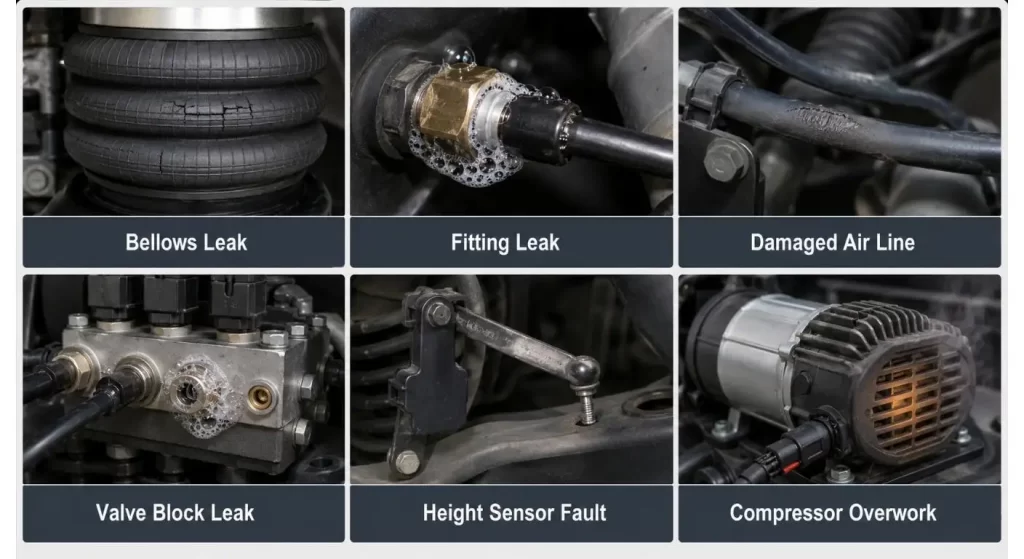
Don't overlook the compressor's running history!
The compressor can run much more than desired if there is a small leak.
The car may lift up for weeks again, but this time the compressor will have to work for longer to replace the air that is leaking out. Eventually, the driver will suffer the effects of a leaking spring and an overheated/wear down air-supply unit.
Prior to installing the replacement, note if the compressor runs too quickly or if the compressor takes too long to lift the vehicle, or if it makes unusual noises. Check the pressure building, electrical supply, intake, dryer and relay.
Damage to the compressor due to leakage for months will not be fixed with a new vehicle air suspension spring.
The symptom can change when the temperature changes
The flexibility of rubber and the air pressure of the rubber tire are dependent on temperature. A leak can be more noticeable on a cold morning, and a level car in a warm workshop can sink out in the cold.
Check for hardening, surface cracking, rubbing, contamination and damage at the fold of the bellows. Additionally inspect the exhaust heat or nearby parts that could be worn-out more on one side than another.
A diagnosis should be made from a series of measurements and from physical evidence, never from one cold start observation.
Think about the condition of the other side
The mileage, weather and suspension movement are generally the same among air springs on the same axle.
If one side cracks with ageing, the other side might not be too far behind. A replacement of both sides can help to minimize the chances of needing a second replacement and the likelihood of having variable axle behavior.
But, the automatic pair replacement is not always required. The damaged spring may be on only one side, it may have been installed recently and can still be used or the other side of the spring might have been damaged.
The good thing about taking the sensible action is that it involves comparing the age of the vehicle, condition, part design, vehicle mileage and cause of failure.
When installing, safeguard the new spring from damage
A replacement air spring can be faulty even before hitched up to vehicle.
The suspension should be adequately supported based on the repair procedure that is specific to the vehicle. Before applying normal load, the new component has to be positioned in the proper manner.
Avoid universal installation practices, where the manufacturer recommends a certain inflation, tightening, and/or ride-height sequence.
The final step in the repair is the calibration
A diagnostic fault clearing, function test and ride-height calibration of the control module may be required after replacement.
Recalibration isn't necessary following all air-suspension repairs, Arnott says, but believes it's best practice to recalibrate height sensors.
The calibration requirements are different for different vehicles. Automatic learning, and diagnostic equipment with designated body-height measurements are used in some systems.
During the workshop, it should be verified that the car's normal level is reached, it can react appropriately to the different available suspension modes and it does not continue to run the compressor needlessly.
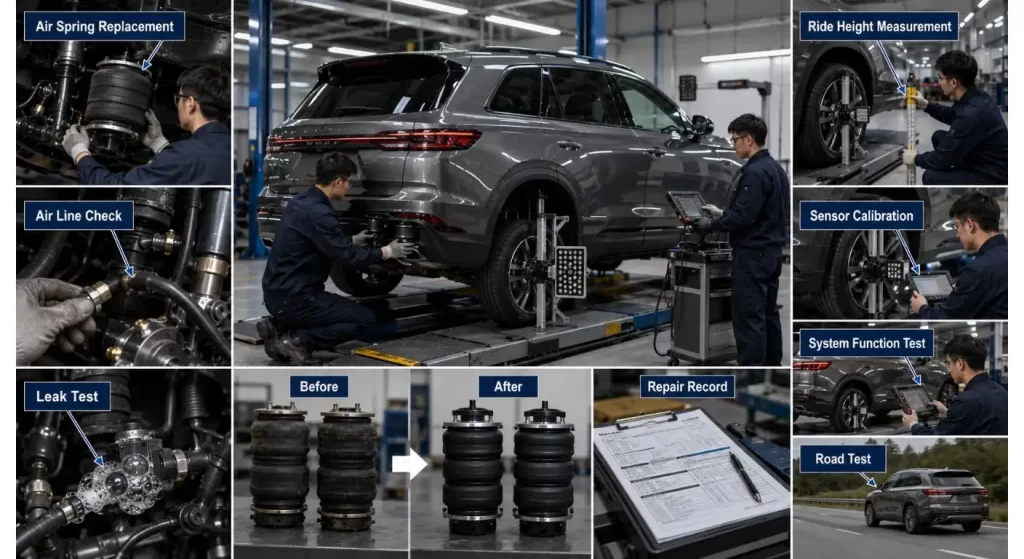
Complete the Workshop with a Road Test rather than a Photo!
Don't assume that a vehicle is level when on a lifting device is a sign the repair is finished.
In the road test, be conscious of:
- Repeated body movements over bumps.
- Steering response
- Pitching under braking
- Rear squat while accelerating
- It is important to keep in mind that there will be noise coming from the repaired corner.
- Suspension warning messages
- The response to height/Drive mode selections are explained.The explanation of Response to height/Drive mode selections.
Re-check the ride height and check for leaks after the road test. A minor installation issue is one that is easier to remedy now than a few days later when the customer comes back.
Conclusion
A vehicle air suspension spring should be chosen and repaired in the whole vehicle suspension system.
The correct replacement should be compatible with the vehicle, axle, suspension configuration, connection design and be of the original dynamic behaviour. The workshop should also be needed to determine the cause of the failure of the old spring, to determine the stress on the compressor and inspect the damper and opposite side, and to perform any necessary calibration.
It's easy to see that the body height has been restored. It's not a successful repair if the vehicle is not being operated as it should.
FAQs
Q1. Vehicle Air Spring Working Principle?
It is a flexible, pneumatically activated spring which acts as a support to the vehicle's body and keeps the ride height.
Q2. What's the differences between an Air Spring vs. Air Strut?
The pneumatic spring component is referred to as an 'air spring. An air strut is an assembly that integrates the air spring and shock absorber.
Q3. Why Does My Car Go Flatter?
These can be caused by a leaking air spring, connector, airline, valve block or other problems with the pneumatic system.
Q4. Do replace Vehicle Air Springs in Pairs?
If the other component of the pair is aging and wearing at a comparable rate, then it may be reasonable to replace both parts, but if they are failing for different reasons, then it may not be advisable.
Q5. When an Air Spring is replaced, does it need to be calibrated?
There is a group that needs a ride-height calibration/diagnostic procedure and a group that doesn't. Please use the cost specific instructions for the problem.


Contact Us
In This Article
- 1 When creating a complaint, begin with the problem the driver actually sees
- 2 Be able to determine if the vehicle is equipped with an Air Spring or Air Strut
- 3 The ride height forms a part of the vehicle's dynamic setup
- 4 The Air Spring and Damper need to be coupled together
- 5 Maintain the Original Driving Behaviour!
- 6 Correctly diagnose the static leakage problem.
- 7 Don't overlook the compressor's running history!
- 8 The symptom can change when the temperature changes
- 9 Think about the condition of the other side
- 10 When installing, safeguard the new spring from damage
- 11 The final step in the repair is the calibration
- 12 Complete the Workshop with a Road Test rather than a Photo!
- 13 Conclusion
- 14 FAQs
