


Air Suspension Valve Block Manufacturer: What Defines Reliable Production?

It's not hard to miss that a valve block is necessary with air suspension. It is small, and not usually visible behind the cover and is not as visible as an air spring or compressor.
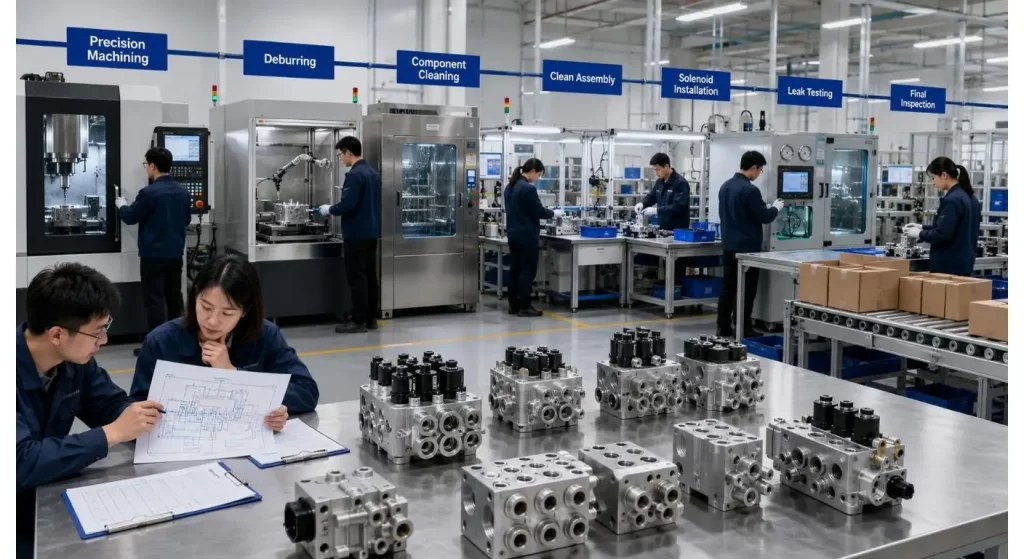
But the important question for buyers is, can a factory machine an aluminium block? It's about the ability of the manufacturer to consistently control air routing, sealing, cleanliness, electrical response and traceability at production volume.
The first step is to start with the Pneumatic Function
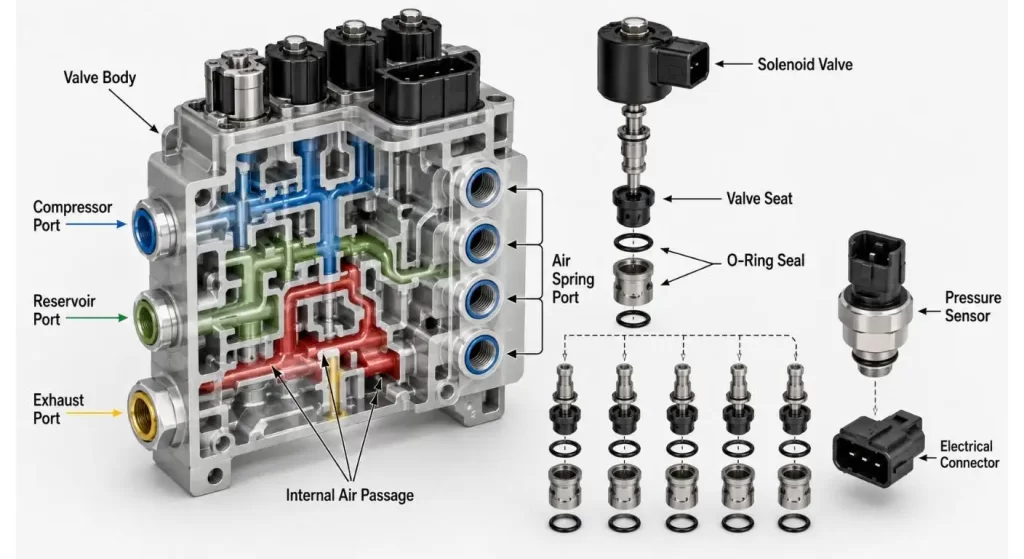
The valve block takes the high pressure air and sends it to the compressor, the reservoir, the air springs and the exhaust line as directed by the suspension controller.
The pneumatic, electrical, mechanical and software functions are integrated in modern passenger car air suspension. ZF refers to the air lines, valves, ride-height sensors, the compressor, air springs and the control module as being part of a coordinated system. When one part of a system fails, it may manifest itself in other parts of the system.
An air suspension valve block manufacturer must first know about the following:
- The vehicle has 360 degrees of freedom.The vehicle has 4 corners, each of which is connected to a port.
- If a system has a reservoir, whether it is active or passive. Whether the system is active or passive.
- The normal and maximum operating pressure are shown.Normal and maximum operating pressure is indicated.
- A valve which can either be normally open or normally closed, depending on the logic defined.
- The exhaust and pressure-release behaviour varies.Exhaust and pressure-release behaviour varies.
- The requirement for a response to be filled and lowered.Empty requirement and required to be lowered.
- Conducts an electrical connection and control signals.
- When the power is removed, the Fail-safe behaviour takes place.
This functional map is important, if not, the part could fit physically but not function.
They should not be limited to being true to size
The performance of the valve block relies on manifold drilled passages, sealing bores, valve seats, cross-holes, threads and intersecting channels within the valve block.
One dimensional report may be correct, but the inner housing has a burr that is causing an obstruction in the flow or it is damaging the seal. Also, cross-drilling may create chips that go into a passage that is hard to see, with no way to get them out.
Cleanliness is a functional requirement
It can be caused by a small metal particle which can remain lodged in a valve block and will not permit the valve to close. It can also perforate a seal or block an air-suspension part, or pass into another part of the air-suspension system.
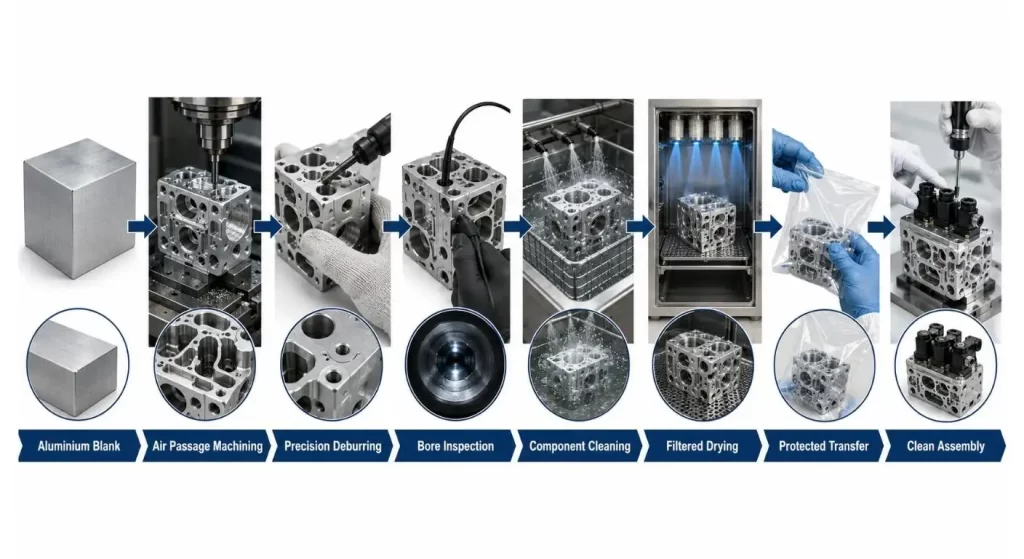
ISO 16232 gives guidance on determining and documenting the presence of particulates on automotive components that are designed for specific functions. It is applicable to incoming and outgoing inspection and monitoring of manufacturing processes like cleaning, surface treatment, assembly processes etc. There is no set cleanliness limit for the standard, the acceptable level should depend on the component and its application.
This is not only a final air blow, but what a serious manufacturer wants.
controlled deburring, validated washing, filtered drying, clean assembly areas, caps on ports, contamination-resistant packaging and other features may be required on the production route.
Buyers should inquire about the method used to collect, filter, measure, record and connect with the production batch cleanliness samples.
| Audit Area | What to Review | Main Manufacturing Risk |
| Pneumatic design | Port map and valve logic | Incorrect air routing |
| CNC machining | Internal bores, seats and threads | Dimensional variation |
| Deburring | Cross-hole and hidden-passage inspection | Restricted flow or seal damage |
| Technical cleanliness | Washing and particle-test records | Internal contamination |
| Seal control | Material, storage and batch traceability | Internal or external leakage |
| Solenoid production | Coil and plunger test results | Slow or failed switching |
| Leak testing | Port-to-port and external test methods | Pressure loss |
| Flow testing | Channel-specific flow comparison | Uneven vehicle movement |
| Environmental validation | Cycling, temperature and vibration tests | Field performance failure |
| Traceability | Material, process and final-test data | Slow containment and analysis |
Seals should be selected as a system
O-rings, valve-seat seals, bonded sealing elements, plugs and interface gaskets are possible components of an air suspension valve block.
Seals which are satisfactory at room temperature may not operate properly if subjected to extended periods of heat, cold, moisture, pressure cycling, compressor oil carry over or assembly lubricant.
One aspect needs to be given particular consideration, which is the sealing. Leaks can occur after many cycles when the O-rings are twisted, cut, contaminated or improperly lubricated and pass the initial inspection.
When it comes to solenoid consistency, it's as important as it is in the machining world
All solenoids are to open and close the desired pneumatic path upon command. The response time and sealing behaviour can be affected by small differences in the coil resistance, magnetic force, spring load, plunger movement or valve-seat contact.
The controlled electrical and mechanical interfaces are the basis of a low-leak solenoid design. Some of Parker's solenoid-valve offerings feature leak-rate control, electrical-interface options, critical sealing and life-cycle validation.
The automotive manufacturer needs to check for more than just continuity, when manufacturing. Some tests that can be performed are coil resistance, current draw, insulation, actuation response, valve position and operation at voltage and temperature limits specified by the customer.
Even if the same outside dimensions are used, but coils or plungers are configured differently, this will affect performance.
The leakage test should distinguish between various failure paths
A valve block has the potential to leak in a number of ways.
An external leak is a leak around a housing joint, connector, plug or seal. If air travels from one circuit to another, but does not escape to the atmosphere it is considered an internal leak.
It's sometimes more challenging to identify the internal leak in the vehicle. Sometimes, however, a valve-block problem can indicate a problem with the air-spring, and this is where an imbalanced ride height can be a clue," says Arnott.
Therefore, a good end of line test should include testing for the following:
- External housing leakage
- Port-to-port internal leakage
- Valve-seat pressure holding
- Exhaust-valve sealing
- This indicates when coils are energized, leakage occurs.
- The time for leakage when coils are de-energized.
- Arranged by decreasing pressure (decay) over a given time of duration.
A single low pressure test might not show the trends of the valve's performance at the normal operating pressure.
Flow Balance will influence the flow of the Vehicle
A valve can be installed properly but fail to provide the proper flow.
There may be restricted spaces that cause one corner to rise slowly. Too much of a difference in channel can result in uneven lifting and lowering. The control module might then run the compressor and/or valves for a longer period to obtain the desired height.
The flow testing should be conducted with well defined pressure conditions and should compare the appropriate circuits not yield one general airflow number.
In the case of replacement products, a sample vehicle or system rig should be used for the assessment of the response. Bench data can not always be used to understand the interaction between the valve block, compressor, reservoir, air-line length, air-spring volume and control software.
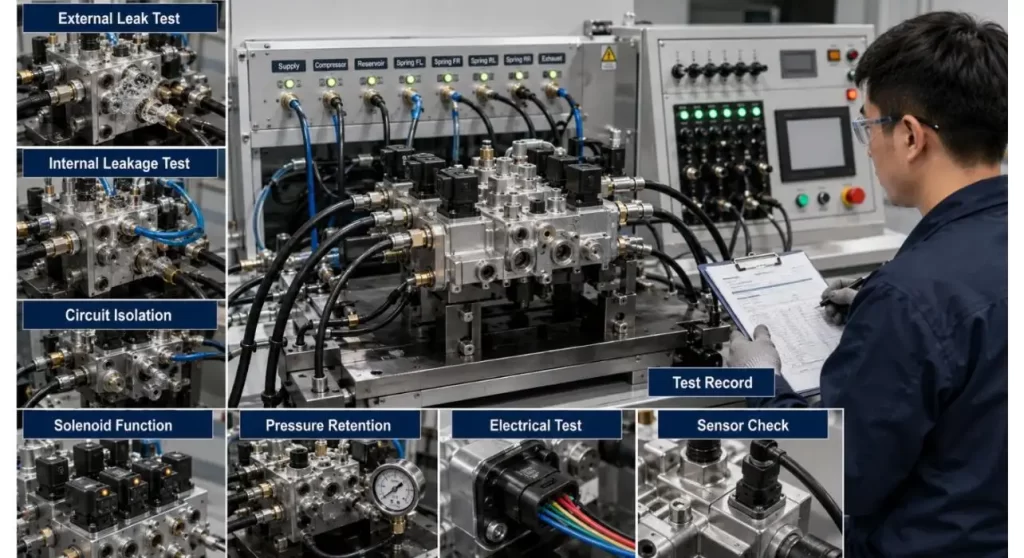
The goal of end-of-line testing is to replicate real commands
A multi-channel electropneumatic component cannot be tested for a leak with just a pass/fail test.
A more robust production test pushes the pressure, fires the solenoids in an orderly fashion, verifies the correct outlet response, verifies electrical results and prints the unit identity.
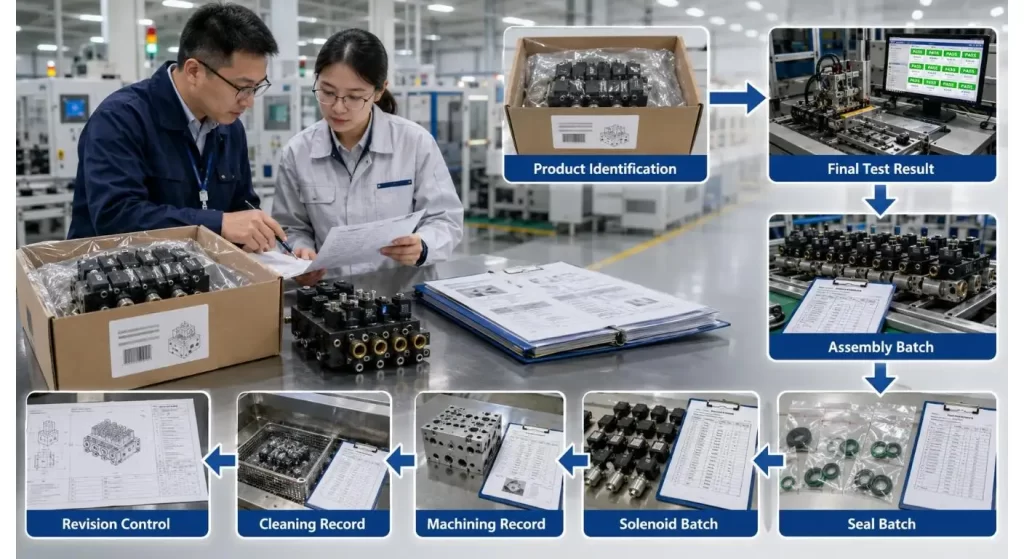
Revison control should be used for the test sequence. If the valve design, coil, seal, software, fixture or the test limit changes the manufacturer should evaluate if there is a need to validate and gain customer approval.
The output should be able to be linked to the machine it has failed in, the assembly station, material lot, operator and test program.
You should be able to see how the vehicle is situated in the environment
Valve blocks can be installed underneath the vehicle, within a wheel-arch area, next to the compressor or inside a protected body compartment. The areas can put the component under varying conditions of water spray, dust, road salt, vibration, temperature and heat.
There may be therefore validation including:
- Pressure cycling
- Solenoid endurance
- Operates at high and low temperatures.
- Thermal cycling
- Vibration
- Water exposure
- Corrosion testing
- Connector sealing
- The quality of the water sample was verified by performing a post-test leak and flow test.
The key is to gather the most tests is not what matters. It is important to link each test to the real environment in which the equipment is installed and the probable failure mode.
Does the certificate assess the quality of the product?
Customers should ensure that the quality-management certificate of the supplier is for the appropriate manufacturing plant and product range. Automotive quality-management publication IATF 16949 still plays a key role in the automotive industry but the factory has to prove how the requirements of the standard are implemented on a daily basis.
In an audit, trace one batch as it goes through the machining, deburring, washing, assembly, testing, marking and packaging process.
Check for indication of good control of nonconforming parts, reworking, test fixtures, calibration, line clearances, engineering change, mixed material prevention.
Protection of ports is not covered by a clean certificate hanging on the wall; and no single solenoid batch on the assembly line is enough to make up for the lack of protection.
Inquire about what happens if a part fails in the field
A dependable air suspension valve block manufacturer will be able to analyse the parts that are returned and not just replace them.
The investigation should try to differentiate contamination, seal damage, electrical failure, internal leakage, incorrect installation, external leakage from the system and control/calibration issues.
ZF states that the air-suspension fault codes usually only refer to a condition of the system and do not necessarily mean that a specific part has failed. Live data, pressure data, calibration checks and system level validation are key components of a proper diagnosis.
Therefore, when a vehicle is returned, the condition of the vehicle reported by the customer should be included with component testing.
Conclusion
Choosing an air suspension valve block manufacturer is not just about finding a CNC supplier that has a leak tester to test the manufactured valves.
The most powerful manufacturer would be able to explain how the valve block is manufactured, and how it acts within the whole suspension system – and why it will not change from prototype to mass production.
FAQs
Q1. So, what does an Air Suspension Valve Block do?
Provides control of vehicle height by communicating compressed air between the compressor, reservoir, air springs and exhaust circuit.
Q2. Is it possible for a Faulty Valve Block to cause Uneven Ride Height?
Yes. If one suspension circuit loses pressure or fails to respond due to internal leakage or a sticking solenoid, the other circuit must compensate for the failure.If one suspension circuit loses pressure or fails to respond due to internal leakage or due to a sticking solenoid, the other circuit must react to the failure.
Q3. The reason of the cleanliness in the production of valve-blocks?
Internal damage to seals, restriction of passages, blockage of valve faces and leakage are caused by metal particles or debris.
Q4. How to Test Valve Block?
Tests include external leakage, internal isolation, solenoid operation, airflow, electrical function and pressure retention.
Q5. Buyer's Request for the Manufacturer?
Try to get drawings, pneumatic logic, part specifications, validation reports, production test methods, traceability and change control procedures.


Contact Us
In This Article
- 1 The first step is to start with the Pneumatic Function
- 2 They should not be limited to being true to size
- 3 Cleanliness is a functional requirement
- 4 Seals should be selected as a system
- 5 When it comes to solenoid consistency, it's as important as it is in the machining world
- 6 The leakage test should distinguish between various failure paths
- 7 Flow Balance will influence the flow of the Vehicle
- 8 The goal of end-of-line testing is to replicate real commands
- 9 You should be able to see how the vehicle is situated in the environment
- 10 Does the certificate assess the quality of the product?
- 11 Inquire about what happens if a part fails in the field
- 12 Conclusion
- 13 FAQs
