


Suspension Control Valve Block: Diagnose the Air Path Before Replacing Parts

The suspension control valve block determines the direction in which the compressed air is flows, the isolation of a circuit and the timing of the discharge. When one of the internal valves fails to close, the vehicle will lean, rise unevenly or a height difference will cause the compressor to constantly attempt to maintain a balance that it can never achieve.
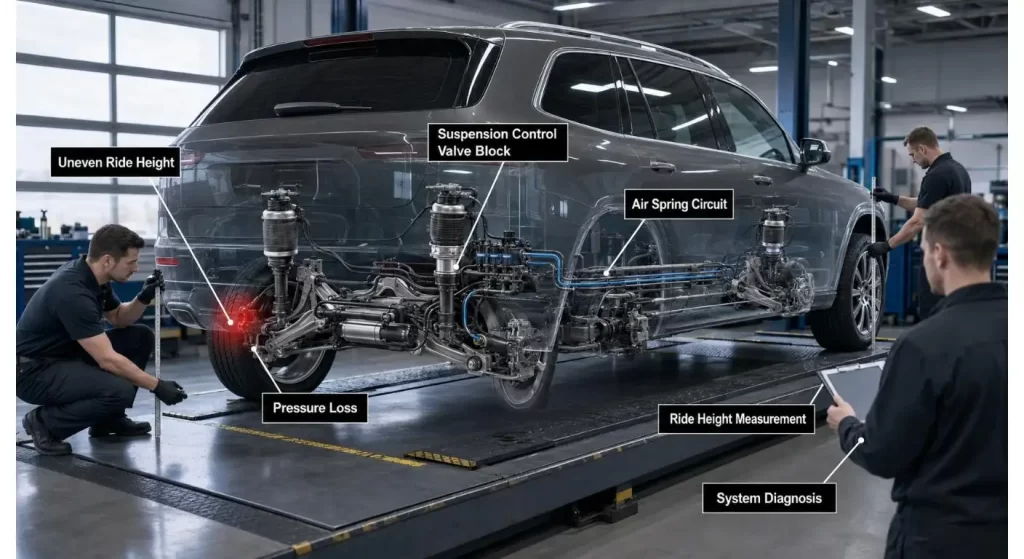
The tricky part is that a valve-block malfunction has relatively similar symptoms as some other air suspension issues.
The block that controls traffic is the Valve Block
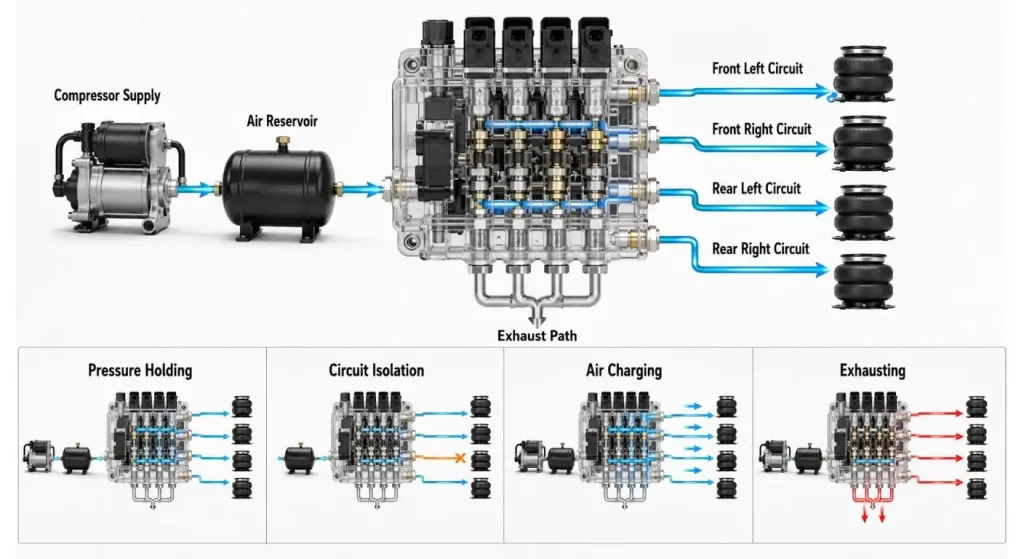
A typical air suspension system has a compressor to develop the air pressure, a reservoir to hold the air pressure, and a valve block to distribute the air pressure to individual air springs or air struts. The suspension control module controls the solenoids inside the block which open and close.
The block thus becomes an element of a group of air lines, but does more. Separates the corners on the vehicle, maintains pressure in certain circuits, and controls volumes of filling and exhaust during change in height.
In addition to ride-height sensors, pressure data, electrical signals and software logic, modern air suspension also requires the following: Because these systems are mechanical, pneumatic, electrical and electronic, ZF recommends them to be diagnosed as a system and not just as mechanical or pneumatic systems.
Each question will be evaluated separately
The format of the complaint may get you connected with a small range of candidates.
When one corner is sinking and the other three are still, check local air spring, fitting, air line and matching valve line. When one of the axles comes up or one of the sensors does, a common air path or control problem is more of a possibility.
If all four corners go up gradually, compressor, dryer, reservoir, line or a larger system leak may be the cause of the problem.
Ride height can be uneven at times and may also be a sign of a valve-block issue, not an air-spring issue, says Arnott. While that's a helpful point to know, it's no conclusive evidence.
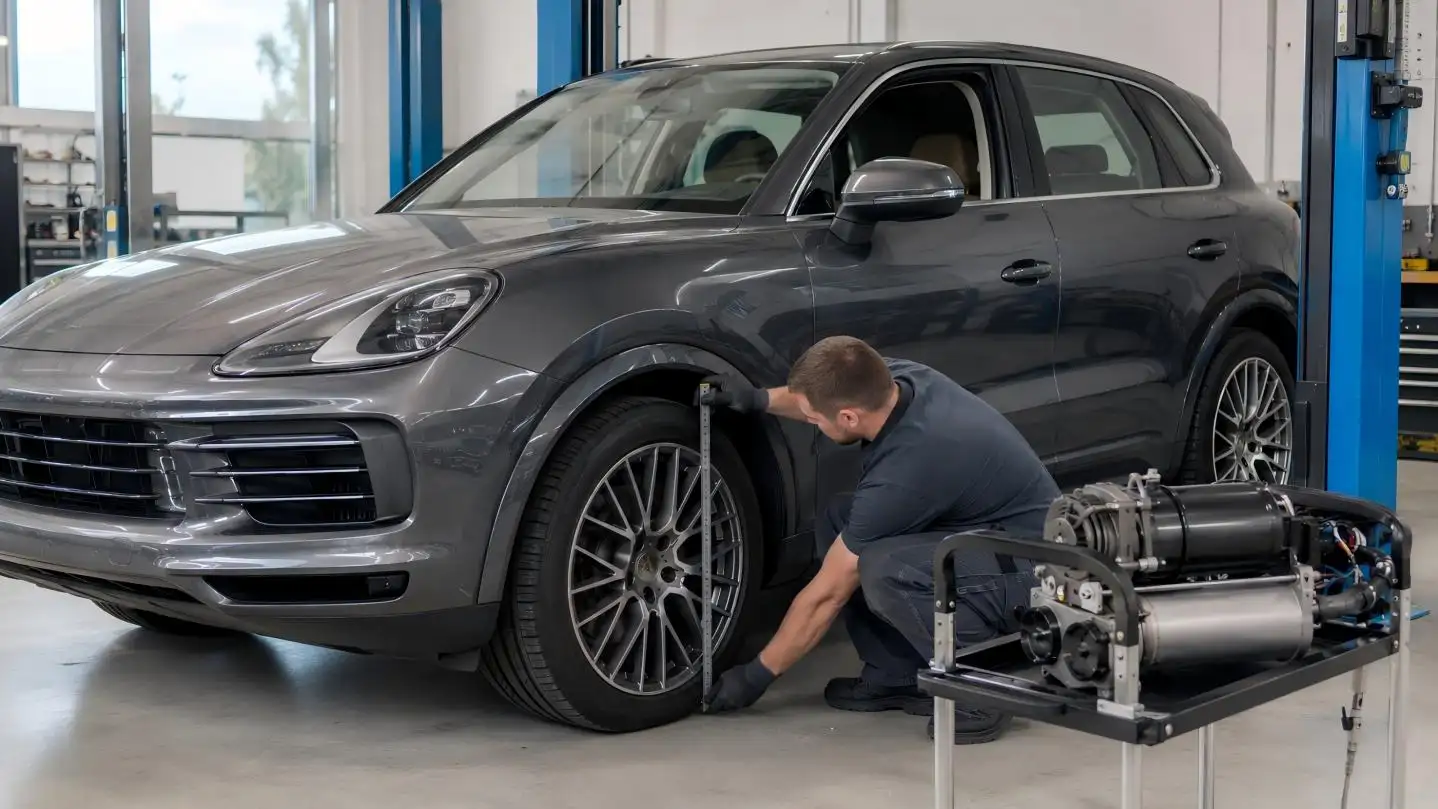
On level ground, take the four corner measures, put the vehicle in the same environment and take measures again before parting off. This straightforward safety measure can help avoid replacing when it's not needed.
| Vehicle Symptom | Possible Valve-Block Issue | Other Causes to Check |
| One corner sinks overnight | Internal leakage in one channel | Air spring, fitting or airline |
| Entire axle lowers | Shared valve path leakage | Sensor or shared air line |
| Vehicle rises unevenly | Restricted or slow valve channel | Height sensor or air-spring restriction |
| Vehicle lowers unevenly | Exhaust path does not open correctly | Incorrect calibration |
| Compressor runs frequently | Valve block cannot hold pressure | External system leak |
| Height changes intermittently | Contamination or sticking valve | Electrical connector or sensor |
| No response at one corner | Solenoid or circuit-control problem | Wiring or blocked airline |
| Fault returns after replacement | Calibration or unresolved system fault | Compressor, dryer or contamination |
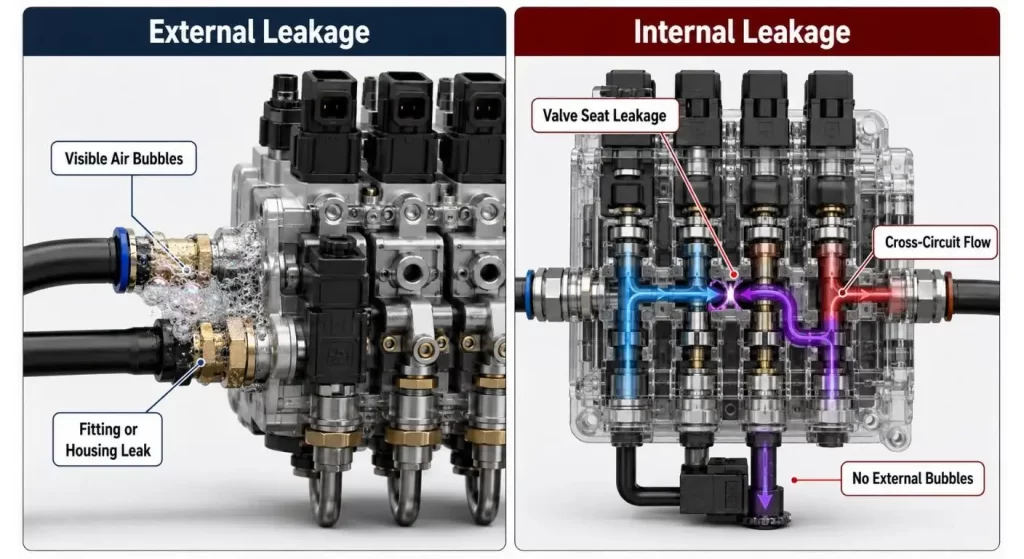
The bubbles that are formed by internal leaks are not necessarily present
When air leakages happen, they are outside the room. A soap solution might show air at the air spring, fitting, airline, valve block port or housing joint area.
The internal leak is another story. Air can flow between and through suspension circuits or via an inside exhaust path without visible bubbles appearing outside of the block.
Because, if replacing the lowest air spring does not fix an overnight sag, it isn't always the lower air spring. The valve block might be sound and be gradually releasing the pressure in that circuit after the vehicle ignition was turned off.
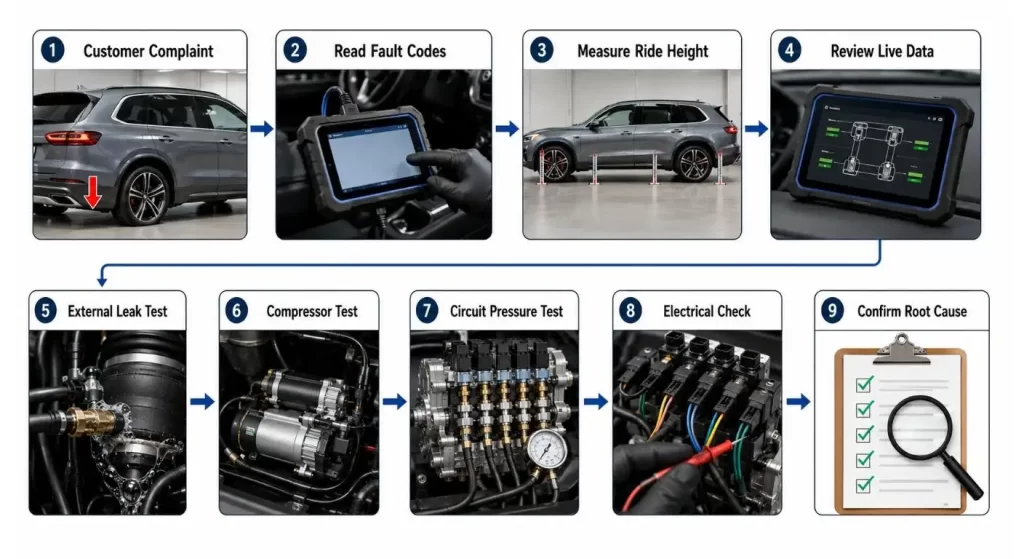
Comparing the pressure retention of channels and observing if the channel pressure loss is through the air spring or to the same valve may be necessary for Diagnosis. A pressure test or line-isolation should be made with the service information unique to the vehicle.
A fault code is not "order
Air Suspension fault codes can be used to detect the conditions in the system, and not necessarily a particular fault. Active sensor values, pressure behaviour, the activity of the compressor as well as the state of calibration should be considered together.
A scan tool is of most value when it indicates what's about to happen and where the real response is different.
Contamination can cause fault that will reoccur in a circuit
Small valves and passages within. A valve may not close clean if it has some moisture, desiccant dust, corrosion particles, a small fraction of the line has been damaged or work shop debris is present.
The symptom may either go away or return. The particle moves and the car keeps the same position for some days and afterwards, the same corner begins to fall once more.
Always clean around all connections prior to opening the system. Discuss and use appropriate tools for square cutting of replacement tubing, disconnect lines, protect exposed ports.
Pulling too tight on some of the quick connect fittings can be destructive to the threads or may lead to new leaks, Arnow also says. The use of the proper connector and torqueing procedure should always be followed.
If contamination is detected, check compressor dryer, intake, reservoir and associated lines. Clean valve blocks put in into a dirty system are usually not a permanent fix.
Compatibility goes beyond physical fit
While superficially appearing the same, two control valves can operate two different port maps, two different solenoids, distinct flow characteristics, and different electrical connectors and/or control expectations.
Before ordering, confirm:
- Vehicle identification number
- Model: Make a copy of the design.Model: Make a second model (a copy).
- Using the wrong suspension or chassis code.Wrong suspension or chassis code.
- Original part number
- Port arrangement
- Airline diameter
- Electrical connector
- Reservoir configuration
- Seconds of operation will vary, see Coding and/or Calibration requirements.
The pneumatic circuit layout of a block which bolts into position may be different to another, even when they are exactly the same type in all other aspects.
Don't assume that a similar connector or shape to the housing means that everything is compatible.
Identify the causes of any damage to the Old Block
Generally, a valve block can wear internally, but if any other part of the valve fails the holding up time of the block will be short.
The replacement part can be impacted by the deterioration of the compressor, water in the dryer or in the lines, saturated dryer, wrong pressure or damaged electrical.
Prior to installation, inspect the air springs, lines, fittings, compressor, dryer, reservoir, pressure sensor, ride height sensor, wiring, relay and grounds.
This approach is essential for the modern air suspension diagnosis as most of the time the visible failed part is not the direct cause.
The new valve block should be the last, rather than the next component around a surface with the same things that need fixing.
Installing Doesn't Work With Dirty or Identified Items
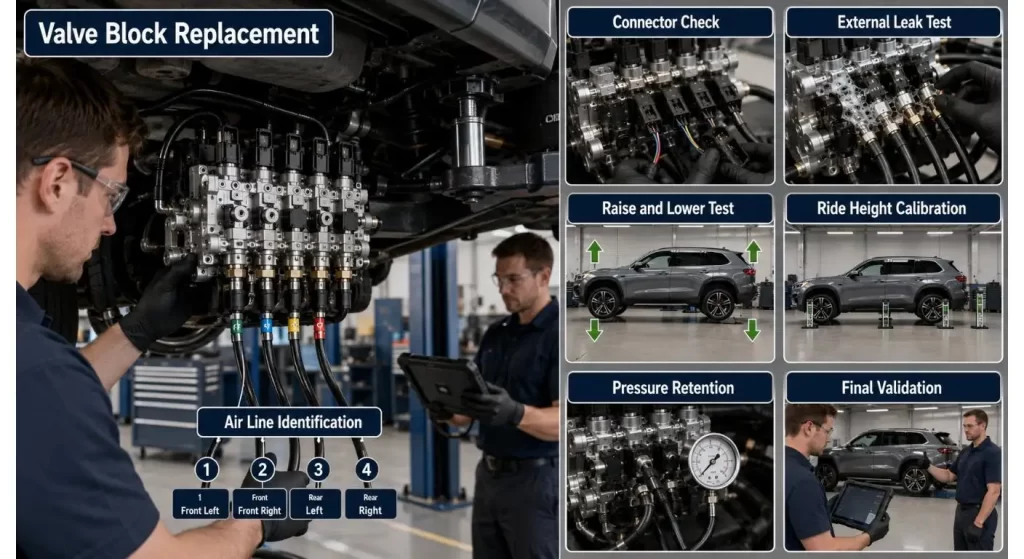
Be sure to mark each airline prior to removal. Crossed connections can cause an abnormal corner to either rise or drop, and generate confusing results when diagnosing.
Be sure to leave the replacement ports closed until all the lines are ready. Check the ends of the tubing, seals, connector seats and mounting. Don't make any connection or install sealing materials unless they are called for by the vehicle repair instructions.
Install valve block - make sure it is oriented the correct way. Properly fix the wiring so that it does not rub, stretch or push on the electrical connector.
If there are rubber isolation mounts, or a heat shield, or a protective cover, install them to prevent damage, not take them off and install new ones as part of checking for missing parts.
Restoration path after installation is known
Never assess the repair based on a "rise one" at the end of the repair.
Reset the specific fault codes and give the approved/recommended raising and lowering instructions. Perform an inspection of all four corners, compressor run times and to ensure all disturbed connections remain leak free.
For some cars, there's a calibration, adaptation or diagnostics function test that needs to be performed after suspension repair. Calibration and post-repair validation, while important to ZF, are concepts vehicles might look level but the control system is not operational.
Park the car and recheck afterwards. The aim of a repair should be to maintain the correct height after the workshop is closed.
Conclusion
The influence of a suspension control valve block on an air-suspended vehicle's suspension operation of raising, lowering and holding, is significant to an air-suspended vehicle.
The first step in forming a sound diagnosis is to get some idea from the vehicle's behavior. Take measurements of corners, identify internal leakage versus external leakage, and decipher fault codes, check for contamination, and confirm precise compatibility for replacement.
By doing so the valve block ceases to be a mysterious part, and it becomes what it is supposed to be—the regulated joint in the middle of the pneumatic suspension.
FAQs
Q1. What is the function of Suspension Control Valve block?
It carries compressed air between the compressor, air springs, reservoir and exhaust circuit to allow the vehicle to adjust and maintain a proper ride height.
Q2. Can a Block with Bad Valve Cause the Sink to Flow into One Corner?
Yes. One suspension, may have a leak or a valve may fail to seal properly when parked.
Q3. Why is the Valve Block Different from the Control Module?
Adapted valve block to control the pneumatic airflow. The control module analyzes the information from the sensors and communicates with the compressor and solenoid valves with electricity.
Q4. Is a Valve Block Receptacle Receptacle or Cleanable?
While external cleaning is good practice, it is inappropriate for all designs to repair or flush the interior of the design. Follow as per procedure set out by the vehicle or component manufacturer.
Q5. Should Calibration be done on a New Block Valve?
Certain cars may need calibration, adaptation or a function test for diagnostics, after the replacement. This is dependent on the vehicle and suspension system.


Contact Us
In This Article
- 1 The block that controls traffic is the Valve Block
- 2 Each question will be evaluated separately
- 3 The bubbles that are formed by internal leaks are not necessarily present
- 4 A fault code is not "order
- 5 Contamination can cause fault that will reoccur in a circuit
- 6 Compatibility goes beyond physical fit
- 7 Identify the causes of any damage to the Old Block
- 8 Installing Doesn't Work With Dirty or Identified Items
- 9 Restoration path after installation is known
- 10 Conclusion
- 11 FAQs
