


China Air Suspension Parts Manufacturer: A Practical Sourcing Guide

It's simple to find an air suspension parts manufacturer in China. Then, it's difficult to locate the one that can understand the application, maintain production after the sample stage, and go in to investigate a problem when the shipment has crossed an ocean.
Improved sourcing process does just that before volume orders are placed.
Write a useable brief about your sourcing project
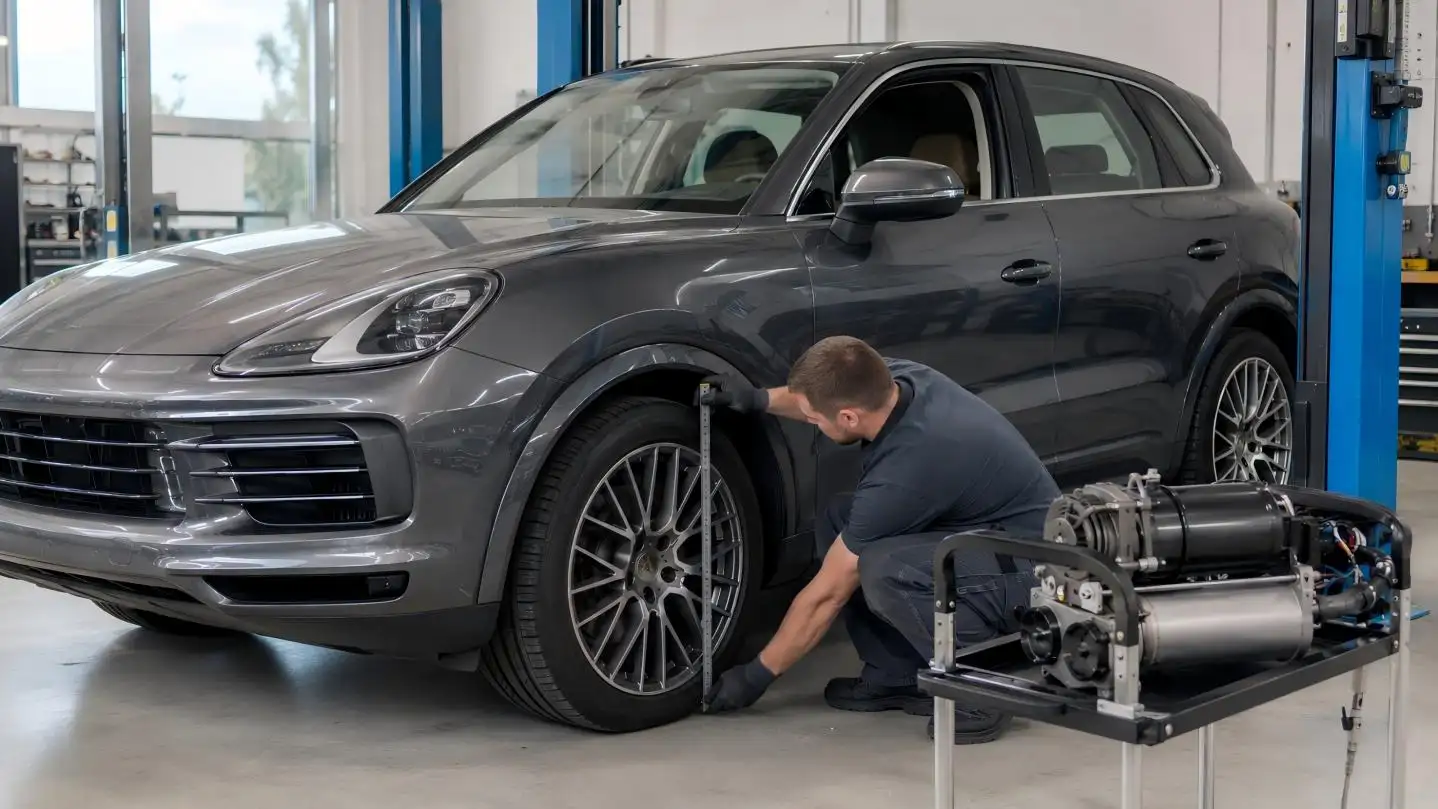
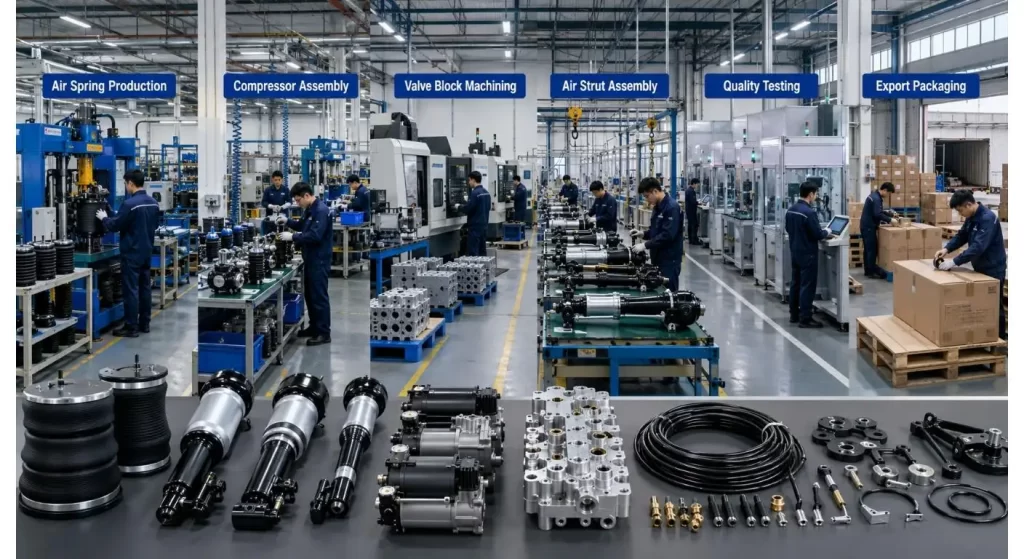
Too general to give an accurate quotation—"Air suspension parts". Identify if project requires air springs, air struts, compressors, valve blocks, height sensors, fittings, brackets or repair kits, complete.
Specify the vehicle application, original part number, suspension position, annual demand, target market, validation requirements, packaging and aftermarket/private label/original equipment development.
If this information is not provided, a supplier may give a similar looking component, without a proper understanding of the component's mounting geometry, electrical interface, duty cycle or control logic.
Understand test kit manufacturers' actual function
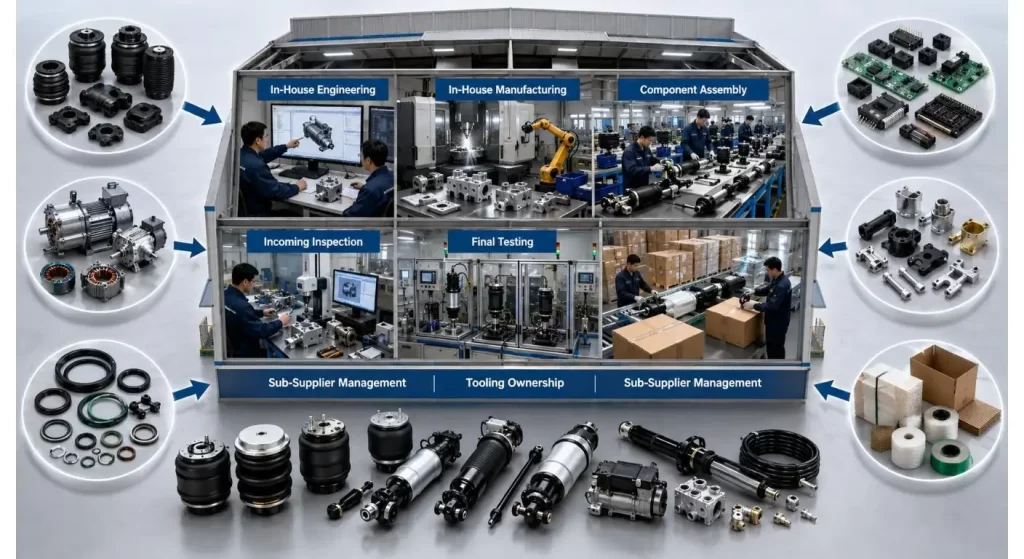
Some companies actually produce the primary component. Others put together parts they bought. There are some that coordinate several experts factories, and are the export interface.
All of them are not off-limits right out of the box. The danger is when the purchaser is not aware of the model being used.
Question what operations are being carried out at the audited site, to what degree everything is outsourced, and identify who owns the tooling and/or who are generating the rubber, aluminium bodies, motors/solenoids, seals and electronics?
Open and the idea that everything is done in-house are more important than transparency.
| Evaluation Area | What the Buyer Should Confirm | Main Sourcing Risk |
| Manufacturing role | In-house, assembly or supply coordination | Unclear production responsibility |
| Product expertise | Engineering knowledge by product family | Reference-number matching only |
| Tooling ownership | Tool location and ownership agreement | Supply interruption or tooling dispute |
| Sample development | Drawings, reports and revision records | Sample does not match final requirement |
| Pilot production | Normal materials, tools and operators | Hand-built samples hide process variation |
| Sub-suppliers | Approval, incoming checks and traceability | Uncontrolled material or component changes |
| Quality system | Certificate scope and shop-floor execution | Documents do not reflect production |
| Change control | Advance notification and revalidation | Unapproved component substitution |
| Export packaging | Port protection, cushioning and pallets | Transit damage or contamination |
| Warranty support | Batch records and root-cause process | Repeated failures without correction |
You should measure the depth and not the size of your tests
It is not just big catalogs, but engineering capability as well.
Select a product group and have focused questions. Talk about design height and fatigue of air springs, duty cycle and dryer performance of compressors or the internal leakage and flow balance of valve blocks.
The replies, of course, indicate whether the supplier has a basic knowledge of the component or whether he just can tell one and find another.
Use samples to assess communication
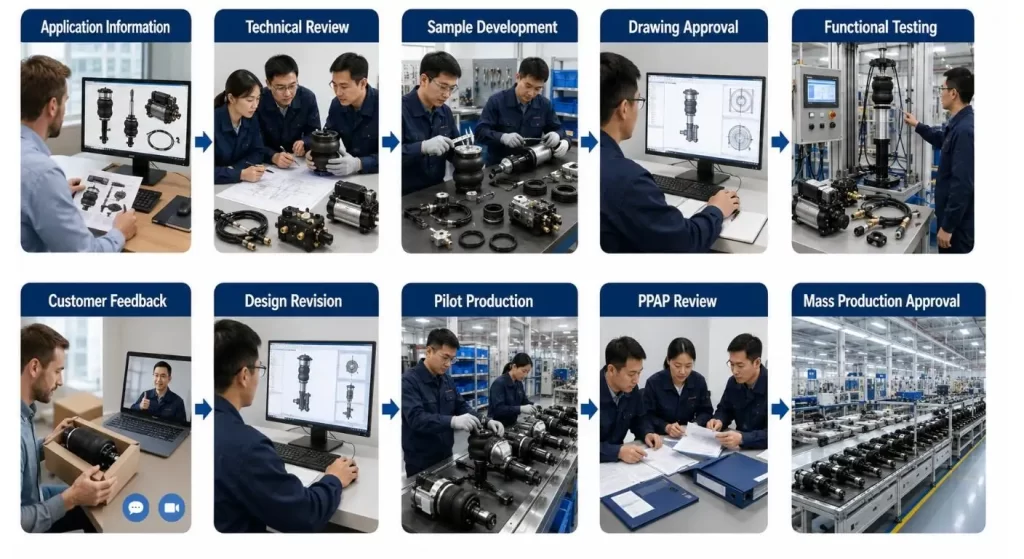
A sample is also kind of a test to the working relationship.
Is the manufacturer clear on drawings, does it document changes, does it report deviations and documents what was tested for? Be careful of suppliers who say, “no problem” for every request as this can cause additional problems for the supplier further down the road.
Ask for a demonstration of dimensions, operations, test environment, marking and packaging. Value of numbered questions, revision tables and written approvals is through languages and time.
Make and score the player's success in terms of process use
It is possible to hand build a prototype and be able to inspect it on a couple of occasions. Normal operators, tools, material, cycle times and test stations are all utilized in mass production.
Ask for a trial dosage of the product, before approval, with the same process you will be using for volume supply. PPAP is a system that AIAG has developed to validate a supplier's capability to prove engineering and specification compliance with a real production run at production volumes, AIAG notes.
A pilot production can detect fixture wear, fixture variation, test bottlenecks and packaging that doesn't work well before the initial large production shipment, etc.
Advise on the supply chain extension of Critical Processes
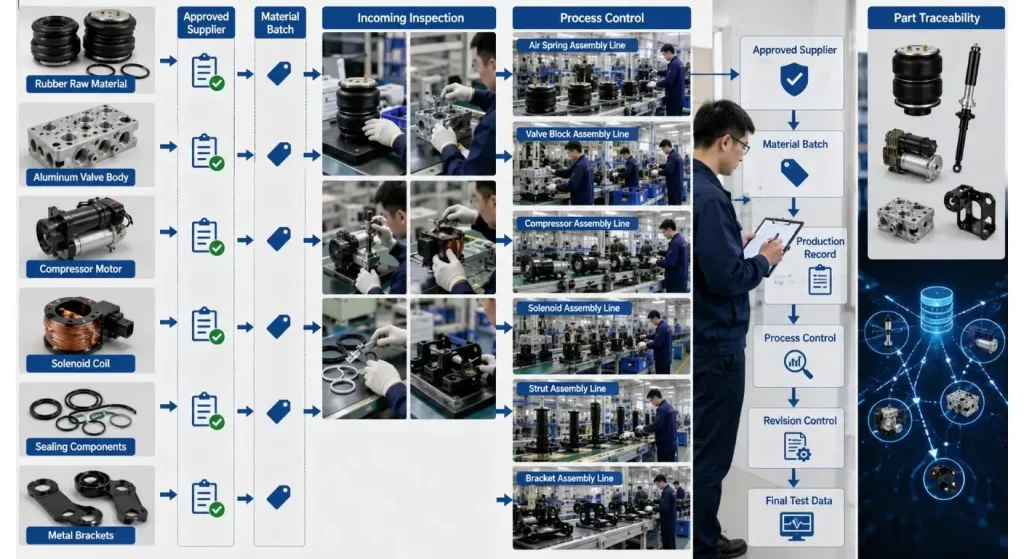
Rubber mixing, vulcanization, heat treatment, welding, CNC manufacturing, coating, motor manufacture, electronics and leak testing are used in the air suspension products.
These processes must also be outsourced to the final manufacturer, where they have to be approved, verified as received, and have change control and batch records.
The AIAG currently has APQP guidance that provides increased focus on sourcing, risk mitigation, gated review, change management and part traceability.
For each completed part, follow back on the audit to the materials and sub-tier processes that are critical to that part. This is a more telling presentation of capacity than a capacity presentation.
Once the Certificate has been verified, then observe the Production
For Automotive Supply, an IATF 16949 Certificate might apply, but it is important for buyers to determine the certified location, scope and the certification body. The list of certification authority organisations for the implementation of IATF 16949 is published by IATF.
It is then compared against the shop floor using quality documents. Are gauges calibrated? Parts rejected from the process separated? Do the operators adhere to the control program? Is there any protection of test limits? Is rework controlled?
There is also a range of customer-specific requirements which are unique for each car-maker and are issued independently by the IATF. A general certificate can not be used as the basis for the requirements of the specific customer program.
Make cleanliness part of the performance
Particles might not seem to be present on the outside of the component but they can be in the seal or passages and cause intermittent faults.
ISO 16232 gives methods to measure and document particulate contamination of the parts to be used in specific functions, as well as to monitor processes like cleaning and assembly. Does not single out any one figure for cleanliness for all products.
Cleanliness is relevant only where there is a buyer versus manufacturer relationship, and then only if it is agreed on; it should be tested and prove to be protected by the buyer while assembling and/or shipping the cleaned ports/ship passages.
Send it in writing via email or fax
One rubber compound, seal source, motor, coil, coating supplier and/or machining route is allowed for an approved sample. Later unapproved change may change performance but part appears to be the same.
The purchasing agreement should set out the criteria for informing the vendor of change, sending of new samples, further validation and/or re-approval by PPAP. Drawings, bills of material, test programs, labels and packaging shall be covered by revision control.
This transforms “same part number” to a product decided and controlled.
Plan the packaging of products before the first export order is placed
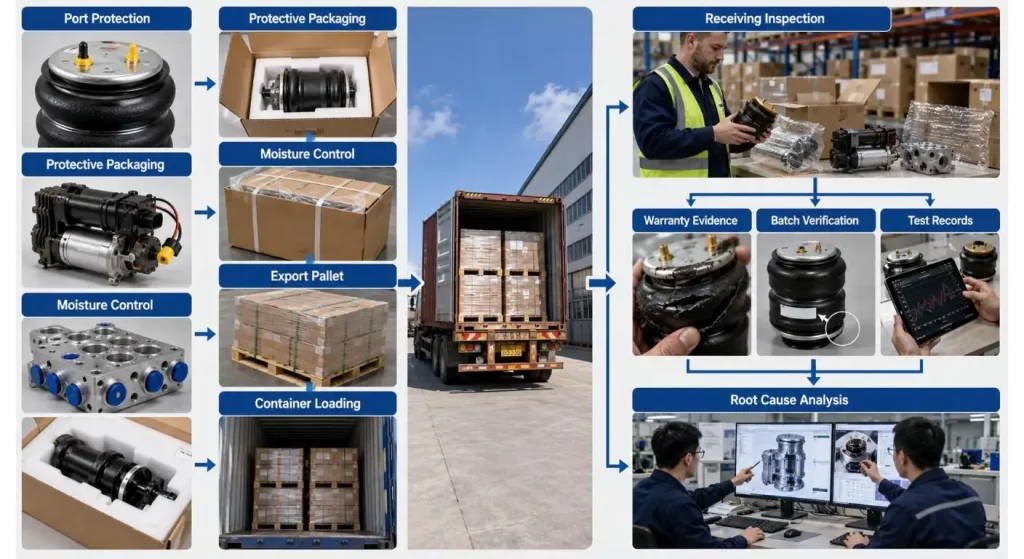
Moisture, dust, vibration, bent connectors, uncapped ports and heavy parts inside the cartons can all damage air suspension parts.
Explain what is meant by the terms port protection, individual cushioning, carton strength, pallet layout, moisture control and the contents of the label during sampling. ISPM 15 applies to the use of raw-wood pallets or crates for international shipment and outlines precautions that are considered effective in minimizing pests that can be a risk with such pallets or crates.
Load actual product weight using method of shipping to test. Hand Carried does not necessarily mean a Stacked export pallet.
An overseas warranty analysis is costly
It is a time consuming and expensive process to send back all the rejected parts to China. Pre-agreed tackling evidence needed: Vehicle application, installation date, mileage, fault description, diagnostic information, photographs, part number and batch.
The manufacturer needs to link that evidence with material, assembly and final test records. A cause, containment action and prevention plan not just a replacement, if the incidents reiterate.
Conclusion
Not all of the best China air suspension parts manufacturers will have a long catalog or would be the cheapest to open.
A reliable partner describes what it is, understands the vehicle application, communicates well when sampling, provides proof of the production process, works with sub-suppliers, documents any changes, provides product security when exported and assists in evidence-based failure analysis.
Prior to the first big order(s) placed, it is helpful to incorporate quality as part of the project to reduce the risk level associated with cross-border sourcing.
FAQs
Q1,.How To Make Sure The Parts Manufacturers for China Air Suspension?
Check raw material sources, machine set up and condition, product range, certificate information, testing capability, sub supplier control and traceability. Do not use a live or on-site audit - only a website.
Q2. Is IATF 16949 a requirement of all suppliers?
Requirements vary upon Customer, Market, and Supply level. Whether or not the supplier is obligated to provide a certification, he/she should demonstrate autoimmune planning and production control.
Q3. Must production of more items be authorised based on one sample?
No. Produce pilot components with normal processes, tools, material, cycle times and inspection methods before approving the production of the volume components.
Q4. Which Parts Of An Air Suspension System Do You Have To Test?
The functional, durability, environmental and leakage tests performed differ according to the various uses of air springs, compressors, air struts and valve blocks.
Q5. Which first information will a buyer include in his initial inquiry?
Include the following information for the vehicles: Application, Original Part Number, Drawings/Sample, Annual Volume, Target Market, Required Tests, Packaging & Branding, Approval.


Contact Us
In This Article
- 1 Write a useable brief about your sourcing project
- 2 Understand test kit manufacturers' actual function
- 3 You should measure the depth and not the size of your tests
- 4 Use samples to assess communication
- 5 Make and score the player's success in terms of process use
- 6 Advise on the supply chain extension of Critical Processes
- 7 Once the Certificate has been verified, then observe the Production
- 8 Make cleanliness part of the performance
- 9 Send it in writing via email or fax
- 10 Plan the packaging of products before the first export order is placed
- 11 An overseas warranty analysis is costly
- 12 Conclusion
- 13 FAQs
