


Durable Air Suspension Compressor: What Makes One Last?

A durable air suspension compressor is NOT just a pump with the biggest motor and/or a higher pressure rating. The length of service is dependent on the frequency of starting, duration of starting time, amount of heat to be dissipated and whether an air system leaks or moisture ever gets to the pneumatic components.
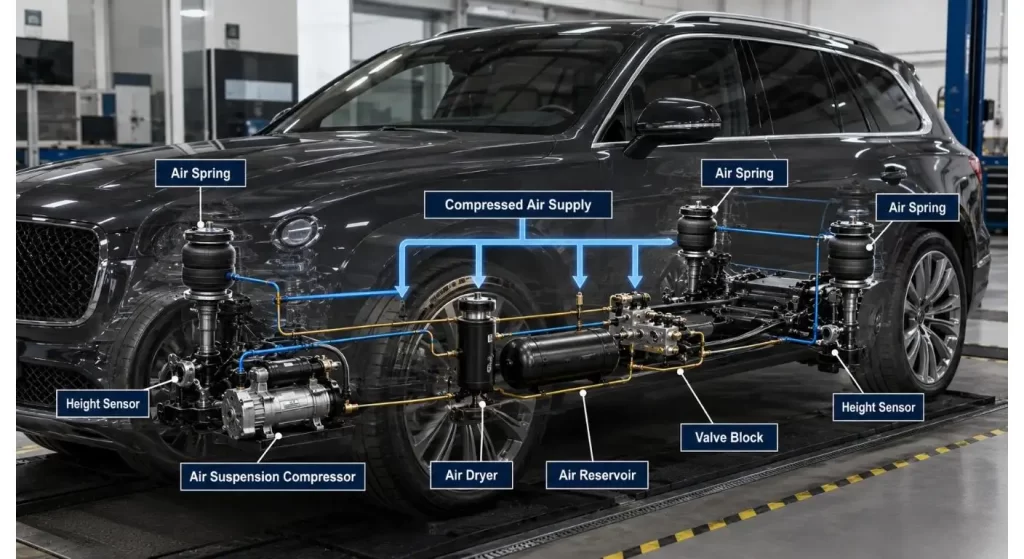
This is why it is possible for the same compressor to last for varying periods of time. One one of them runs short to correct the height of a ride. The other one takes all the trips looking for a small leak that overloads either its motor, relay, connector or dryer.
Workshops and parts buyers are not interested in “How powerful is it?,” they are interested in “Can the entire system allow the power to operate within its operating envelope?”
The word Durable means 'by the Operating Pattern'
The ride-height and load compensation are controlled by a compressor driven by air. The needed unit is dependent on the volume of the system, amount of target pressure, adjustment time, space required for installment, noise level and control strategy.
That's because yet another range of power classes and compact modular compressors with built-in drying and even optional quick-release functions is offered by AMK to illustrate the point that one specification does not fit all types of air-suspension system.
The duty profile of a vehicle is often significantly different if it is used to adjust its height and then replace changing loads more than once. Match the compressor to the actual cycle can start the durability.The first step to durability is with matching the compressor to that actual cycle.
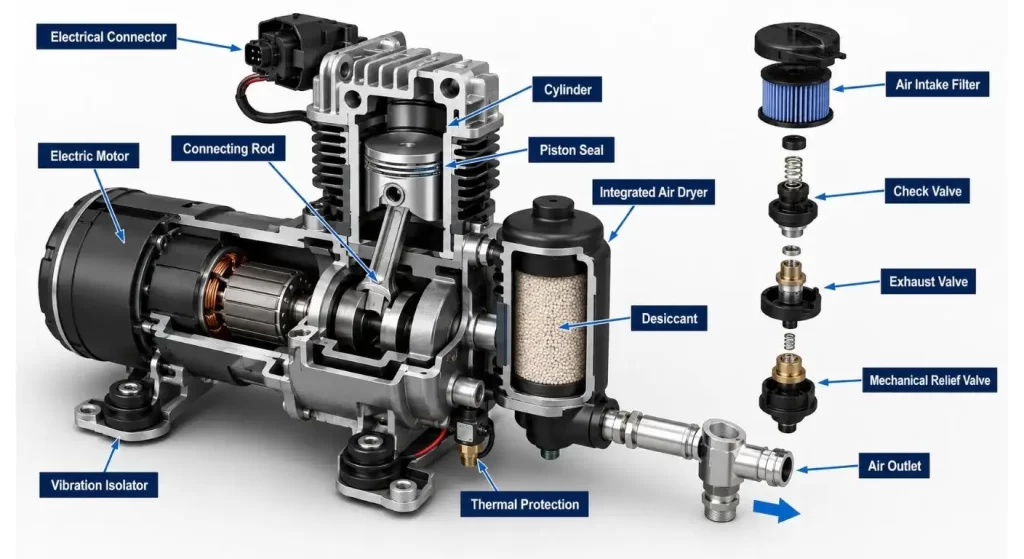
Duty Cycle is more about it than its peak pressure
Obviously, maximum pressure has little sense to compare but it does not indicate the running time of the compressor before cooling.
In addition to light duty compressor systems, which might have a duty cycle of as low as 9%, Firestone offers extremes duty compressor systems that can be used in the desired application continuously. What's the difference and that is why it is important to consider pressure, airflow and duty cycle together.
If filling the system requires frequent or longer cycles, the compressor might achieve the required operating pressure, but not be a good fit. Verify vehicle adjustment speed, frequency of adjustment and cooling time.
| Selection Area | Why It Matters | What to Confirm |
| Vehicle application | Determines system compatibility | Model, year and suspension type |
| Target pressure | Must meet system demand | Approved operating range |
| Airflow | Affects height-adjustment speed | System volume and fill time |
| Duty cycle | Controls safe operating duration | Run and cooling intervals |
| Integrated dryer | Limits moisture contamination | Dryer and vent condition |
| Electrical system | Supports stable motor operation | Voltage, relay, fuse and ground |
| Mounting design | Controls noise and vibration | Brackets and isolators |
| Thermal environment | Influences motor and seal life | Airflow and nearby heat sources |
| System leakage | Determines compressor workload | Air springs, lines, valves and fittings |
| Control compatibility | Affects filling, venting and shutdown | Connector, software and calibration |
Get the band on first, no problems!
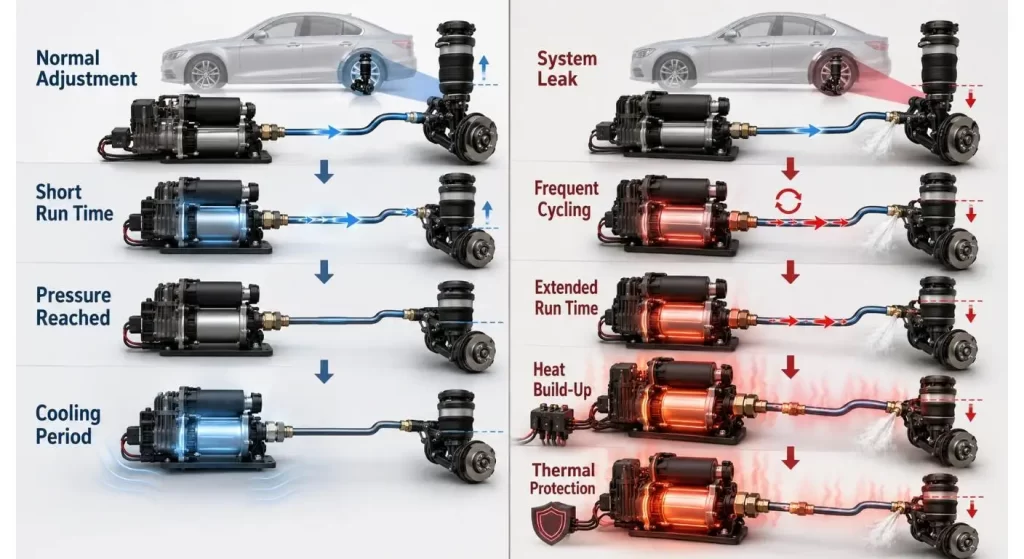
Quickly cycles are indicative of another malfunction in the compressor.
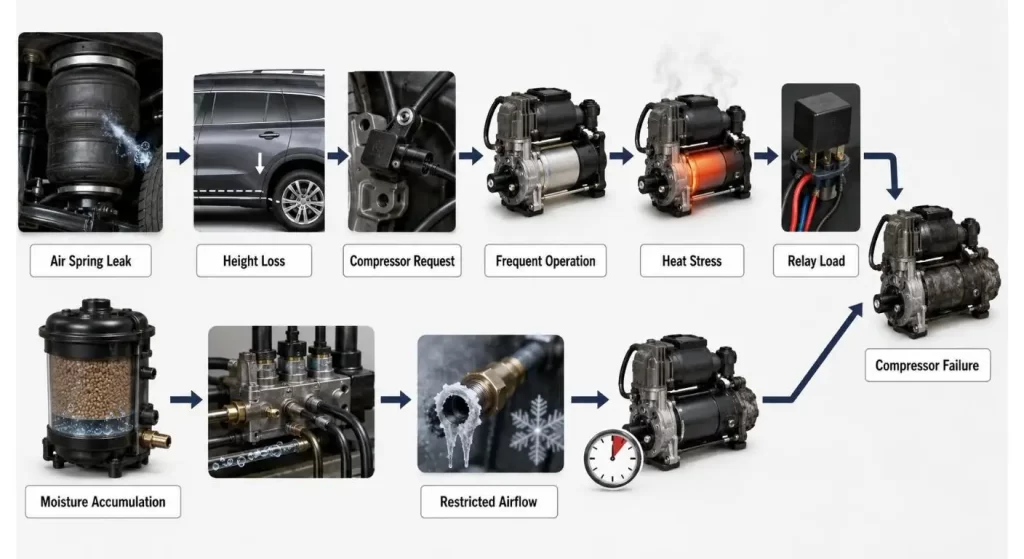
Repeated pressure loss occurs from leaking air springs, cracked lines, loose fittings and/or an incorrect valve block. If the compressor is leaking for too long, it can overheat the compressor and damage the compressor's relay, says Arnott. It advises performing a cause analysis of the failure, instead of simply changing out the pump.
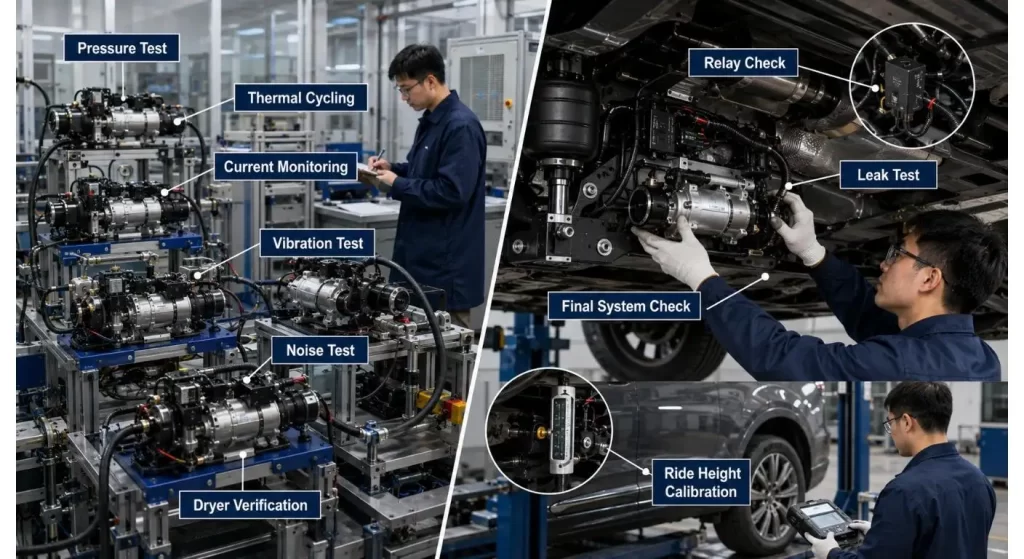
These include the following practical checks: suspension faults checked, drop test to determine if the vehicle drops off the stand, use of soap solution on air spring, lines, fittings, valves and reservoir joints. Once filled, check for system pressure and normal (automatic) compressor shutdown.
It is possible for a new compressor to cause another leak without repairing the leak in surprising time.
How do you design for heat management?
Heating occurs as a result of compression, repeated starts, wiring resistance and the electric motor.
The compressor must have air flow, protection from exhaust heater heat, positioning and spacings available. Excessive run time may be restricted by the controller and thermal protection must continue to be a means to protect the component and not a typical operating procedure.
Some vehicle-specific replacement compressors have features such as heavy-duty motors and thermal overload protection, says Arnott. When thermal shutdown occurs repeatedly, though, the cause of the suspension must be diagnosed.
The plant is shielded from the entire system by dry air
All compressors will bring in air humidity. If not removed from the system, it may damage valves, lines, reservoirs and air springs.
Moisture may lead to low compression efficiency, may frost in cooler temperatures and result in liquid leaks causing larger run time of the compressor and damage to lines, explains Arnott. AMK provides clean and dry compressed air by using integrated dryers which are capable of undergoing drying under varying climatic conditions.
In replacement check the water path, dryer, vent and check for water contamination. This is because it's a functioning piece of the unit, and not just an additional accessory to the pump.
Service life can be reduced by an electrical supply
The battery, charging system, fuse, relay, harness, connectors, ground points and controller are all important factors in the operation of the compressor.
Low voltage will cause a slower motor speed and cause electrical stress. Territories have corroded, causing resistance and heat. If the controller requests the compressor to shut off the compressor can be left running by a sticking relay.
According to Arnott, the relay should be replaced as needed as a faulty relay can result in continuous operation harming the compressor's longevity. Prior to installation, check for previous overheating, loose grounds, the incorrect fuses, discoloured wires and melted connectors.
Vehicle-Specific Fitment is one of the components in Durability
The choice of a compressor may be determined by the physical dimensions of the compressor, but may not necessarily be the correct compressor for the system.
Different vehicle platforms may have different connectors, mounting points, calibration, drying arrangements, airflow, pressure range, etc. and discharge-valve design. AMK's aftermarket includes a focus on vehicle specific parts for the specific application and original specification.
Do not remove adjust brackets, cut into or otherwise alter the original harness or fittings without following a procedure approved by the manufacturer or designer. The semi-experimental setup can lead to vibrations, leakage from the system, electrical shorting, and moisture infiltration.
Most members would be interested in hearing how the Compressor sounds after it has been put in place!
Noise is a more than just a comfort matter. An abnormal compress sound can be a result of the new compressor being placed under tension, in contact with the body, on damaged isolators or a restriction.
AMK knows that minimum noise and vibration emissions are key design criteria for its compressor range. Once installed, listen while filling, venting and shutting down. A repetition of rattling, clicking sounds or slow increase of pressure or abrupt pressure change should be noted.
Check if the data was repaired completely
Once set up, clear relevant faults, perform the authorised calibration, clear filling and venting, repeat the leak test and check that the vehicle level does not change when at a standstill after the test.
Record compressor run time, supply voltage, currents drawn, state of relay and ride height results, if applicable. The replacement is not fully validated until there is no pressure loss in the entire system and the compressor shuts down properly.
Conclusion
Proper usage, duty control, clean dry air, a stable electrical source, heat control and synced pneumatic systems are essential to the durability of reliable air suspension compressors.
To replace a pump that fails due to issues unrelated to the pump is, as mentioned, a waste of money. The following measures are used to repair the system, starting with identification of the root cause of overloading the compressor and concluding with a thorough system checks.
FAQs
Q1. Why do Air Suspension Compressors Break Down?
It is caused by leaking, excessive duty cycle, over heating, moisture, low voltage, damaged wiring, bad relay, limited air flow and mounting issues.
Q2. How to Determine if the Compressor or Air Spring is Bad?
Inspect stored faults, Vehicle Height after Standing, Compressor Operation and run the system with a soap-solution leak test. Beware of a sunken car which, by itself, is not an indicator of compressor failure.
Q3. Would you like to replace the Relay with the Compressor?
Examine and follow the manufacturers' guidelines specific to that vehicle. Rust on or broken relays may cause the compressor to run and perhaps cause damage to the new one.
Q4. Why the Integrity of a Dryer is Important?
It can cause the drying up of the compressed air, which helps prevent damage to the compressor, the plug, the pipeline and other pneumatic components.
Q5. Is the original compressor able to be replaced by a Higher-Pressure Compressor?
Not using pressure as a sole basis. The fitment, airflow, duty cycle and electrical requirements also need to match along with mounting, controls and calibration.


Contact Us
In This Article
- 1 The word Durable means 'by the Operating Pattern'
- 2 Duty Cycle is more about it than its peak pressure
- 3 Get the band on first, no problems!
- 4 How do you design for heat management?
- 5 The plant is shielded from the entire system by dry air
- 6 Service life can be reduced by an electrical supply
- 7 Vehicle-Specific Fitment is one of the components in Durability
- 8 Most members would be interested in hearing how the Compressor sounds after it has been put in place!
- 9 Check if the data was repaired completely
- 10 Conclusion
- 11 FAQs
