


Automotive Air Suspension Manufacturer: Evaluating a Complete System

An auto air suspension manufacturer and the one who is able to manufacture auto air suspensions is very easy to judge by the way of the catalogue and really hard to judge by the way of the functioning of the products together.
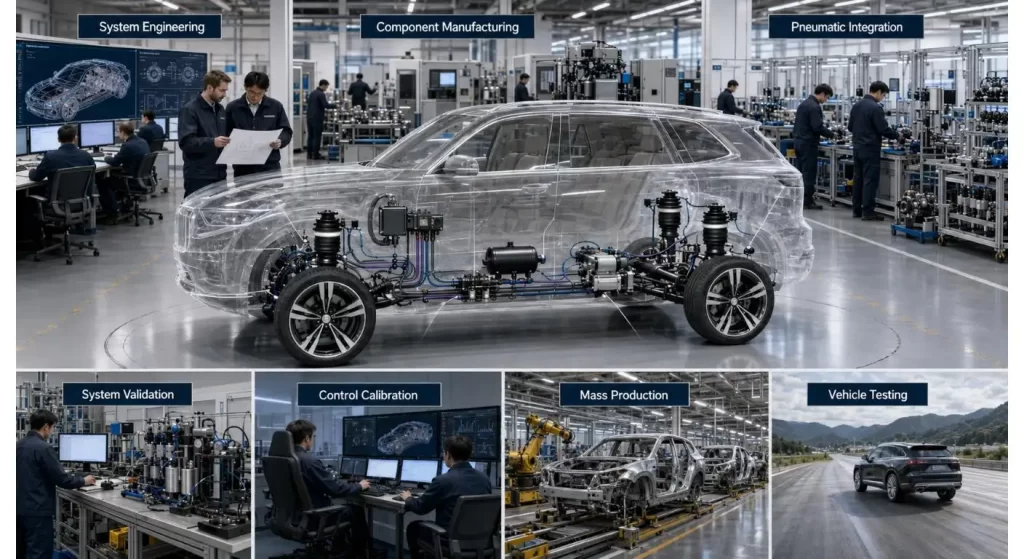
Air springs, compressors, valve blocks, sensors and controllers are available from supplier. The true challenge is to see if it can grasp how those components behave whilst under stress in various loading conditions over changes in height and whilst the car is in motion.
The product for the vehicle makers and serious aftermarket brands is NOT a box of components, it's a chassis-control system.
Start the design with the auto and not an already established P/N
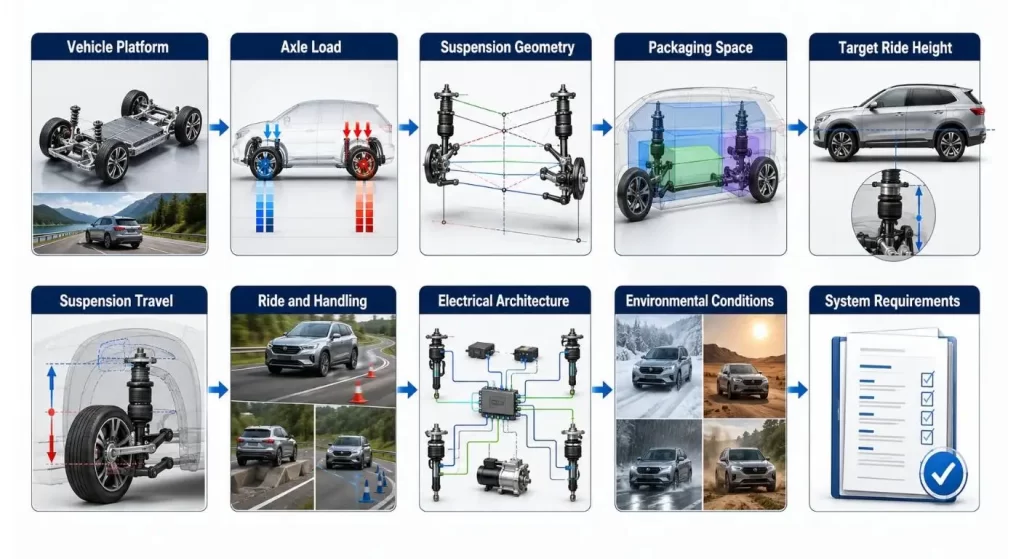
The vehicle target is a good starting point for a development discussion.
If the model is a large SUV an adjustable ground clearance and comfortable high-speed handling may be required. For a luxury sedan, the priority is probably the smoothness and quietness of height adjustments. Different axles loads and tighter packaging may occur in an electric vehicle.
The modern air suspension, ZF says, is an integrated system that is made up of pneumatic, mechanical, electrical and software components. In passenger-car systems, this height can be adjusted independent of load and the ride height can be changed at high speed, reducing the height without altering the ground clearance and vice-versa.
The manufacturer needs to make such targets measurable requirements, corner loads, ride heights, suspension travel, raising and lowering times, pressure reserves, noise, current draws and fault behaviours.
Designate an interface team just for one team.Have one team with one interface team.
Some problems seem to "show up" between components and are very expensive.
The compressor can do its own job of supplying its desired air flow, but still have too slow a fill rate due to line restrictions. Although an air spring can be higher on pressure it may feel wrong due to incorrect geometry and wrong damper placement. A height sensor can be accurately on the bench but not after it is installed.
A good car air suspension manufacturer ought to have a managed interface document, which must include porting, connectors, mounting points, pressure minimization, electrical load, communications signals, software versions and diagnostic behaviour.
If there is no clear ownership for the interface, then each supplier can claim that his/her individual component is ok and that the whole car isn't.
| Evaluation Area | What to Confirm | Main Project Risk |
| Vehicle engineering | Vehicle targets converted into system requirements | Components selected without vehicle context |
| System architecture | Pressure, reservoir and valve strategy | Slow or unstable height control |
| Component matching | Air spring, compressor and valve compatibility | Poor system response |
| Interface ownership | Mechanical, pneumatic and electrical definitions | Responsibility gaps |
| Control calibration | Version-controlled software and parameters | Incorrect height or frequent cycling |
| System validation | Rig, environmental and vehicle tests | Component tests miss interactions |
| Technical cleanliness | Complete pneumatic-chain control | Valve blockage or internal leakage |
| Production readiness | APQP, testing, capacity and safe launch | Prototype quality cannot be repeated |
| Variant management | Part, software and vehicle configuration links | Mixed or incompatible products |
| Field analysis | Returned-part and root-cause process | Repeated warranty failures |
The idea here may sound obvious, but it's extremely worth emphasizing
The arrangement of the pneumatics dictates how the car rides, adjusts its height and maintains it.
The engineers must determine whether the system employs a reservoir, the isolation of the four corners, the location for measuring the pressure and the method for controlling exhaust air. Line diameter and routing also has an impact on the response time and sound.
For each option there is a compromise. The larger the size of the reservoir the more packaging space in a box, the higher the valve flow the more sudden it'll be moved, the larger the compressor the more heat, current draw and noise. However, manufacturers with solid production operations make these interactions before freezing of the production tooling.
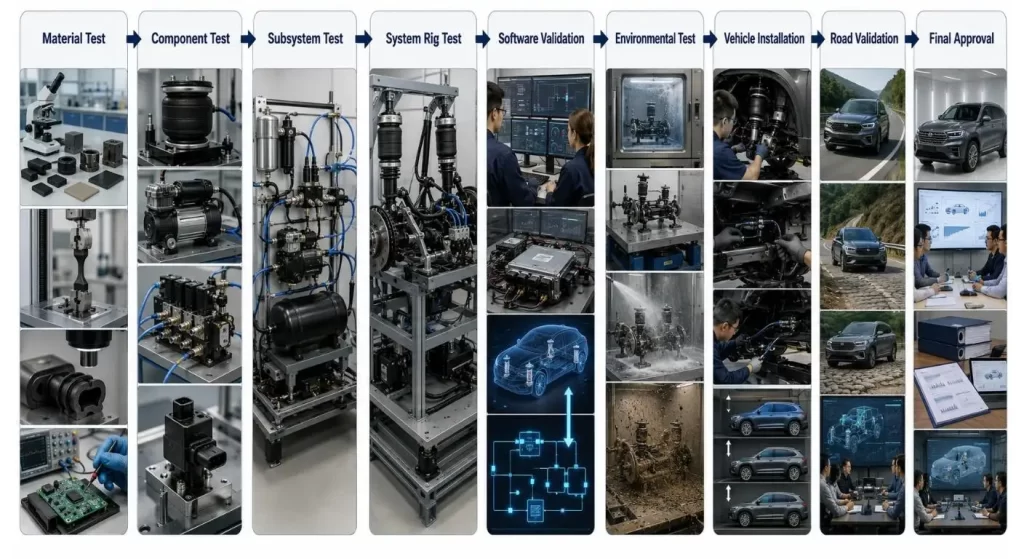
Using a system rig here comes in very handy. It helps engineers to determine and compare fill time, pressure stability, exhaust behaviour and fault recovery prior to fitting rejection in a whole vehicle.
Treat calibration as a product!
The feel of the air-suspended vehicle isn't just a matter of the hardware.
The control strategy will cause the compressor to operate at the same time as the valves are opened, the same speed as the body is moving, and the same set of conditions (with the same height) as the load and operating temperature and/or low voltage dictate. It also determines which action will be taken in case of a sensor malfunction or pressure alert.
Like drawings, calibration files must always be handled. A revision, reason, record of supporting test and vehicle-applicability record is required for each software or parameter change.
Although a replacement component might bolt in, it may still not correct slowly or if its performance varies from that of an original system, cause compressors to cycle frequently.
This is a good example of why it is a system manufacturers advantage to have an understanding of both the hardware and the control logic, instead of taking the last few weeks of a project to perform calibration.
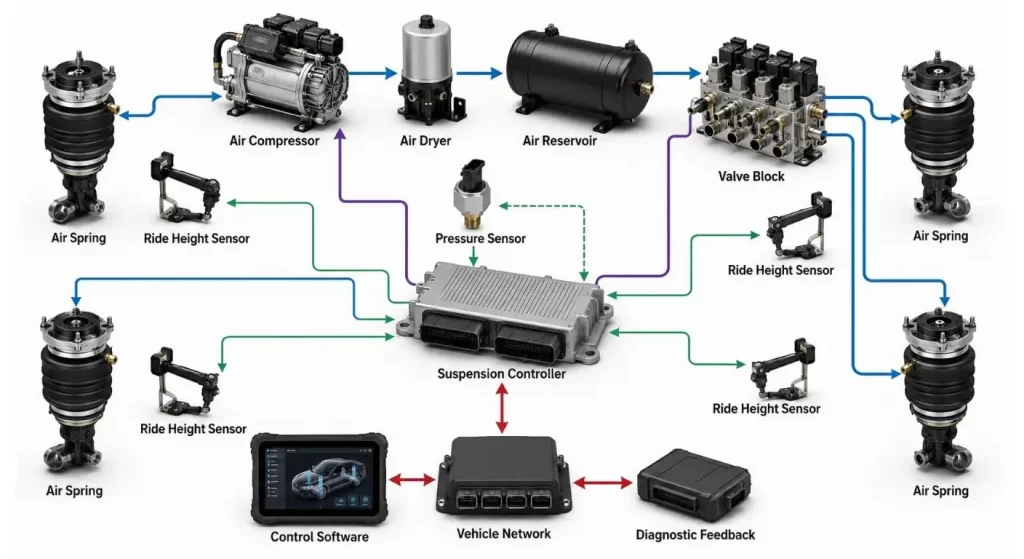
System components alone cannot be validated
You need to perform component testing but that will not show any interactions.
An air spring can go through the process of cycling pressures while the vehicle still has an imbalance for any overnight layover. A compressor can pass a bench endurance test and yet overheat under a vehicle cover which is not properly ventilated. An external leak test maybe useful without recognising slow cross leakage within the valve block.
The ISO 16750 are standards that apply to the electrical, mechanical and climatic environment of automotive electrical/electronic components based on the place of mounting. That principle is holistic as the valve block under the car and the controller in the cabin see different conditions.
Still require a vehicle to final approve as comfort and noise and body control are all items that can't be approved on a component bench.
Directs to clean the entire pneumatic chain
The air pathway can carry the one particle that remains in one component.
There may be a metal chip causing the valve seat to remain open. Fragments of rubber can obstruct a passage. A moisture/dryer debris may later come in contact with the reservoir/value block.
ISO 16232 is a standard for the quantitative assessment and documentation of particulate contamination of functionally relevant automotive components and for control of the cleaning and assembly processes. There is not a single overall limit as the amount of cleanliness depends on the component and system to be used.
Deburring, washing, filtered drying, port protection and packaging are all under the control of a responsible manufacturer throughout the entire system.
The responsibility for cleanliness should not stop at the factory's door! During storage, shipment and installation, protection should be given to air lines, reservoirs, and service parts as well.
Prove Mass-Production Readiness
With hand adjustment and using some additional inspection, an outstanding prototype can be developed by putting on a development workshop. The result will be required in the serial production at normal cycle time.
APQP and Control Plan methods link product development and risk analysis, process planning and continued manufacturing controls. In light of the increased complexity of vehicles, and an increasingly automobile world that is automated and electric, AIAG has modernized these methods.
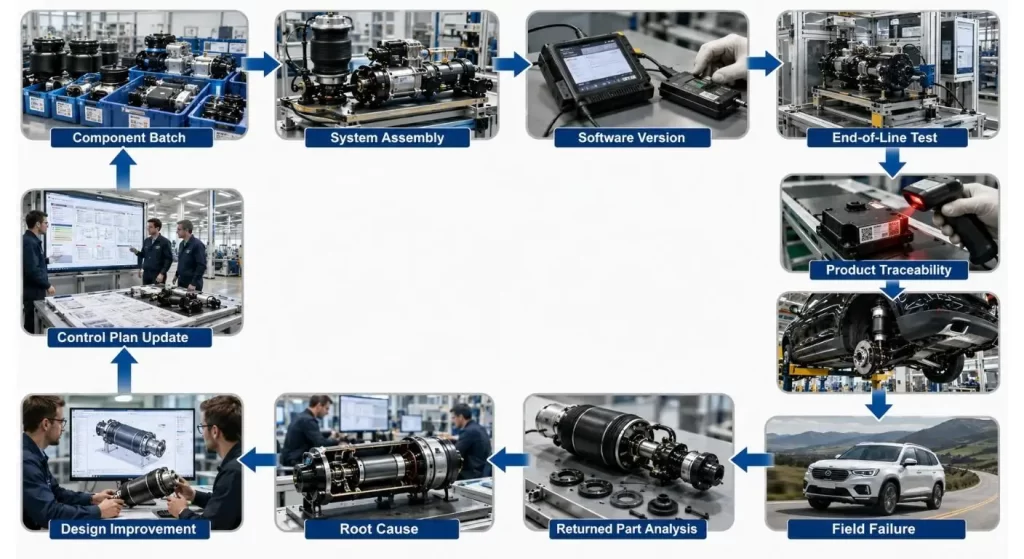
Production readiness activities shall include the interfaces that are important, leak and flow checks, software configuration, measurement systems, capacity/safe launch and traceability.
IATF 16949 sets out an automotive quality-management framework that is a strong customer specific orientation. While certification helps, buyers need to establish verification of actual plant, the range of products and shop-floor implementation.
Mix-ups during calibration where the wrong calibration is loaded into the controller, or where mixed valve-block variants have made it into the assembly line, can not be illustrated by the certificate. That's because the evidence comes from that AFR, the actual process.
Now is the time to shift into neutral
Each platform could have varied body configurations, axle loads, battery packs and suspenders as well as regional requirements.
It is possible to share parts and make it a cost reduction, but similar-looking parts cannot be mixed. The smallest changes in the geometry of the spring, software or connectors can make a difference.
The following elements should be connected to variant control: Vehicle configuration, part number, software level, calibration, end of line test/ packaging label. Traceability should be able to be read for years after production.
The same period of gymnastics should apply to service parts, too. An axle position, production date, suspension code and a calibration should be easily identifiable from a replacement catalogue, enabling the workshops to choose the appropriate component.
The project will run for two weeks.The project will last for 2 weeks
Not all air suspension companies making automotive air suspension products make all the products.
Another factory might shape air springs, as well as buy compressors. Yet another could be to manufacture whole struts based on external parts which would be dampers, seals or electronic components. That might be right, but it must be certain who owns what.
Even if the successful parts are from a number of specialist factories, the finished-system supplier should still take on responsibility for integration.
Use a field return to learn.Improve knowledge through field return
Sometimes failures of an air suspension are attributed to failure of the ultimate element when the cause was actually something else.
If you have a compressor fixing the leaking spring (being used as a compensator), then the compressor may actually die. Some contamination can enter from the dryer, causing the valve block to stick. Failure to perform the "ride-height calibration" by the workshop can cause an air strut to be returned.
A credible manufacturer will test a part back that he was returned to in the condition it was received and will determine which parts were to fault and which caused by the installation or system. Results should be incorporated into plans, control plans and service instructions.
Useful failure analysis analysis involves the inspection of components and the vehicle history, fault records, operating conditions and related repairs. If not, the manufacturer might replace a good component, while missing the root cause of failure in the system.
Conclusion
Not all of the automotive air suspension manufacturers have the longest product line.
The indicators of the conversion of vehicle targets into pneumatic architecture, matched hardware, controlled calibration, meaningful validation and stable production, all relate to a company's capability.
The following should be identified as key attributes to consider when assessing the interface ownership, complete-vehicle testing, technical cleanliness, disciplined variant control, and field failure analysis of buyers. It's those capabilities that make different pieces a reliable air suspension system.
FAQs
Q1. So what does the manufacturer of automotive air suspensions make?
Its size and contents dictate that it can be manufactured to generate air springs, compressors, dryers, reservoirs, valve blocks, sensors and controllers and air lines, and complete system assemblies.
Q2. Why System Integration Is important?
These components influence in Vehicle Pressure, Response time, Noise, Energy consumption, Vehicle height and diagnostics. Good individual pieces can fail to perform well when the pieces interface are incorrect.
Q3. Should the Complete Vehicle be subjected to a Manufacturer Test?
Yes. Rig tests are good, but the vehicle tests are important for comfort, noise, body control and height changes and real diagnostic behaviour.
Q4. Is IATF 16949 The Sufficient Standard For Approving a Manufacturer?
Buyers need to establish the scope of the certificate, and the Audit of the engineering, production practices, testing, traceability and change control practices at the actual facility.
Q5. Information required for a Custom Air Suspension Project:
It can take inputs such as vehicle mass, axle loads, suspension geometry, target heights, travel, and environment conditions, response time, and electrical architecture and validation requirements, to name a few.
Share on Social:


Contact Us
In This Article
- 1 Start the design with the auto and not an already established P/N
- 2 Designate an interface team just for one team.Have one team with one interface team.
- 3 The idea here may sound obvious, but it's extremely worth emphasizing
- 4 Treat calibration as a product!
- 5 System components alone cannot be validated
- 6 Directs to clean the entire pneumatic chain
- 7 Prove Mass-Production Readiness
- 8 Now is the time to shift into neutral
- 9 The project will run for two weeks.The project will last for 2 weeks
- 10 Use a field return to learn.Improve knowledge through field return
- 11 Conclusion
- 12 FAQs
