


Custom Air Suspension Parts Compressor Design: Airflow, Duty Cycle and Thermal Protection

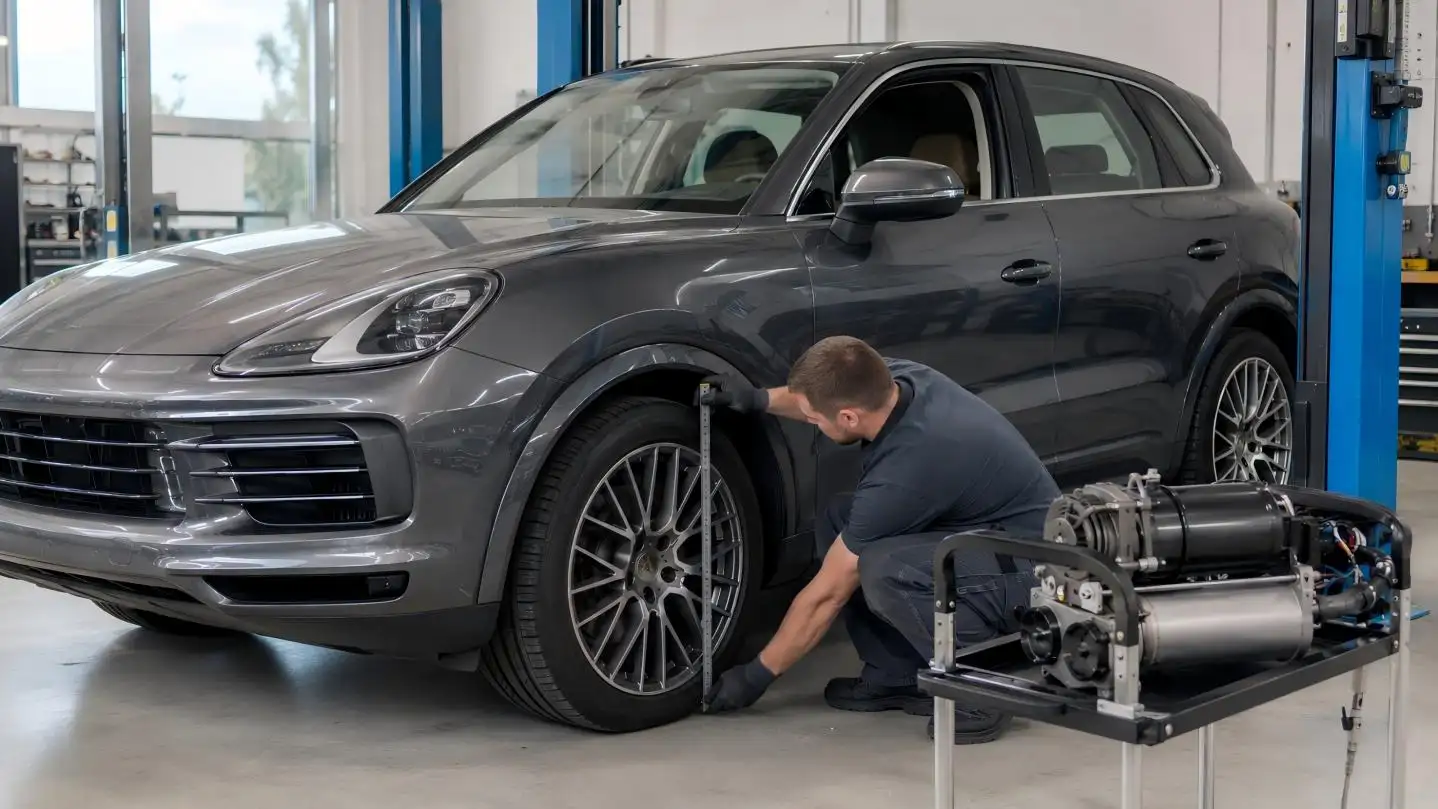
An air suspension compressor does more than produce pressure. It must raise the vehicle within the ECU's permitted time, recover reservoir pressure without excessive current draw, and remain below its thermal limit during repeated leveling cycles.
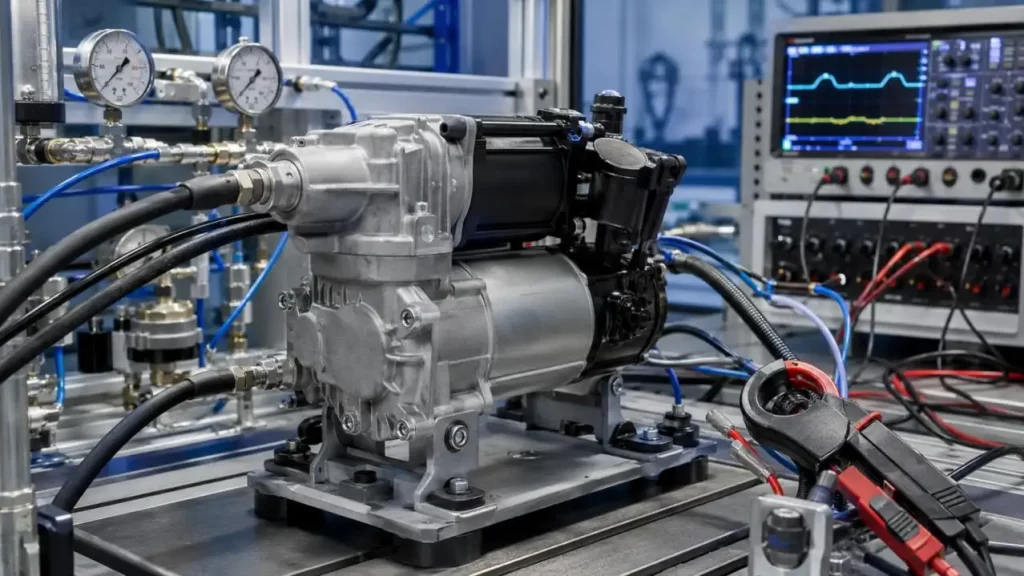
For this reason, Custom Air Suspension Parts should be engineered as a pneumatic, electrical and thermal system—not selected from one maximum airflow figure.
A Slow Lift Is Not Always a Weak Compressor
Slow height recovery, frequent compressor starts and thermal shut-down can indicate compressor wear, but the same symptoms appear when air springs leak, dryers restrict flow or supply voltage falls.
Before replacing hardware, record:
•Pressure before and after each operating cycle
•Time required to reach the commanded ride height
•Voltage and current at the compressor terminals
•Housing or motor temperature after repeated cycles
•Pressure decay after the compressor stops
| Symptom | Possible cause | Useful verification |
| Slow lift at high pressure | Poor pressure-side airflow | Plot flow at several pressure points |
| Normal first cycle, slow later cycles | Thermal accumulation | Record temperature and recovery time |
| Frequent short starts | Air spring or valve block leakage | Static pressure-decay test |
| High current with low output | Mechanical restriction or wear | Compare current, pressure and flow together |
A new compressor installed into a leaking system may quickly suffer the same failure. Diagnosis must therefore precede Custom Air Suspension Parts selection.
Airflow, Pressure and Temperature Must Be Read Together
Free-air flow is measured with little outlet resistance. It describes basic displacement but does not predict suspension lifting speed because compressor output falls as pressure rises.
A first-stage estimate can be expressed as:
t ≈V(P2,abs - P1,abs) / Patm × Qaverage
For example, raising an idealized 10 L system from 4 to 9 bar gauge requires approximately 50 L of free-air equivalent. At an average pressure-corrected flow of 20 L/min, the theoretical filling time is about 2.5 minutes before leakage, temperature and line losses are included. These figures illustrate the calculation method; they are not Huijie product ratings.
Electrical and thermal behavior must be evaluated simultaneously:
Pinput =V×I
At an illustrative 12 V and 20 A, the compressor receives 240 W. Only part becomes useful pneumatic power; the remainder appears mainly as motor, pump and wiring heat.
Duty Cycle Needs Test Conditions
Duty Cycle=ton/(ton+toff)×100%
A duty-cycle claim is incomplete unless it states:
•Test period
•Outlet pressure
•Ambient temperature
•Supply voltage
•Cooling arrangement
•Thermal cut-off and reset criteria
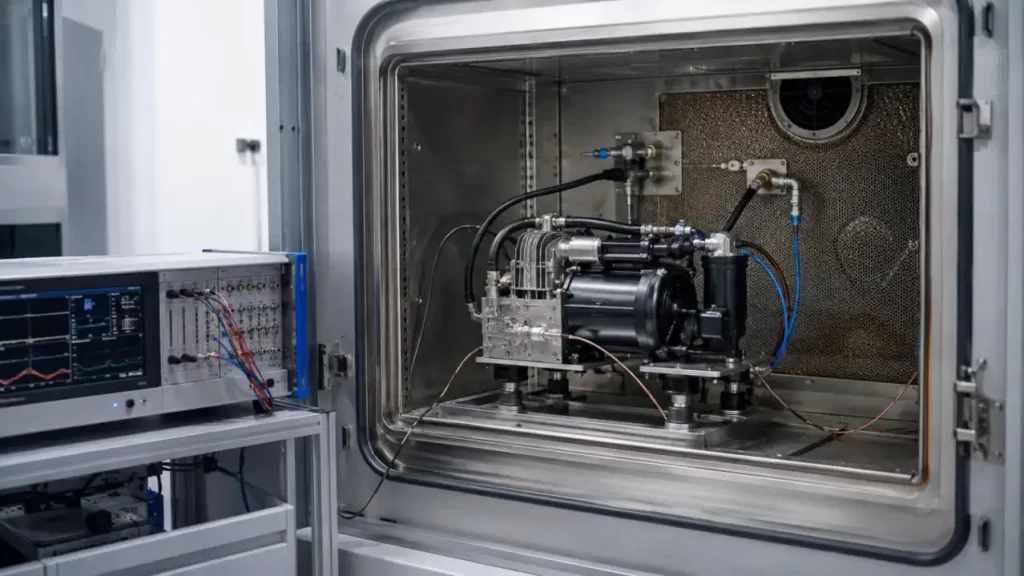
Thermal protection prevents immediate damage, but frequent cut-off indicates incorrect system sizing, insufficient cooling or unresolved leakage.
Compare Custom Air Suspension Parts by Operating Envelope
Different compressor architectures solve different problems. The comparison should remain application-specific.
| Design choice | Option A | Option B | Selection criterion |
| Pneumatic output | High free-air flow | High-pressure flow optimization | Initial fill versus reservoir recovery |
| Motor | Brushed DC | Brushless DC | Cost, controller design, EMC and life |
| Operating mode | Intermittent duty | High-duty operation | Occasional adjustment versus frequent leveling |
| Thermal control | Mechanical cut-off | Sensor and ECU control | Basic protection versus active diagnostics |
| Packaging | Integrated dryer and relay | Modular components | Direct fit versus service flexibility |
No thermal strategy can compensate for a compressor that is undersized at its actual working pressure.
Match the Compressor to the Air Circuit and Vehicle
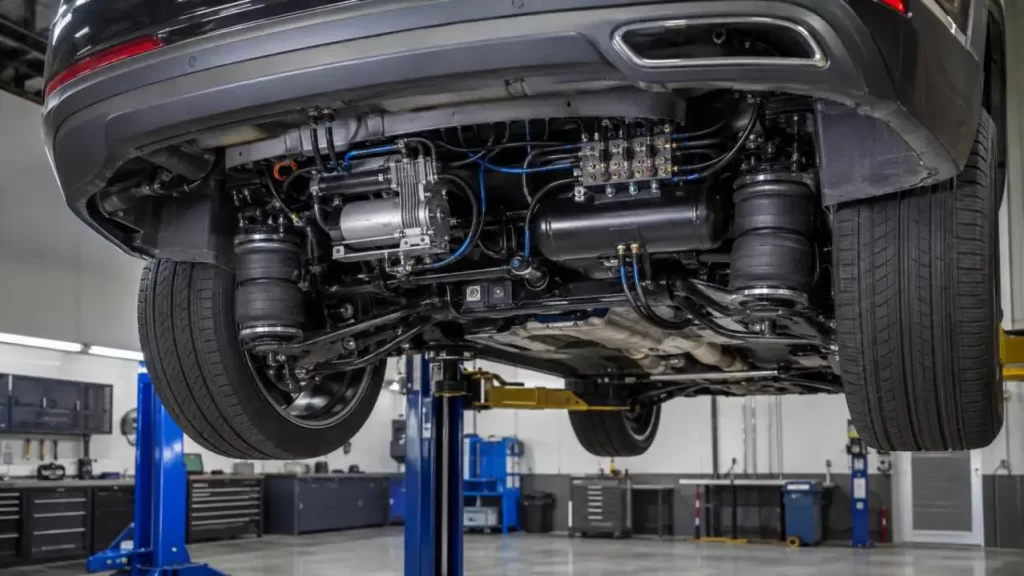
Correctly engineered Custom Air Suspension Parts must account for air spring volume, reservoir size, valve-block restriction, line diameter, target pressure and allowable recovery time.
Huijie's valve-block configurations use both Φ4 and Φ6 interfaces. Examples include a 5-Φ4 + 3-Φ6 configuration for the 2018–2022 Audi Q7 and a 6-Φ6 configuration for applications including the Porsche Panamera 970, Audi Q7 and Volkswagen Touareg. These dimensions matter because smaller passages, long lines and multiple fittings increase pressure loss and compressor run time. View Huijie valve blocks
Electrical fitment is equally important:
•Rated voltage and starting current
•Relay and fuse capacity
•Connector pinout and grounding
•ECU operating-time limits
•Bracket geometry and vibration isolation
•Intake, dryer and discharge-port arrangement
Huijie's published compressor applications provide OE-number and vehicle-year references for initial matching:
| Vehicle platform | OE references | Application years |
| Audi Q7 4L | 4L0698007A/B, 7L0698853A, 7L8616006A | 2002–2010 |
| Mercedes-Benz W164/X164 | 1643201204, 1643200904, 1643200204 | 2005–2012 |
| Jaguar X350/X358 | C2C2450, C2C22825, C2C27702 | 2004–2009 |
| Tesla Model X | 670039247 | 2017–2021 |
OE matching is only the first filter. Pressure-flow behavior, current, connector, bracket and control compatibility still require validation. Explore Huijie air suspension compressors
Installation Determines the Real Thermal Load
Before installing new Custom Air Suspension Parts, technicians should repair air leaks and inspect the dryer, intake filter, relay, fuse and ground connection. The compressor also needs cooling clearance and correctly torqued vibration isolators.
Common causes of excessive run time include:
•Saturated or blocked desiccant
•Internal valve-block leakage
•Undersized or sharply bent lines
•Low terminal voltage
•Restricted intake airflow
•Repeated ECU leveling commands
Noise should be measured under working pressure in the production mounting position. An unloaded bench test cannot represent structure-borne vibration inside the vehicle.
Convert Huijie Production Capacity into Verifiable Evidence
Huijie offers the following manufacturing capacity:
| Production Capacity | Scale or control |
| Air suspension manufacturing experience | 15+ years |
| R&D and production base | 10,000 m² |
| Air suspension product range | 2,000+ products |
| European-car application coverage | 95% |
| New products developed annually | 100+ |
| Regular-item dispatch | 1–3 days |
| Pre-shipment inspection | 100% testing stated |
Our working current and voltage are checked for OE-level performance. For a custom program, this production control should be expanded into agreed acceptance limits for pressure-side airflow, current, leakage, noise, temperature rise and recovery time.
Validation references ISO 16750-2/-3/-4 for electrical, mechanical and climatic loads, ISO 20653 for ingress protection, ISO 7637-2 for electrical transients, CISPR 25 for EMC and ISO 9227 for salt-spray methods.
Specify the Evidence Before Requesting a Quote
A Custom Air Suspension Parts RFQ should include the vehicle, OE reference, system volume, pressure range, target recovery time, operating frequency, ambient temperature and electrical interface. Buyers should request:
•Pressure-flow-current curves
•Duty-cycle and thermal-reset conditions
•Leakage, noise and durability reports
•Drawings and connector specifications
•Sample approval and batch traceability
•Certification scope and manufacturing address
Huijie's broad OE database and in-house product platform provide a practical starting point for custom compressor development. Buyers can submit their vehicle data and operating conditions to Huijie for technical matching before moving to sample testing and commercial quotation.
FAQs
Q1. Does Huijie offer Custom Air Suspension Parts?
Huijie offers air suspension compressors, air springs, struts, valve blocks and after market parts. For a custom request, vehicle platform, OE reference and anticipated performance must be provided.
Q2. What details do Huijie require for a custom compressor quotation?
Huijie requires the vehicle model, chassis, year of production, OE number, voltage, pressure range, and the interface for installation. Recovery time, operating frequency and inflation environment are critical for the design of the compressor.
Q3. How does Huijie validate vehicle configuration?
The product information published by Huijie includes vehicle platforms, chassis codes, OE numbers, and production years. The further connection of the control system, brackets, and airflow air demand should also be verified.
Q4. Does Huijie test all air suspension compressors before shipping?
Huijie's products are tested before shipment. On its compressor pages, it refers to checking working current and voltage. However, Huijie allows other limits to be agreed upon for airflow, leakage and thermal.
Q5. Does Huijie supply pressure-flow and duty-cycle data?
Pressure-flow-current curves and duty-cycle data for each model should be requested as it is currently not published for any of its products.


Contact Us
In This Article
- 1 A Slow Lift Is Not Always a Weak Compressor
- 2 Airflow, Pressure and Temperature Must Be Read Together
- 3 Compare Custom Air Suspension Parts by Operating Envelope
- 4 Match the Compressor to the Air Circuit and Vehicle
- 5 Installation Determines the Real Thermal Load
- 6 Convert Huijie Production Capacity into Verifiable Evidence
- 7 Specify the Evidence Before Requesting a Quote
