


Suspension System Parts: How the Chassis Works Together
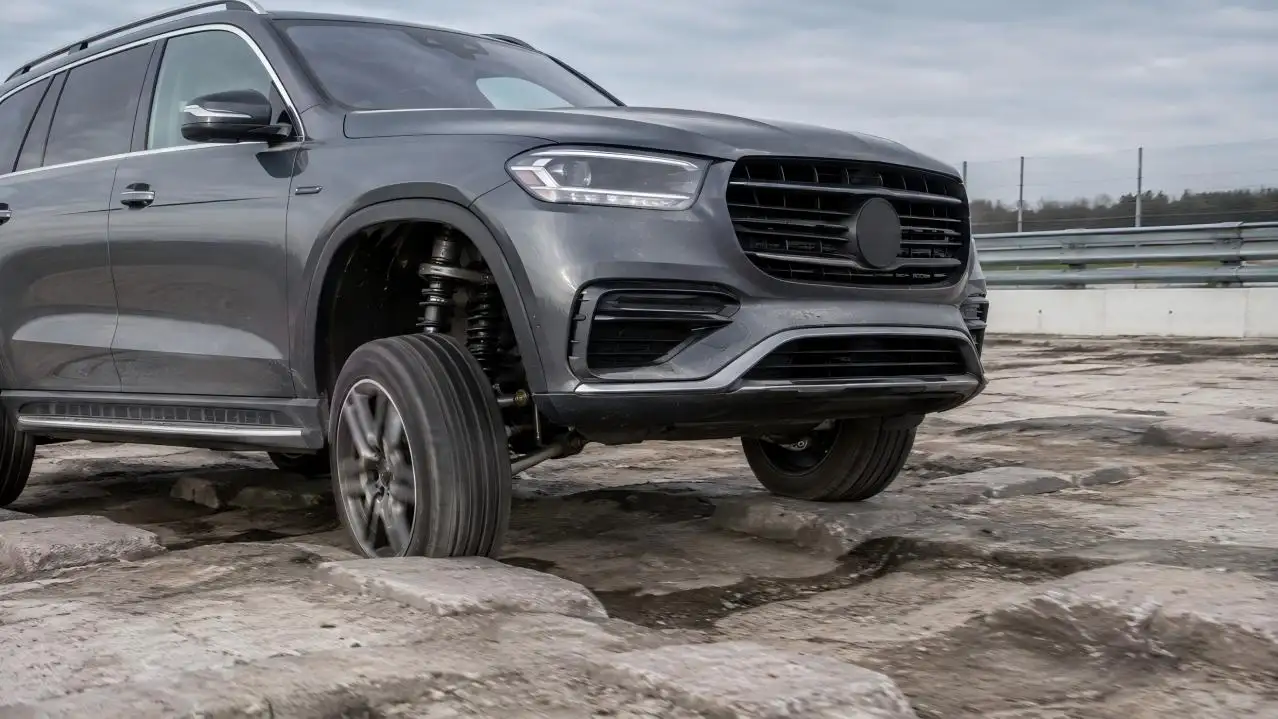
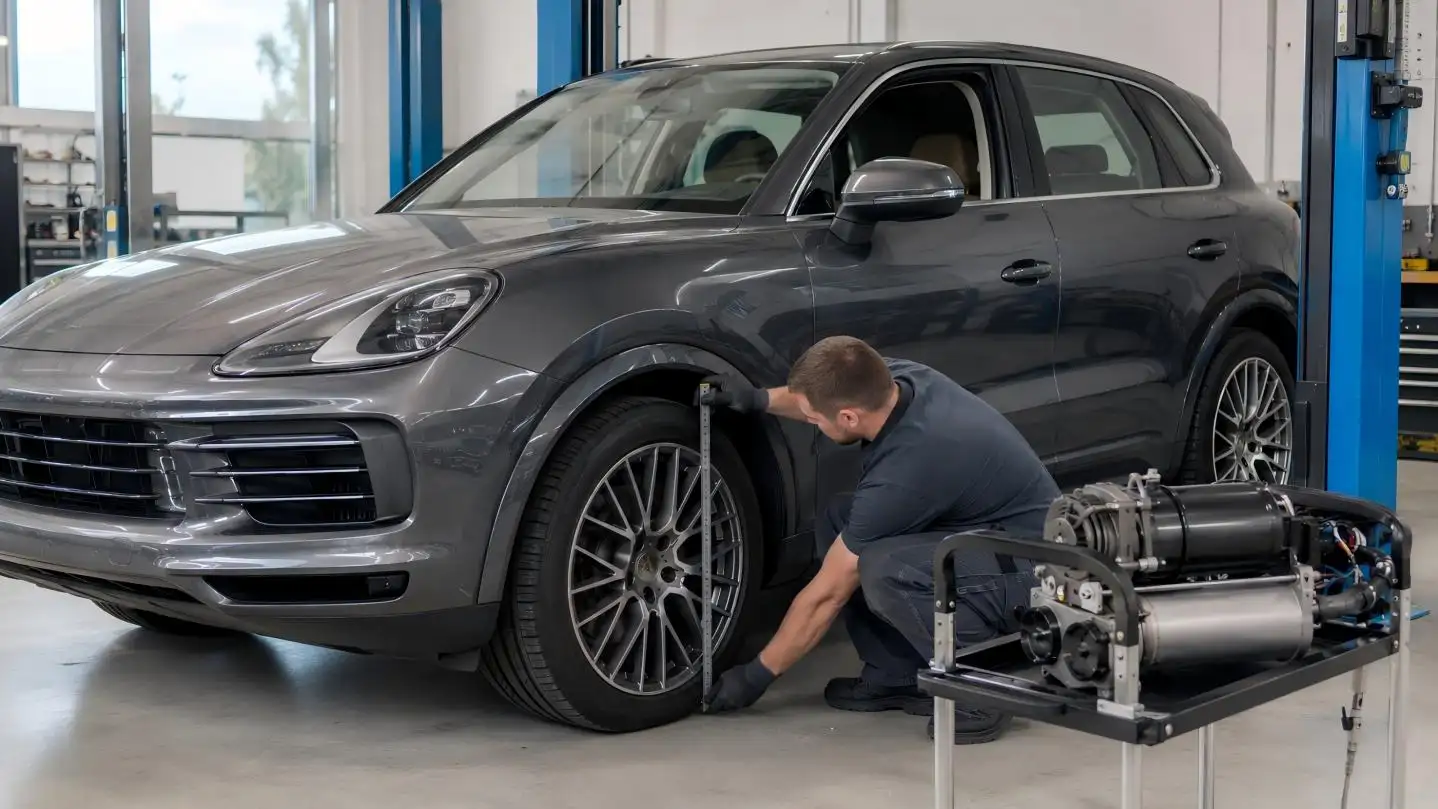
Suspensions problems don't show up in a clear and simple way.
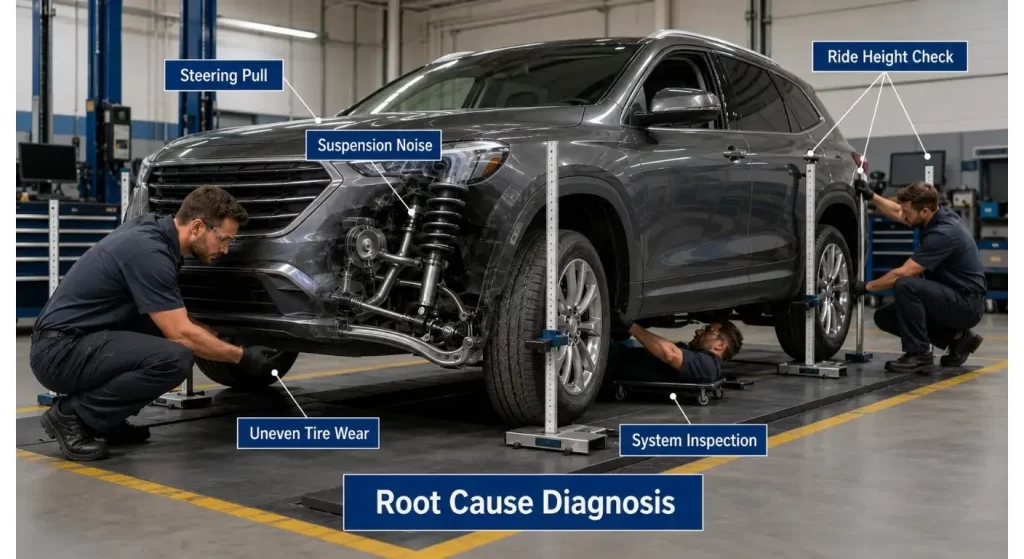
The elements of suspension system operate in the interaction between the tyre and the car body. A helpful inspection comes after making that connection as opposed to focusing on each part individually.
Put the tire prints on the ground
Check the tires prior to lifting vehicle.
Uneven shoe wear (such as from a cupping or scattered low spot(s) in the shoe, or a difference between the left and right shoe) can indicate movement that may not be noticeable when observing shoes while they are stationary.
Control arms, bushings, ball joints, tie-rod ends and wheel bearings all contribute to the wheel being in the proper position. If worn, the wheel can roll differently while braking, turner cornering or coming from a road shock, leading you to experience irregular wear and tear on your tires.
Inquire of the timing of the symptom, too.
If there's a knock on slow turns, it's likely that the load path is different from a repeated rattle on broken pavement. A car that still drifts even without applying the brakes to it may not be as bad as a car that drifts back and forth during braking.
It's better to conduct a short road test than a shelf full of replacement parts.
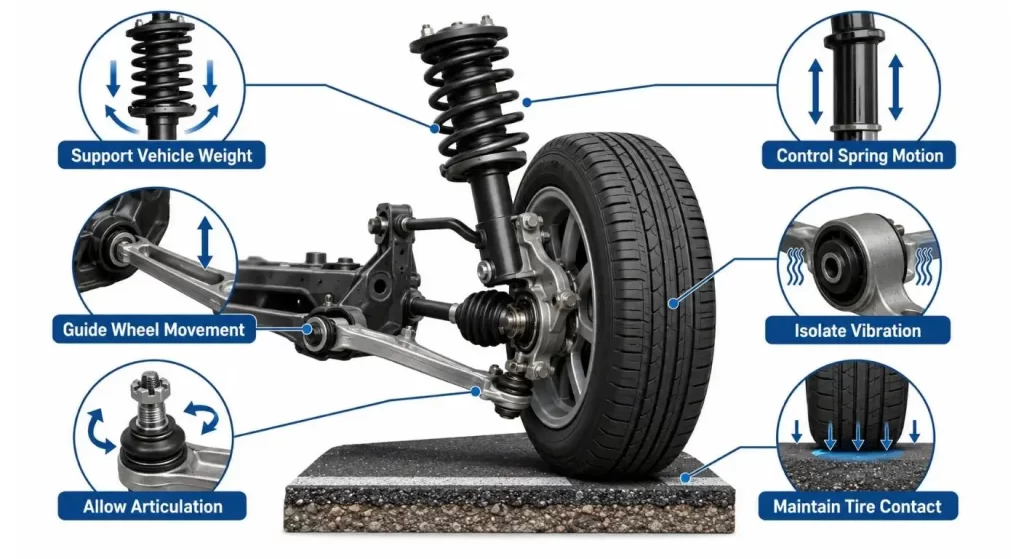
Identify the functions or purposes of each component
There are several functions of a suspension system.
Spring supports the weight of the vehicle and takes the vertical movement up and down due to flexing of the road. The movement of the spring and body is controlled by the shock absorber or strut. The wheel is controlled by control arms. Ball joints permit joints to bend. Bushing allows for some motion and filter out vibration.
The stabiliser bar minimises excessive left/right suspension movement when cornering.
These parts work in conjunction with each other. The geometry, springs, dampers, joints, anti-roll devices and tyre behaviour all combine for the suspension design to provide balance between comfort and handling to get the required balance.
This is why a vehicle might be at the proper height but still be bouncing, wandering, etc. and not feel stable.
| Suspension Part | Main Function | Common Warning Sign |
| Coil spring | Supports vehicle weight | Uneven ride height |
| Shock absorber or strut | Controls spring and body movement | Bouncing or poor stability |
| Control arm | Guides wheel movement | Alignment change or wandering |
| Ball joint | Allows steering and articulation | Knocking or steering play |
| Control arm bushing | Isolates vibration and controls movement | Braking shift or vague steering |
| Stabilizer link | Transfers anti-roll-bar force | Rattle over uneven roads |
| Strut mount | Connects the strut to the body | Noise while turning or over bumps |
| Wheel bearing | Supports wheel rotation and position | Humming, vibration, or wheel play |
| Tie-rod end | Transfers steering movement | Loose steering or toe variation |
Each spring and damper is needed the other
An abnormal spring or failure of one of the springs may cause it to sag down at one corner of the car. Even if the ride height appears normal, the damper can be worn out allowing for "repeated bouncing".
The suspension springs connect the wheels to the car body, says ZF. They along with the shims, assist in road holding under varying loads and road conditions under the shock absorbers.
If the spring/damper is being replaced, check the assembly around the spring/damper:
- Upper mount
- Spring seat
- Bump stop
- Dust cover
- Bearing
- Fasteners
- Opposite-side component
A damaged mount may result in the mounting creating noise during operation similar to that of a strut failure. Dust cover can be torn allowing dirt to find its way in to the damper shaft. If the bump stop collapses, it can cause the suspension to hit hard when the road is input large.
Don't fix just the easily-seen patch, which results in half a problem.
The joints are the important parts of a control arm
The control arm is used to constrict the wheel into a certain movement. The bushings and ball joint are able to move the wheel in this way, but they don't allow it to move freely in all directions.
A worn ball joint can also cause a knuckle knock and/or steering play. Bushing wear can occur with a lower noise level. The driver might feel some "moments of drifting" in steering, a small steering drift when braking, or feel some "rolling" on seams in the road before hearing any strange noises.
Check bushings for wear in direction of operation. A rubber bushing may appear good when not under load, but may move a lot when loaded by the weight of the vehicle.
When figuring out a replacement control arm the resemblance of the image is not sufficient as well. The amount of stiffness in bushing, joint location, as well as mounting-hole position and arm geometry can impact wheel alignment during suspension travel.
The correct part needs to be the same vehicle, axle, body and suspension.
Even the tiniest of links can generate an unexpected "noise"
The stabilizer links are comparatively small, but can frequently make harsh knocking noise when driving on rough roads.
The noise can occur when there is a difference in speed between the wheels and may occur when going into a driveway at an angle. Under smooth driving conditions, the vehicle will not make any noise.
But the problem is, loose brake hardware, worn out underbody shield, steering joint, ball joint, or a worn strut mount can make the same noise, too.
Never change the stabilizer for just "some sound" from that corner
Metals conduct a suspension noise well. Not all the time is the place where it begins the place where it is heard.
Often, the symptoms in Steering and Suspension are similar.
Drivers are not segmented into clearly defined categories for steering, suspension, tyres and wheel bearings
The toe and/ or steering response can alter if the tie rod end is worn. A wheel bearing can cause a noise or cause the wheel to move in an unwanted manner. If the wheel is bent, it can be the cause of vibration. If the pressure in the tire is not correct, the car can also feel unstable even if the parts of the vehicle's suspension are not faulty.
MOOG classifies the following issues as being related to either steering or suspension: pulling, abnormal noise, tire wear, excessive bouncing and steering response.
First of all: Check before ordering parts:
- Get rid of any cracked, bald or unevenly worn tires.
- Wheel damage
- Wheel-bearing play
- Steering joints
- Brake components
- Ride height
- Previous alignment results
Otherwise, it might be a new suspension part that's blamed for something that it never caused.
Seek the failure mode
If a component is worn it can damage the neighbouring components.
If the damper leaks it can allow additional movement and cause the wear of the mount and bump stop. A loose ball joint can cause misalignment to occur, which can cause tires to wear more quickly. If the spring is broken then its seat might become damaged or it could come into contact with a component nearby. If a bushing fails, it can cause the control arm to dislodge itself from its correct position.
Thoroughly clean the area before deciding. Road dirt may be able to cover any cracks, movement around a mounting hole, polished contact marks or slipped sleeves, and new cracks or movement in boots.
Check both sides of the car! The side which is not damaged may be the best reference to correct position and clearance.
It does not aim to set up a really long list to replace. The first step is to see the failures and, second, to determine if the failure affected something else later.
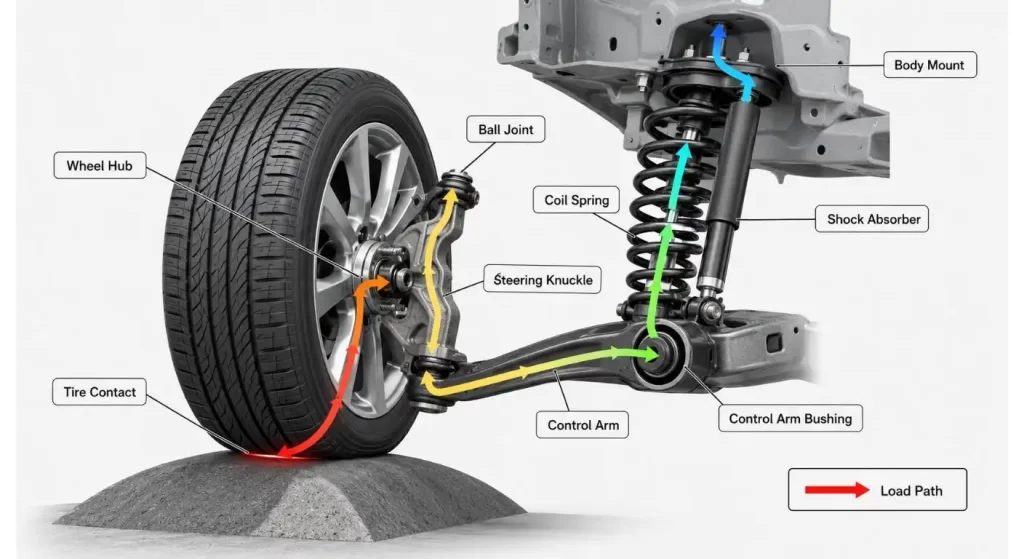
Many times the part quality is not apparent
A product photograph can look great and the details of the product that do not stand out well can be concealed within the suspension part.
The factors that are significant for a ball joint or stabilizer link are: the stud, the bearing surface, the grease, the dust boot, the sealing ring and the corrosion protection. The hardening of studs and sealed dust boots is important because waterproofing and contaminating the load bearing face will affect the durability.
On a control arm inspect weld consistency and retention, the orientation of the bushings, coating and dimensional accuracy. In the case of springs and dampers, check the axle load, model and suspension package and mounting design.
Fits the vehicle should imply more than "the bolt holes align.
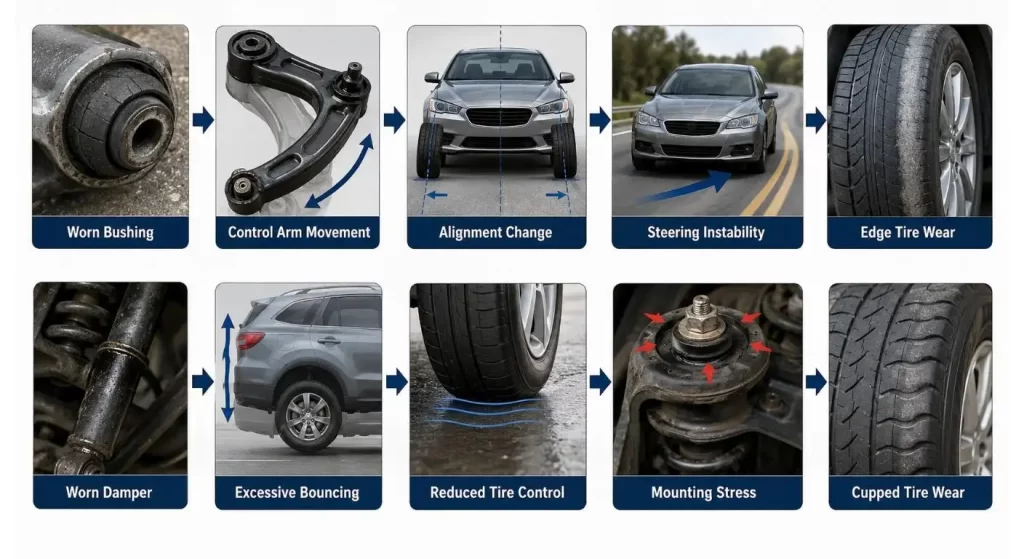
How to install it can be the next failure
Installing suspension system parts correctly is crucial to ensure they last long enough.
Final tightening of the rubber bussed control arms might be required at a normal ride height. If they are tightened during the hanging of the suspension they may be very tight when the vehicle is lowered, leaving the rubber permanently twisted.
Springs need to be positioned properly in their respective seating positions. A joint with a taper should be totally seated. Gripping should not be used to damage the damper shafts. Use of self locking nuts, retaining clips and specified single use fasteners should be replaced if necessary.
When wheel position has changed due to adjusting the wheels, check the alignment. It is NOT a good idea to match up old bolting marks.
The final test is an original complaint.
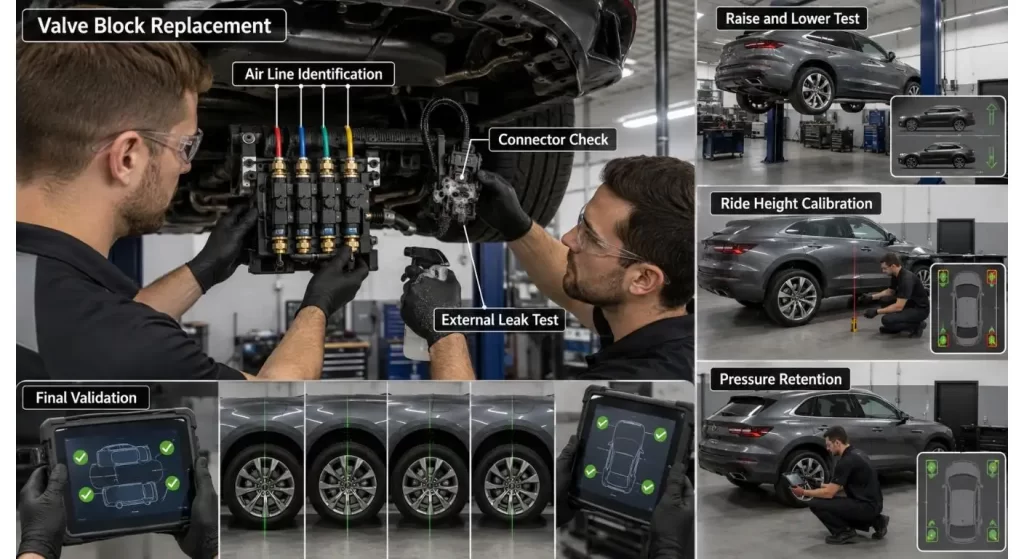
Conclusion
The function of the suspension system parts is to carry loads, facilitate wheel motion, to control body motion and to keep tyres on the road.
That's why the first step in making a reliable diagnosis is not the vehicle's behaviour, it's the vehicle's behaviour. Take the symptom from the tire all the way to the joints, arms, springs, dampers and mounts. Identify failure path, accurately replace and test on the road.
The most expensive suspension repair isn't the best. It's the one that restores the correct feel to the car.
FAQs
Q1. What is the Parts of a Main Suspension System?
The common components which are included are springs, shocks or struts, control arms, ball joints, bushings, stabilizer bars, links, mounts, knuckles and other wheel-end components.
Q2. Will One Worn Suspension Part Affect Other Parts?
Yes. Excessive motion or improper gearing can result in more wear in the tires, mounts, joints, dampers and surrounding suspension parts.
Q3. Why Does a Vehicle Knock Over Small Bumps?
It may be caused by stabiliser links, bushings, ball joints, steering joints, dampers, brake components and even loose underbody parts.
Q4. Should Suspension Parts be changed in pairs?
Springs, dampers and some axle components are typically in pairs to ensure that they perform in a balanced manner. The decision will be based on part condition and vehicle specific instructions.
Q5. Does Wheel Alignment Need To Be Done After Suspension Repair?
When a repair could impact wheel alignment, toe, camber, caster and/or suspension mounting geometry, alignment should be checked.
Share on Social:


Contact Us
In This Article
- 1 Put the tire prints on the ground
- 2 Identify the functions or purposes of each component
- 3 Each spring and damper is needed the other
- 4 The joints are the important parts of a control arm
- 5 Even the tiniest of links can generate an unexpected "noise"
- 6 Never change the stabilizer for just "some sound" from that corner
- 7 Seek the failure mode
- 8 Many times the part quality is not apparent
- 9 How to install it can be the next failure
- 10 Conclusion
- 11 FAQs
