


Air Suspension Leaking Overnight: Causes and Fixes
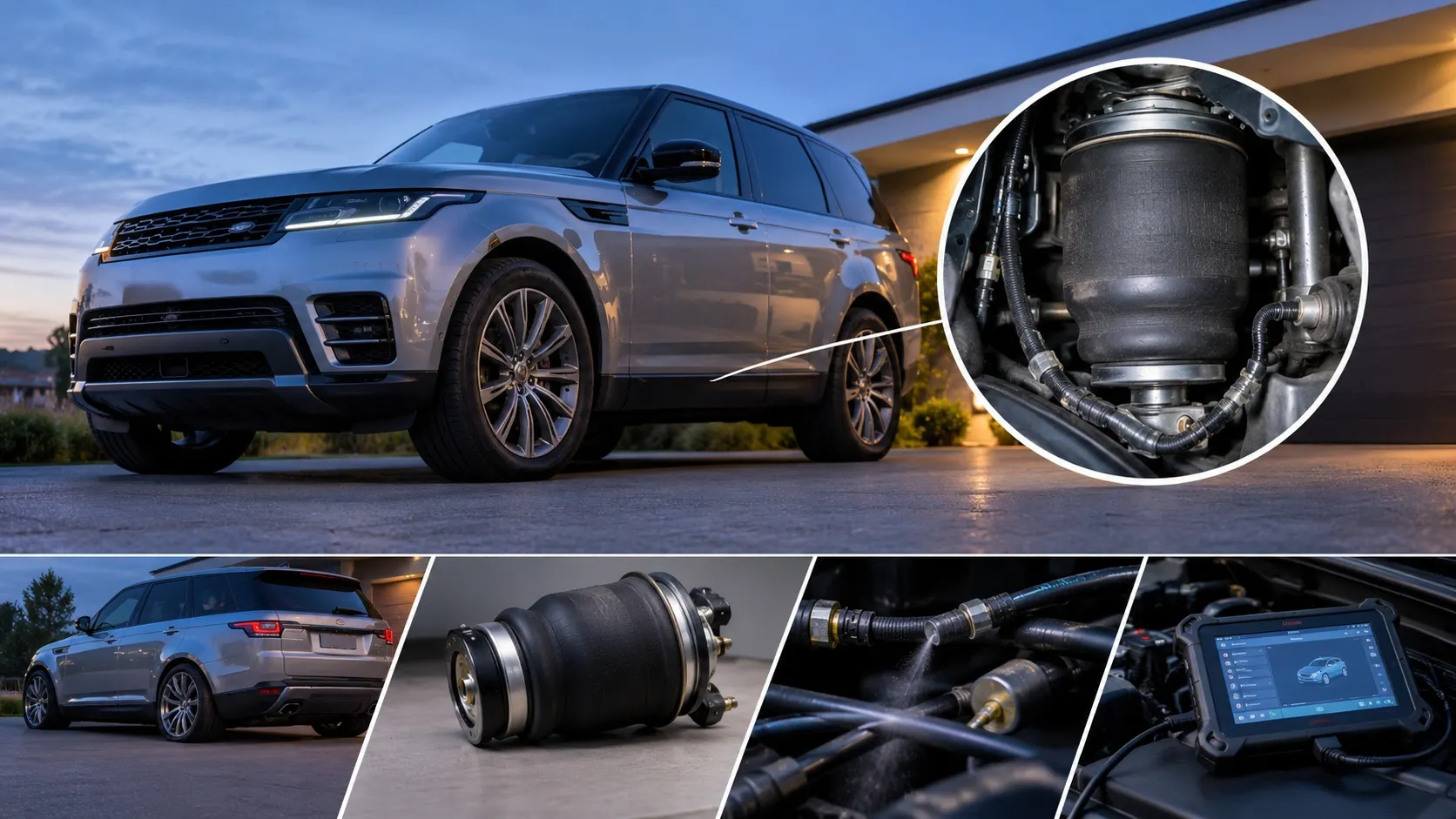
During the night, your car's air suspension could leak and cause the wheels to droop down or the rear end to lower, or the whole car to seem closer to the ground than before it was parked. It's a common issue in cars that have air suspension systems, whether they are luxurious sedans, SUVs or commercial vehicles.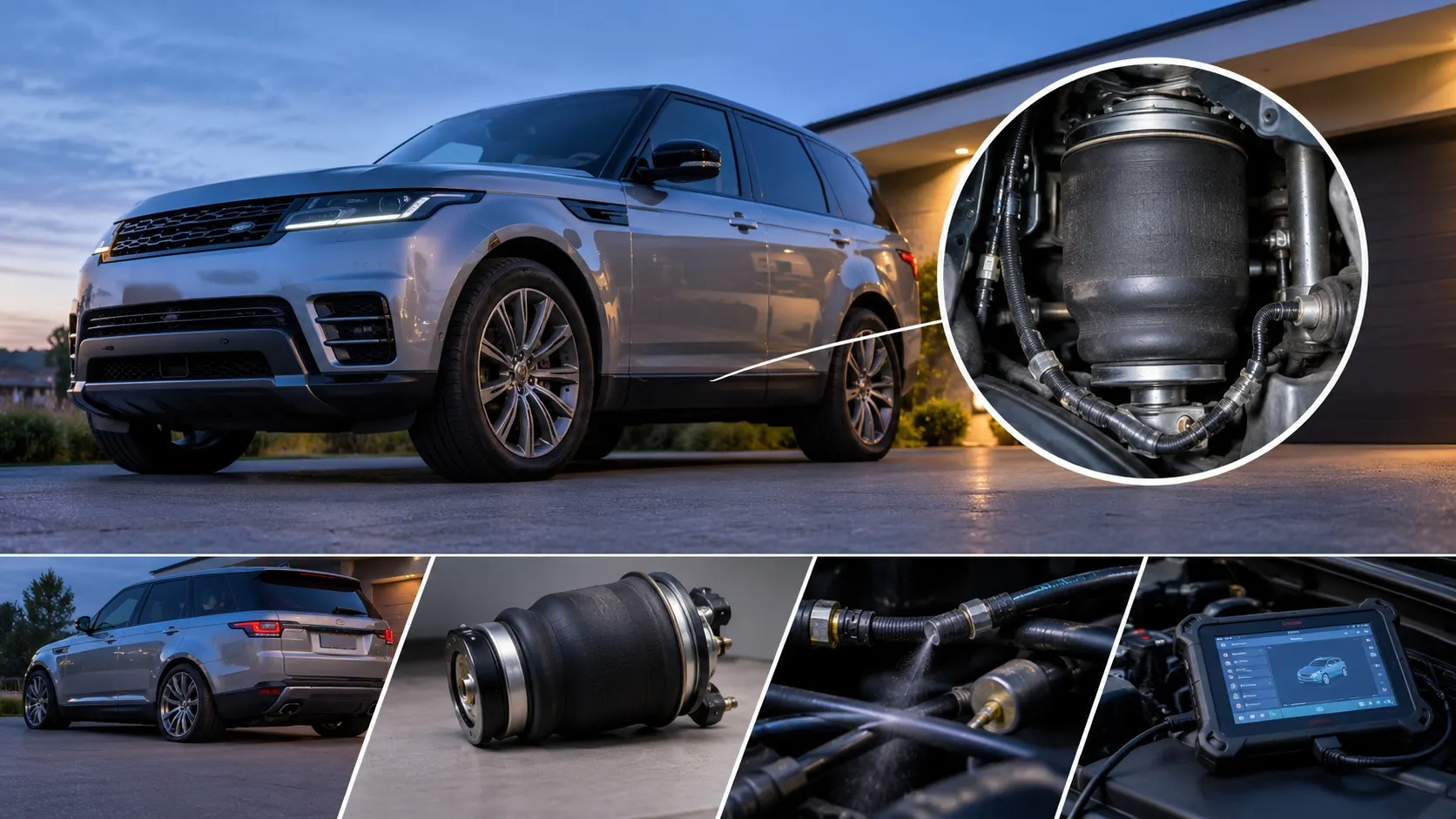
An air suspension system uses compressed air to keep the vehicle level, enhance ride quality and adjust ride height, as opposed to coil springs. The system can also lose pressure over time as air leaks out of the system while the vehicle is parked. A small leak will leave a noticeable droop in the roof overnight, and will possibly lead to other suspension parts being damaged.
Now that you know what causes air suspension to leak overnight, you can decide on the cause of the leak, prevent unnecessary repairs and consider which service is required: Air Spring Service, Replacement Valve Block or Compressor Service.
Most common causes, warning signs, diagnosis, repair and maintenance strategies for loss of air overnight in an air suspension system are presented.
What Does It Mean When Air Suspension Leaks Overnight?
Air suspension leakage occurs when compressed air flows out of one or more parts with the vehicle standing still, during the night. The air springs hold up the vehicle, which can cause a loss of pressure to cause the suspension corner or axle to drop.
This is a typical system response and can be caused by temperature changes and/or a vehicle's leveling strategy, and may be accompanied by a slight difference in height. If a vehicle is consistently leaking, or parts are failing, however, it should be inspected.
Common signs include:
-
One side of the vehicle sitting lower than the other.
-
The rear suspension sagging after several hours of parking.
-
All four corners dropping noticeably overnight.
-
The air suspension compressor running frequently after startup.
-
Warning messages such as “Air Suspension Fault” or “Suspension Failure.”
-
A rougher ride or reduced ground clearance.
-
Delayed suspension height adjustment after starting the engine.
The location and severity of the sagging can provide valuable clues about which components may be failing.
1. Common Causes of Air Suspension Leaking Overnight
1.1 Damaged or Worn Air Springs
One of the most common causes of overnight air suspension leaks are air springs. The flexible rubber bellows of these components expand and contract with the suspension.
Rubber may age over time due to road debris, moisture, salt and repeated compression cycles. When the vehicle is parked, there could be a slow leak of air through the small cracks or through the damaged folds.
Air springs can be particularly susceptible when the suspension is at its lowest point or when the rubber bends over and over again at the same spot.
Typical symptoms:
-
One corner drops overnight.
-
The vehicle sits unevenly after parking.
-
A hissing sound comes from an air spring.
-
The compressor runs longer than usual after startup.
When an air spring has leaked, the best repair is to replace the defective unit. Air Spring replacement should only be recommended to replace both air springs on the same axle if the service history for both springs is comparable, but the recommendations of the manufacturer will determine this.
1.2 Leaking Air Lines and Fittings
Air suspension systems are compressed air delivery systems that operate through pneumatic lines from the compressor to the valve block to the air springs.
These lines and connections may deteriorate or be damaged from vibration, corrosion, road debris, incorrect installation or aging seals.
A small leak at a fitting will cause a gradual loss of pressure in the system, even while the vehicle is in the parking lot.
Some potentially problem areas are:
-
Air line connections near the air springs.
-
Push-to-connect pneumatic fittings.
-
Connections around the valve block.
-
Corroded or cracked air tubing.
-
Damaged seals and O-rings.
A technician can test these connections with a suitable leak detection liquid, or with a special pneumatic leak testing tool. If the leak has been confirmed it should be repaired before it can result in further loss of pressure.
1.3 Faulty Air Suspension Valve Block
The valve block regulates the valve operation between the compressor, reservoir, and individual air springs. Carries valves and seals which guide air to the necessary suspension parts.
When an internal valve fails to close completely, air can flow around the valve or out of the system through an exhaust route. This can result in the loss of height at one corner, one axle or several suspension points.
Sometimes a faulty valve block can give symptoms that can be confused with a leaking air spring so it is essential to make the correct diagnosis.
For instance, if the suspension keeps dropping, but it doesn't correlate with a visible leak at the air spring, the valve block and internal seals might need to be tested again.
Depending on the vehicle design and the availability of serviceable components, the replacement or rebuilding may take care of the problem.
1.4 Air Suspension Compressor Problems
Air suspension compressor to provide compressed air to maintain ride height. A compressor failure itself does not necessarily result in a leak immediately; however, if a leak exists, the compressor failure can make the leak more obvious.
If the system goes flat while the vehicle is parked, the compressor might refill the system after the vehicle is started. A failing or broken compressor is unlikely to be able to do this.
Some potential warning signs are:
-
The vehicle remains low after starting.
-
The compressor runs for unusually long periods.
-
The suspension raises slowly or inconsistently.
-
A compressor overheating or system-pressure warning appears.
Frequent running of the compressor to make up for a leak will cause excessive wear and may result in compressor failure.
Thus, the cause of the leak should be determined and mended, rather than just the compressor replacement.
1.5 Temperature Changes
Air suspension can be affected by cold weather. The cooler the temperature gets, the more the air within the system shrinks and rubber seals and flexible parts can become less flexible.
This can help to make a small height adjustment to suspension or identify a leak that was more apparent when it was hotter.
But if a temperature change is not automatically linked to significant and/or repeated overnight sagging, then. . . .
If one corner sinks more than the other corners, it is more likely to be a leak or a faulty part than a temperature change.
1.6 Damaged Air Reservoir or Dryer Connections
Others air suspension systems feature an air reservoir storage tank and a system of air dryers to eliminate moisture from the system.
Loss of pressure while the vehicle is parked may be due to a leaking reservoir, broken connection or a seal that has deteriorated. Eventually, the pneumatic components can be damaged by moisture-related corrosion.
These types of issues are not as apparent as a visibly damaged air spring, but can be a recurring suspension fault.
The following should be inspected during a complete diagnostic inspection: reservoir connections, air lines, dryer assemblies, and related seals.
2. How to Diagnose Air Suspension Leaking Overnight
Proper diagnosis avoids over replacement of parts. Prior to buying replacement parts, identify the location of the air leak and if it is mechanical, pneumatic or electrical.
Step 1: Measure the Vehicle's Ride Height
Park the vehicle when the suspension is level and let it settle per the manufacturer's instructions.
Take a measurement from a constant point on each wheelhouse to the center of the wheel. Take the measurements and compare them after the car has been parked overnight.
If it is a localized problem, it could be that a corner falls a little bit each time it is dropped. Multiple corners sagging at the same time can indicate a need to look into the pneumatic component or system-control issue.
Never use visual impression alone since the results may be affected by uneven ground and loading.
Step 2: Listen for Air Leaks
With the vehicle stationary, listen for a continuous hissing sound around the air springs, air lines, fittings, and valve block.
A noticeable hiss can help narrow the search, but the absence of noise does not rule out a slow leak.
Never crawl beneath a vehicle supported only by its air suspension. The system can lose pressure unexpectedly, creating a serious crushing hazard. Use properly rated mechanical supports and follow the vehicle manufacturer's lifting and support procedures.
Step 3: Perform a Leak Test
A technician may apply a compatible leak-detection solution to accessible pneumatic connections and look for bubbles.
Specialized equipment may also be used to isolate circuit sections and evaluate pressure retention.
Testing should follow the manufacturer's procedures because some systems have specific requirements for depressurization, electronic controls, and suspension positioning.
Step 4: Scan for Diagnostic Trouble Codes
Modern air suspension systems often use electronic height sensors, pressure sensors, compressor controls, and solenoid valves.
A diagnostic scan tool can identify stored fault codes that help narrow the potential causes.
However, a fault code does not always identify the failed component directly. For example, a pressure-related code may result from a leak, a weak compressor, a sensor problem, or a restriction in the pneumatic system.
The most reliable diagnosis combines electronic fault data with physical inspection and pressure testing.
3. How to Fix Air Suspension Leaking Overnight
The correct repair depends on the source of the pressure loss.
|
Identified problem |
Typical repair |
|---|---|
|
Cracked or leaking air spring |
Replace the damaged air spring |
|
Leaking air line |
Repair or replace the affected line |
|
Damaged fitting or seal |
Replace the fitting or sealing component |
|
Faulty valve block |
Repair or replace the valve block |
|
Leaking air reservoir |
Repair or replace the affected reservoir or connection |
|
Weak compressor |
Test and replace if confirmed defective |
|
Faulty height sensor |
Diagnose wiring and sensor operation, then repair as needed |
After repairs, the system should be tested for leaks and correct ride height. Some vehicles also require suspension calibration or a prescribed initialization procedure.
It is important to confirm that the vehicle maintains its height after being parked again. A repair that temporarily raises the suspension without eliminating the leak will not solve the underlying problem.
4. How Much Does It Cost to Repair an Air Suspension Leak?
Air suspension repair costs vary depending on the vehicle make and model, the failed component, labor rates, and whether original-equipment or aftermarket parts are used.
The following figures are broad estimates in the United States, not vehicle-specific quotations.
|
Repair type |
Illustrative cost range |
|---|---|
|
Leak diagnosis |
$100–$250 |
|
Air line or fitting repair |
$100–$400 |
|
Single air spring replacement |
$300–$1,000 |
|
Valve block replacement |
$300–$900 |
|
Air compressor replacement |
$500–$1,500 |
|
Air reservoir or related repair |
$200–$700 |
Actual prices can fall outside these ranges, particularly for luxury vehicles, complex systems, or models requiring extensive disassembly.
If the vehicle has been driven repeatedly with a significant leak, the compressor may also have suffered excessive wear. In that situation, the total repair cost may be higher than the cost of fixing the original leak alone.
To obtain an accurate estimate, ask the repair shop to identify the source of the leak, separate parts and labor costs, and explain whether additional components have been damaged.
5. Can You Drive With Air Suspension Leaking Overnight?
Whether you can drive the vehicle depends on how severe the pressure loss is and how the suspension behaves.
A minor leak with stable ride height may allow limited movement to a repair facility, but continued driving can worsen the condition.
Driving should be avoided if:
-
The vehicle sits extremely low or unevenly.
-
A tire may contact the body or wheel arch.
-
The suspension cannot maintain safe ride height.
-
Steering or handling feels unstable.
-
A suspension warning indicates a serious system fault.
-
The vehicle bottoms out or makes unusual suspension noises.
If the vehicle is heavily sagging, cannot regain its normal ride height, or has compromised handling, arrange professional assistance or towing.
Do not repeatedly restart the compressor or drive long distances in an attempt to restore ride height. A persistent leak can overload the compressor and increase the risk of further damage.
6. How to Prevent Air Suspension Leaks
While air springs and seals will wear on their own, they can be serviced and extended service life of an air suspension system.
Regularly check suspension parts. Check for cracks in the rubber, broken air lines, corrosion and any strange differences in height.
Don't let dirt build up under the car. Cleaning up old dirt, road salt and debris can minimize corrosion and damage on exposed suspension parts.
Take care of compressor alarms. If the compressor operates too often, this can be a sign of a pressure-control or leak problem.
Follow the proper lift technique. There are some vehicles that need to be put in a special lift mode called suspension service mode. Do not stress systems by following the manufacturer's guidelines.
Fix leaks as soon as they are small. If the leak is small, it can lead to a much bigger repair job due to the additional failure of other parts and/or the compressor running more than normal.
Follow vehicle specific service instructions. The intervals between inspections, calibration and replacement will differ from brand to brand.
7. Frequently Asked Questions About Air Suspension Leaking Overnight
Why does my air suspension drop overnight but work normally during the day?
A small leak may gradually release air while the vehicle is parked. When you start the vehicle, the compressor restores the lost pressure, temporarily returning the suspension to its normal height. This can make the problem seem intermittent even when a component is deteriorating.
Why does only one corner of my air suspension sink overnight?
One corner dropping often points toward a leaking air spring, air line, fitting, or valve associated with that suspension circuit. However, internal valve block leakage can sometimes create similar symptoms, so testing is necessary before replacing parts.
Can a faulty air suspension valve block cause overnight sagging?
Yes. A valve block that does not seal correctly can allow air to move through the system or escape through an exhaust path. The resulting symptoms depend on the system design and which valves or seals have failed.
Is it normal for air suspension to lose height when parked?
Small height changes can occur under certain conditions, depending on the vehicle's design and temperature. Significant, repeatable sagging, especially on one side, should not be assumed normal and warrants inspection.
Will replacing the air compressor fix an overnight leak?
Not necessarily. The compressor supplies air, but it does not seal a leaking air spring, fitting, or valve block. Replacing the compressor without identifying the pressure-loss source may leave the original problem unresolved.
Should I replace both rear air springs at the same time?
It depends on the vehicle, the age and condition of both air springs, and the manufacturer's recommendations. Replacing both may be sensible when they have similar wear, but a technician should assess the condition and cost before recommending paired replacement.
Conclusion
If the air suspension is leaking during the night, it is likely that the system is losing pressure or isn't maintaining the vehicle's level ride height. Worn air springs, pneumatic line damage, leaking fittings and defective valve blocks are the most common causes. Symptoms can also be caused by compressor issues or problems can result from a chronic leak.
The only way to do this properly is to measure the ride height, check accessible parts, perform a diagnostic trouble code scan and then do a proper leak test. If a source is identified the faulty part can be replaced before it causes damage to the compressor, lowers repair costs and restores a reliable suspension performance.
Don't assume the compressor can lift the vehicle back up again when it sinks a second time at night that the system is healthy. The first step to a permanent repair is to locate and repair the original leak.
Share on Social:


- PREV: Control Arm Bushing Replacement Cost: Complete Guide
- NEXT: Null
Contact Us
In This Article
- 1 What Does It Mean When Air Suspension Leaks Overnight?
- 2 1. Common Causes of Air Suspension Leaking Overnight
- 3 2. How to Diagnose Air Suspension Leaking Overnight
- 4 3. How to Fix Air Suspension Leaking Overnight
- 5 4. How Much Does It Cost to Repair an Air Suspension Leak?
- 6 5. Can You Drive With Air Suspension Leaking Overnight?
- 7 6. How to Prevent Air Suspension Leaks
-
8
7. Frequently Asked Questions About Air Suspension Leaking Overnight
- 8.1 Why does my air suspension drop overnight but work normally during the day?
- 8.2 Why does only one corner of my air suspension sink overnight?
- 8.3 Can a faulty air suspension valve block cause overnight sagging?
- 8.4 Is it normal for air suspension to lose height when parked?
- 8.5 Will replacing the air compressor fix an overnight leak?
- 8.6 Should I replace both rear air springs at the same time?
- 9 Conclusion
